
Nairobi National Park Guide
Plan a Nairobi National Park safari with current fees, clear gate guidance, an interactive map, realistic wildlife profiles, a practical day sequence and ways to compare Nairobi National Park tours.
Nairobi National Park: the practical answer
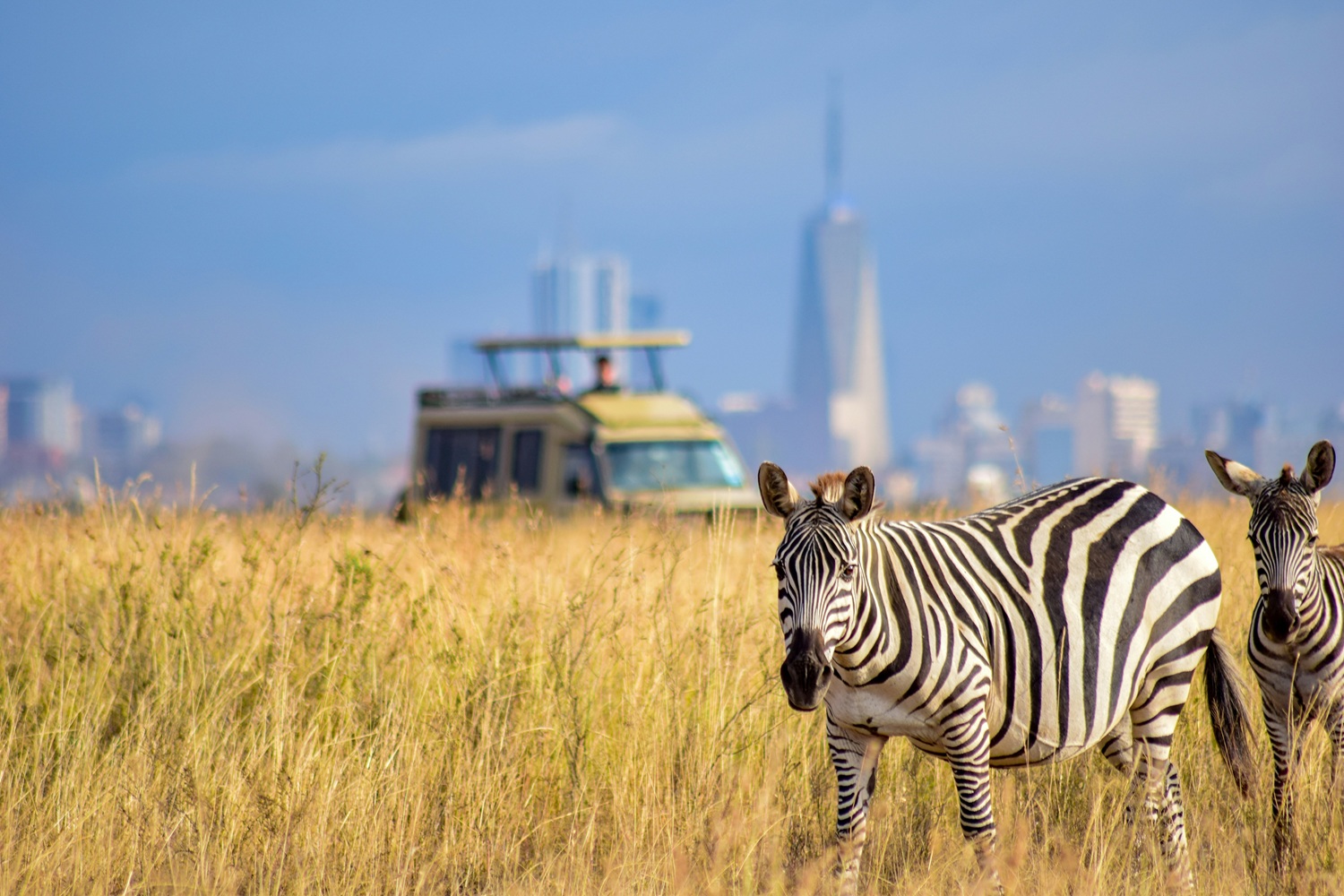
Nairobi National Park protects about 117 km² of open and wooded grassland, dry forest, riverine habitat and seasonal wetlands immediately south of Kenya’s capital. It was established in 1946 as Kenya’s first national park. The attraction is not simply “safari near a city”: it is a genuine protected landscape known for rhinos, plains wildlife, predators, more than 400 recorded bird species and unusual views of wildlife against Nairobi’s skyline.
Quick answers
- Opening hours
- 6:00 AM–6:00 PM for day visitors.
- Adult fee
- From KES 1,000 or USD 40–80, depending on visitor status.
- From the CBD
- About 8–10 km via Lang’ata Road.
- Time needed
- 4–6 hours for a focused drive; a full day for a slower visit.
- Self-drive?
- Yes; pay the separate vehicle charge and follow KWS rules.
- 4×4?
- Safest after rain; KWS warns many roads may require it in the long rains.
- Elephants?
- Not normally resident. The park has the other four Big Five species.
- Official payment
- KWS Pay/eCitizen; confirm the live rate immediately before paying.
Best time to visit Nairobi National Park
The park is accessible year-round. Early morning is the strongest all-season planning rule: temperatures are cooler, light is softer and wildlife is often more active. Drier periods generally make road travel simpler and grass easier to scan; greener months bring stronger colour, flowers and bird activity but can make some tracks muddy.
Wildlife viewing
Start at opening and drive slowly. Heat, wind, rain and grass height matter more than a rigid “best month.”
Photography
Morning often gives cleaner skyline views and gentler light. Haze can change during the day.
Rainy conditions
KWS advises that many park roads may require 4WD in the long rains. Recheck conditions close to travel.
Month labels are planning shorthand, not a weather or sighting guarantee.
Nairobi National Park fees (2026)
These person-entry rates were checked against the live Kenya Wildlife Service park page on 12 August 2026. A separate vehicle charge applies. Rates can change, so use the live KWS page before payment.
| Visitor category | Adult | Child / student |
|---|---|---|
| East African citizen | KES 1,000 | KES 500 |
| Kenya resident | KES 1,350 | KES 675 |
| African citizen | USD 40 | USD 20 |
| Non-resident | USD 80 | USD 40 |
Vehicle charge per day
| Vehicle capacity | KWS charge |
|---|---|
| Under 6 seats | KES 600 |
| 6–12 seats | KES 1,500 |
| 13–24 seats | KES 3,000 |
| 25–44 seats | KES 4,500 |
| 45+ seats | KES 5,000 |
KWS wording around the exact boundary between “child” and free admission for very young children is not perfectly aligned across documents. Families travelling with a five-year-old should confirm directly with KWS.
Access and gate planning
Main Gate • confirmed
The current KWS page directs visitors via Lang’ata Road, past Langata Army Barracks, about 8–10 km from Nairobi’s CBD. This is the safest default in a first-time plan.
Mbagathi / Central Workshop
Older KWS publications list an access point on the Magadi Road side, but naming varies. Confirm current opening and permitted use before relying on it.
East Gate
KWS publications have listed East Gate via ICD Road off Mombasa Road. The live park page does not currently confirm daily operating status, so check directly with KWS.
Nairobi National Park map
The Leaflet/OpenStreetMap map loads automatically. Markers identify access or visitor features by type. The optional one-day self-drive route follows roads currently mapped in OpenStreetMap and shows a practical loop. It is planning guidance, not live navigation; follow KWS signs, closures and staff instructions.
Markers are for orientation and may be approximate. Visitor-site availability and gate status can change. Wildlife moves freely; the map deliberately does not claim exact animal locations. Follow KWS signs and staff instructions on the ground.
Self-drive and one-day planning
1. Arrive before opening
Use Main Gate unless KWS has confirmed another access point. Have permits and payment details ready so your best light is spent inside the park.
2. Cool hours: open habitat
Drive slowly through broad grassland and wooded edges. Scan rather than racing between reported sightings.
3. Midday: designated stop
Use an officially designated viewpoint or picnic site if open. Stay in the vehicle everywhere else and keep food secured.
4. Afternoon: water and habitat edges
Work suitable river, pool and grassland margins from established roads, leaving ample time to return before 18:00.
Fuel
Fill before entry. Slow wildlife viewing makes distance and time harder to predict.
Vehicle
High clearance is useful; choose 4WD after rain or when KWS advises it.
Navigation
Use KWS signage and an offline road map. Never create your own track or follow wildlife off-road.
24 mammals to know
Likelihood labels describe a visitor’s realistic encounter context, not a census or promise. Animals move across habitats and seasons; named viewpoints are never guarantees.
Impala
One of the park’s most dependable antelopes, often in female herds or bachelor groups.
- Where to look: Scan open grazing areas and transitions into light woodland rather than one named junction.
- ID / behavior: Chestnut coat, white belly and black rump marks; mature males carry lyre-shaped horns and may herd females.
African buffalo
A conspicuous large grazer when herds are out in the open, but animals can disappear into cover during hot hours.
- Where to look: Look across open grass and near water from authorized roads, especially in cooler hours.
- ID / behavior: Heavy body, broad muzzle and swept horns; older bulls often have a solid horn boss and may rest apart from herds.
Plains zebra
A familiar open-country grazer that often feeds alongside other herbivores.
- Where to look: Use long views across plains and recently grazed areas.
- ID / behavior: Broad black-and-white striping continues onto the belly; family groups commonly include one stallion, mares and young.
Masai giraffe
Nairobi’s native giraffe is often seen browsing rather than grazing.
- Where to look: Scan thorny woodland, bush edges and open country with scattered trees.
- ID / behavior: Irregular, vine-like dark patches; males tend to be heavier and browse higher than females.
Coke’s hartebeest (kongoni)
A signature Nairobi grassland antelope with a long face and high shoulders.
- Where to look: Look across short and medium grassland in broad, quiet sweeps.
- ID / behavior: Sloping back, elongated face and bracket-shaped horns; often stands alert with an excellent view over the grass.
Grant’s gazelle
A large pale gazelle that tolerates relatively dry ground and may appear in small groups.
- Where to look: Scan open, shorter grass and drier-looking plains.
- ID / behavior: White rump patch extends above the tail; larger and paler than Thomson’s gazelle, with long ringed horns.
Thomson’s gazelle
A small, quick gazelle associated with open grazing areas.
- Where to look: Search short-grass patches where visibility is good.
- ID / behavior: Bold black side stripe and compact build; tail flicking and sharp bounding are common when alarmed.
Common eland
Africa’s largest antelope can look surprisingly delicate at distance despite its size.
- Where to look: Scan far across plains and open bush, especially for loose groups.
- ID / behavior: Tan coat, slight shoulder hump and spiral horns in both sexes; adults often walk steadily rather than bunch tightly.
Blue wildebeest
Present in the Nairobi ecosystem, but local distribution changes and sightings are less dependable than zebra or impala.
- Where to look: Use wide grassland views and avoid planning around a particular herd location.
- ID / behavior: Heavy forequarters, sloping back, dark mane and curved horns; often grazes in loose lines or groups.
Common warthog
Often encountered grazing on its knees or trotting between feeding and refuge areas.
- Where to look: Watch short grass, road verges and open patches near cover.
- ID / behavior: Large head, facial warts and upright tail when running; family groups commonly include a sow and piglets.
Waterbuck
A water-associated antelope more likely in suitable damp habitat than on the driest plains.
- Where to look: Scan greener grass and wooded margins near permanent water without leaving the road.
- ID / behavior: Shaggy grey-brown coat and a conspicuous white rump ring; males carry long ridged horns.
Bohor reedbuck
A discreet medium-sized antelope that relies on cover and can remain motionless before bounding away.
- Where to look: Look carefully along taller grass near wet ground and drainage lines.
- ID / behavior: Yellow-brown coat, white underside and forward-curving horns on males; often seen singly or in pairs.
Eastern black rhinoceros
Nairobi National Park is an important rhino refuge, but vegetation and daily movement make sightings unpredictable.
- Where to look: Scan broad habitat edges patiently; do not use online pins as a wildlife-locating tool.
- ID / behavior: Pointed, prehensile upper lip adapted for browsing; often carries the head higher than a white rhino.
Southern white rhinoceros
A grazing rhino whose visibility varies with grass height, light and where animals choose to rest.
- Where to look: Use long open views and stay at least the KWS minimum distance if you encounter one.
- ID / behavior: Broad square lip, long head held low and a pronounced shoulder hump; often grazes steadily.
Lion
Lions occur in the park, but a Nairobi National Park safari should never promise a sighting.
- Where to look: Scan quietly in cool hours and notice prey behaviour rather than chasing reports across the park.
- ID / behavior: Tawny coat; adult males may have a mane. Lions rest for long periods and can vanish in surprisingly short grass.
Spotted hyena
A capable hunter and scavenger that ranges widely, so daytime encounters are a bonus.
- Where to look: Check open ground during the first and last part of legal visiting hours.
- ID / behavior: Rounded ears, spotted coat and a back that slopes toward shorter hindquarters; groups communicate with whoops.
Black-backed jackal
A small adaptable canid that may be seen alone or as a pair moving through open habitat.
- Where to look: Scan quieter plains and scrub edges, especially when light is cool.
- ID / behavior: Rust-coloured flanks and a dark silver-flecked saddle; alert ears and an efficient trotting gait.
Cheetah
Open country can suit cheetahs, but their low numbers and wide movements make them unpredictable.
- Where to look: Use binoculars across open plains; never crowd or box in a cat if one is found.
- ID / behavior: Slim build, small head and black tear marks; often uses a slight rise to scan before moving.
Leopard
Present but much harder to see than common herbivores, even for experienced guides.
- Where to look: Look for shape, tail and rosettes in shaded cover; avoid treating named “leopard” sites as a guarantee.
- ID / behavior: Rosette-patterned coat and long tail; solitary, quiet and exceptionally good at using cover.
Serval
A long-legged small cat associated with grass that supports rodents and other small prey.
- Where to look: Watch damp or taller grass in cooler hours from the road.
- ID / behavior: Very large ears, long legs and bold black spots and stripes; may pause upright to listen before pouncing.
Hippopotamus
Hippos are tied to suitable water and are not an open-plains sighting.
- Where to look: Use designated viewpoints around river and pool habitat; never approach on foot unless KWS explicitly permits it.
- ID / behavior: Barrel body, eyes and nostrils high on the head; may surface quietly, so scan water patiently.
Olive baboon
Highly adaptable troops forage both on the ground and in trees.
- Where to look: Commonly noticed along access areas and woodland edges, but keep food out of sight.
- ID / behavior: Dog-like muzzle and olive-grey coat; troops are socially complex and young often play close to adults.
Sykes’s monkey
More arboreal and habitat-specific than baboons or vervets.
- Where to look: Watch the canopy and forest edge where mature trees provide food and cover.
- ID / behavior: Dark grey-blue body with a pale throat; moves through branches and may be detected by calls first.
Vervet monkey
An alert, adaptable monkey that may become bold around people if food is available.
- Where to look: Look in riverside trees and around established visitor areas without feeding or encouraging them.
- ID / behavior: Grey coat, black face edged in white and long tail; uses distinct alarm calls for different threats.
12 useful birds to learn
This selection mixes easy beginner birds with genuinely scarce or seasonal targets, so “present” does not mean “likely on one drive.”
Helmeted guineafowl
Noisy ground birds often moving in flocks.
- Where to look: Watch road margins and short grass.
- ID / behavior: Speckled body, bare blue-and-red head and bony casque; runs readily before flying.
Common ostrich
The world’s largest bird is one of the easiest park birds to recognize at distance.
- Where to look: Scan broad plains rather than woodland.
- ID / behavior: Huge, flightless and long-necked; males are black-and-white, females and young grey-brown.
Yellow-necked spurfowl
A typical ground bird of East African savanna.
- Where to look: Check verges and open scrub in the morning.
- ID / behavior: Bare yellow throat, red facial skin and spotted brown body; often calls loudly from the ground.
Grey crowned crane
An elegant wetland bird whose presence depends on suitable conditions.
- Where to look: Scan damp grass and pool margins.
- ID / behavior: Golden crown, grey body and white wing panel; pairs may dance or call together.
Secretarybird
A terrestrial raptor that hunts by walking through grass.
- Where to look: Scan open plains carefully with binoculars.
- ID / behavior: Very long legs, hooked bill and black crest quills; strides rather than hopping.
Kori bustard
A huge, heavy ground bird that can still blend into pale grass.
- Where to look: Search far across undisturbed open country.
- ID / behavior: Bulky mottled body and slow deliberate walk; males are much larger than females.
Jackson’s widowbird
Breeding males become conspicuous when displaying above suitable grass.
- Where to look: Look over taller grass in the wet breeding period.
- ID / behavior: Male is black with a drooping tail and pale shoulder; bouncing display flight is distinctive.
Lesser kestrel
A small migratory falcon; occurrence varies strongly with season and year.
- Where to look: Scan for hovering or feeding falcons over open ground.
- ID / behavior: Slender-winged kestrel; males have a cleaner grey head and less heavily spotted back than common kestrels.
Madagascar pond-heron
A small-number non-breeding visitor, mainly expected from roughly May to October.
- Where to look: Study small herons around marshy edges; identification can be difficult outside breeding plumage.
- ID / behavior: Pale heron with buff-streaked non-breeding plumage; use several features and treat uncertain IDs cautiously.
Red-throated tit
A small active woodland bird that may join mixed feeding groups.
- Where to look: Listen and watch in acacia-rich riverine vegetation.
- ID / behavior: Dark head, pale cheek patch and rufous throat; constantly searches twigs and foliage.
Great egret
A tall white heron found wherever shallow water offers feeding.
- Where to look: Scan pool margins and flooded grass.
- ID / behavior: Long yellow bill outside breeding condition, black legs and a slow spear-like strike at prey.
Saddle-billed stork
A striking large stork best treated as a special sighting.
- Where to look: Search shallow water and open river margins.
- ID / behavior: Black-and-white body and a red-and-black bill with a yellow saddle; sexes differ in eye colour.
Trees, shrubs and seasonal plants
Trees & shrubs
The park’s wooded grassland, dry forest and riverine habitats support very different plant communities. These profiles are recognition prompts, not a complete checklist.
Fever tree
A moisture-associated savanna tree with immediately recognizable bark.
Recognition: Smooth yellow-green bark, fine paired thorns and a light spreading crown.
Large-leaved croton
One of the characteristic trees in Nairobi’s drier forest habitat.
Recognition: Large leaves with paler undersides, rough bark and a broad crown; fallen seeds may collect below.
African olive
An evergreen tree forming part of the park’s forest community.
Recognition: Narrow leathery opposite leaves, grey-green foliage and a sturdy often gnarled trunk.
Whistling thorn
A small savanna tree famous for its relationship with ants.
Recognition: Pairs of straight thorns and swollen dark thorn bases; some hollow swellings whistle in wind.
Ngong nesaea
A restricted-range shrub associated with seasonally wet ground in the Nairobi region.
Recognition: Small wetland shrub; difficult to confirm from a moving vehicle, so treat field IDs as provisional.
Short candelabra euphorbia
A restricted-range succulent that can remain visible outside the main flowering season.
Recognition: Short branching candelabra form with succulent green stems; the sap of euphorbias can be irritating.
Flowers, reeds & understory
Seasonal rocky wetlands and grassland can hold localized herbs that may be visible only after rain. Some of the most important habitat is closed to visitors for conservation.
Red oat grass
An ecologically important warm-season grass that can colour the plains red-brown when seed heads mature.
Recognition: Nodding clustered seed heads with reddish tones; easiest to learn when mature.
Maasai lovegrass
A tufted East African grass whose airy seed heads catch low light.
Recognition: Loose branching panicles and fine spikelets; grass identification usually requires close detail.
Clarke’s murdannia
A regional wet-season herb associated mainly with the Nairobi–Thika area.
Recognition: Small delicate flowers and narrow leaves; visibility is strongly seasonal after rain.
Nairobi squill
A bulbous plant known from the Nairobi area that may be inconspicuous outside its growth or flowering period.
Recognition: Leaf and flower characters are needed for confidence; never dig up bulbs or collect plants.
Scheffler’s ethulia
One of the localized herbs recorded in Nairobi’s seasonal wetland flora.
Recognition: Small flowering herb; photograph several details and expect specialist confirmation.
Athi River tephrosia
A localized legume associated with the wider Nairobi–Athi landscape.
Recognition: Pea-family flower and compound leaves; exact identification is difficult without flowers and locality context.
Nairobi dayflower
A geographically restricted dayflower relative recorded from the Nairobi region.
Recognition: Blue dayflower-like blooms and soft stems; flower structure matters for a reliable identification.
Kaessner’s dibrachionostylus
A restricted-range herb highlighted in KWS conservation planning.
Recognition: A specialist identification; use it as a conservation prompt rather than a roadside tick.
Things to do
Dawn game drive
Use the coolest hours for patient wildlife watching and soft skyline light.
Birding
Bring binoculars and give water, grassland and woodland equal attention.
Skyline photography
Use wide compositions and changing light; haze determines how clearly the city appears.
Designated picnic
Stop only where KWS allows, keep food controlled and carry every piece of rubbish out.
Ivory Burning Site
Visit this conservation landmark if current access and your route allow.
Walks / fitness activities
Only in designated places or through an activity specifically arranged with KWS—never as an independent walk.
Compare Nairobi National Park tours
A Nairobi National Park tour is often sold as a half-day, full-day or city-attractions combination. Compare the same vehicle type, group size and fee treatment before judging price.
| Format | Best for | Check before booking | Typical fee treatment |
|---|---|---|---|
| Self-drive | Independent timing and experienced local drivers | Vehicle suitability, KWS payment and current gate/road status | Person entry plus separate vehicle fee |
| Shared half-day | Lower per-person transport cost | Maximum group size, pickup time, seat/roof access and total park time | Ask whether KWS fees are included or paid separately |
| Private half-day | Photography, families and flexible pacing | Vehicle type, private-use confirmation, pickup boundary and overtime | Often quoted with or without fees—verify in writing |
| Private full-day | Birding, picnic time and slower wildlife watching | Lunch, water, maximum hours and return time before gate close | Verify person entry, vehicle entry and any activity fees |
| Multi-day Kenya circuit | Combining Nairobi with Amboseli or the Masai Mara | Park sequence, driving time, accommodation level and all inclusions | Usually packaged, but exclusions vary by operator |
Rules and safety
Respect opening and closing times.
Move slowly and quietly.
No off-road driving or new tracks.
Wildlife always has right of way.
Except at designated visitor places; keep doors closed.
Secure food and do not change animal behavior.
Bring reusable containers and carry out all rubbish.
Keep phones and sound devices quiet and obey KWS staff.
Nairobi National Park FAQ
What are Nairobi National Park opening hours?
Kenya Wildlife Service currently states that the park is open from 6:00 AM to 6:00 PM for day visitors, unless a visitor is spending overnight in an authorized facility.
How much is Nairobi National Park entry in 2026?
Current adult entry is KES 1,000 for East African citizens, KES 1,350 for Kenya residents, USD 40 for African citizens and USD 80 for non-residents. Child rates and separate vehicle fees also apply; recheck KWS before payment.
Can I self-drive in Nairobi National Park?
Yes. Self-drive visitors can enter with an eligible vehicle after paying the applicable person and vehicle fees. Stay on established roads, keep within 40 km/h and follow every KWS instruction.
Do I need a 4×4 for Nairobi National Park?
A 4×4 is the safer planning choice during or after the long rains because KWS warns that many park roads may require four-wheel drive then. Conditions vary, so ask KWS or your operator close to travel.
Are there elephants in Nairobi National Park?
Elephants are not normally resident in Nairobi National Park. The park is known for four of the Big Five—lion, leopard, buffalo and rhino—while elephant-focused travelers should consider places such as Amboseli.
How long should I allow for a Nairobi National Park safari?
Four to six hours suits a focused morning drive, while a full day allows slower wildlife watching, a designated picnic stop and more flexibility. Wildlife sightings are never guaranteed.
What is the best time for a Nairobi National Park tour?
The park is open year-round, but early morning is the strongest default for cooler temperatures, softer light and more active wildlife. Road conditions and visibility change with rain and season.
Which gate should I use?
The Main Gate on Lang’ata Road is the clearly confirmed normal access on the current KWS page. Older KWS publications also list Mbagathi and East gates, but confirm their current operating status before relying on them.
How this guide was checked
See.Africa checks time-sensitive visitor information against first-party Kenya Wildlife Service sources. Fees, access, hours, rules, activities and contacts were reviewed on 12 August 2026. Wildlife likelihood uses KWS census and management-plan evidence but is intentionally framed as context rather than a sighting promise. Map markers are for orientation only.
Leave a Reply