
Kruger National Park Guide
The practical 2026 guide to Kruger National Park: best time to visit, current conservation fees, gate times, self-drive regions, camps, interactive map, wildlife, malaria advice and how to plan your safari days.
Kruger National Park at a glance
Kruger National Park is South Africa’s flagship self-drive safari park, stretching through Mpumalanga and Limpopo across nearly two million hectares. Its road network, public rest camps and nine entrance gates make Kruger unusually easy to explore independently while still offering guided drives, walks and private-lodge options.
Quick Answers
Best time to visit Kruger National Park
May to September is the best time to visit Kruger National Park for most first-time wildlife trips. The dry season brings sparser vegetation, cooler mornings and more concentrated water sources. The wetter summer from roughly November to March is hotter and greener, with excellent birding, young animals and dramatic storm light.
For easiest game viewing
June–September usually offers the clearest visibility and strongest concentration around permanent water. Early mornings can be cold.
For birds + green scenery
November–March brings summer migrants, lush vegetation and newborn animals, but heat and afternoon storms are common.
For balance
April–May can combine greener scenery with improving visibility and more comfortable temperatures.
Which part of Kruger is best?
Southern Kruger is the best first-trip choice for most visitors because it combines dense road coverage, several gates and camps, river systems and strong general wildlife. Central Kruger around Satara is the natural second base for travellers who want open-country driving and predator habitat.
| Region | Best for | Useful bases | Trade-off |
|---|---|---|---|
| South | First safari, Big Five, dense road network | Skukuza, Lower Sabie, Berg-en-Dal | Busiest region around popular sightings |
| Central | Lions, open savanna, longer loops | Satara, Olifants | Longer transfers from southern gates |
| North | Elephants, mopane landscapes, quieter roads | Letaba, Mopani, Shingwedzi | Less dense classic plains game in places |
| Far North | Birding, river forest, baobabs, solitude | Punda Maria / Pafuri area | Far from southern arrival points |
Kruger National Park entrance fees in 2026
For the SANParks tariff period 1 November 2025 to 31 October 2026, daily conservation fees differ by visitor category. International visitors pay R602 per adult and R300 per child aged 2–11. SADC and South African citizen/resident rates are lower.
R602 adult
R300 child aged 2–11 per day in the current tariff period.
R275 adult
R137 child in the current SANParks tariff period.
R134 adult
R67 child with applicable proof of status.
Kruger gates, access and opening times
Kruger has nine public entrance gates: Crocodile Bridge, Malelane, Numbi, Orpen, Pafuri, Paul Kruger, Phabeni, Phalaborwa and Punda Maria. All national access roads to the gates are tarred. Choose a gate according to your first camp rather than the gate that merely looks closest on a national map.
| Gate | Best first base / area | Typical planning use |
|---|---|---|
| Paul Kruger | Skukuza | Most direct main approach to Skukuza |
| Phabeni / Numbi | Skukuza / Pretoriuskop | Useful from Hazyview side |
| Malelane | Berg-en-Dal | South-west access |
| Crocodile Bridge | Lower Sabie / southeast | Excellent for a southeast itinerary |
| Orpen | Satara / central | Direct central access |
| Phalaborwa | Letaba / Olifants | Central-north access |
| Punda Maria / Pafuri | Far north | Best for northern specialist trips |
Kruger National Park map: gates, camps and regions
Use this map to understand Kruger’s scale, main rest camps, entrance gates and regional airports. The optional one-day layer shows a planning sequence from Skukuza toward Lower Sabie and back; it is not turn-by-turn road navigation.
Map precision: camp waypoints use SANParks-published GPS data where available. Gate and airport pins are orientation points and should not be treated as navigation-grade coordinates. Broad areas show geography only—not live wildlife locations. Follow official signs, maps and current SANParks instructions.
How to plan a Kruger self-drive day
Dawn: be ready at opening
Start when your camp or gate opens. Predators and nocturnal species may still be active, while cooler temperatures improve general wildlife movement.
Morning: drive slowly
SANParks allows up to 50 km/h on tar and 40 km/h on gravel, but a much slower wildlife-viewing pace is more productive. Scan drainage lines, shade and water.
Midday: use a camp or picnic stop
Refuel, eat and reset during the hottest hours. A waterhole or river viewpoint can still be productive without adding many kilometres.
Afternoon: protect your return margin
Do not squeeze in one last distant loop. Gate and camp closing times are strict; turn back early enough for wildlife delays and road speed limits.
20 mammals to know in Kruger National Park
Kruger supports an exceptional mammal community, from the Big Five to wild dogs, sable antelope and smaller primates. Sightings vary by habitat, season and luck.
African bush elephant
Seen throughout Kruger; rivers, dams and mopane woodland can hold large herds.
Lion
Central open country around Satara is famous lion habitat, but prides occur across much of the park.
Leopard
Search wooded drainage lines, river roads and large trees, particularly in southern Kruger.
African buffalo
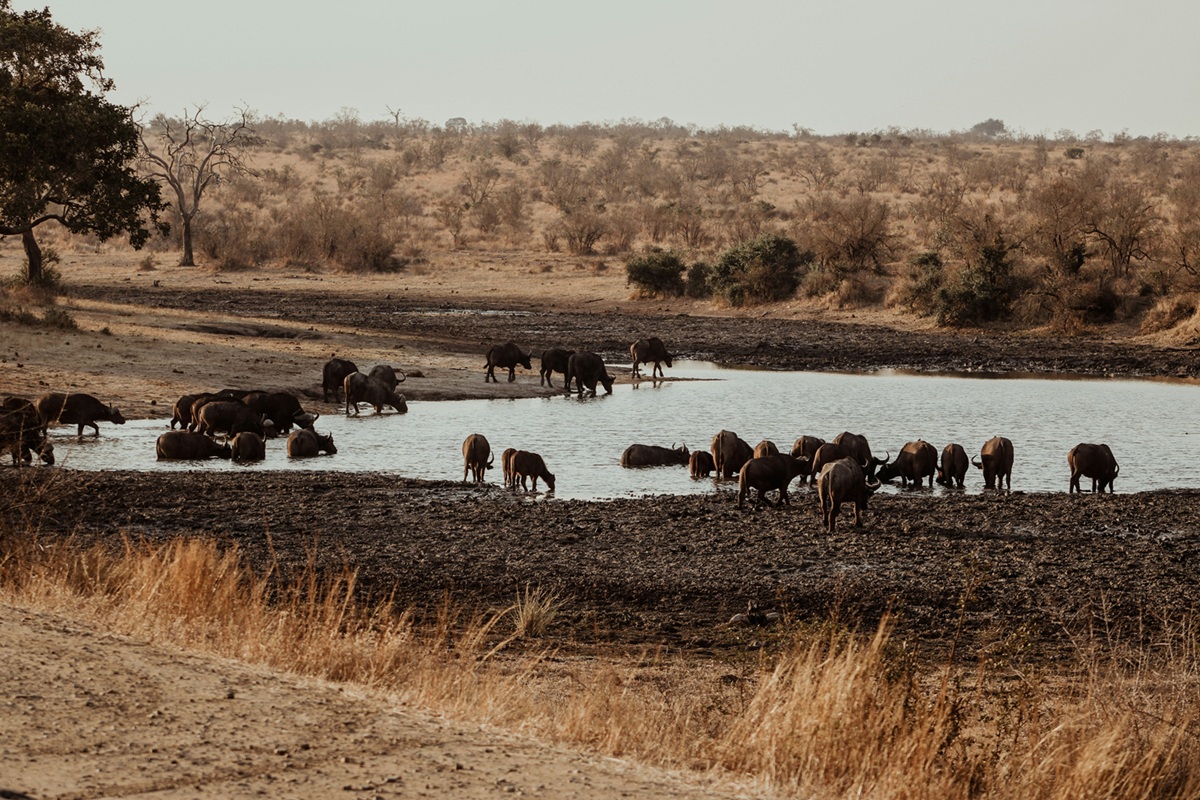
Large herds often concentrate near reliable water and productive grazing.
White rhinoceros
Kruger remains important rhino habitat. Avoid sharing precise locations online.
Black rhinoceros
Far less predictable than white rhino and associated with thicker browsing habitat.
Spotted hyena
Often encountered at dawn, near dens, around kills or moving along roads after dark.
African wild dog
Packs travel fast and sightings are unpredictable; southern and central encounters are highly prized.
Cheetah
Look in more open savanna where visibility suits a daytime pursuit hunter.
South African giraffe
Widespread in browse-rich savanna; their height makes them useful predator-watch companions.
Show 10 more Kruger mammals
Impala
Kruger’s ubiquitous medium antelope and a key prey species; look for mixed herds along woodland edges and open grazing.
Greater kudu
Large-eared browsers of denser woodland and thickets; mature males are unmistakable with long spiral horns.
Plains zebra
Often found in open grazing areas and frequently mixed with wildebeest and other grazers.
Blue wildebeest
Resident herds favour open savanna, with central Kruger offering particularly suitable grassland habitat.
Common warthog
Often grazes on its knees in short grass and runs with its tail upright when alarmed.
Waterbuck
A shaggy antelope with a conspicuous white rump ring, usually encountered close to reliable water.
Nyala
Strongly associated with dense riverine cover, with northern and northeastern Kruger especially rewarding.
Sable antelope
A special sighting identified by bold facial markings and long swept-back horns; distribution is patchy.
Hippopotamus
Look and listen at major rivers and deeper pools; never approach water edges outside designated safe areas.
Chacma baboon
Large social primates seen throughout Kruger, especially around rivers, rocky terrain and mature trees.
10 Kruger birds worth learning
Kruger is one of southern Africa’s classic birding destinations. Rivers, open savanna and the far north each produce a different mix; summer adds migrants, while resident raptors and hornbills can be found year-round.
Southern ground hornbill
Watch roadsides and short-grass savanna for slow-moving family groups of these huge, threatened terrestrial hornbills.
Lilac-breasted roller
One of the easiest colourful birds for beginners: scan exposed branches and wires for a compact turquoise-and-lilac hunter.
Bateleur
Look up for a short-tailed eagle with long wings and a distinctive rocking flight over woodland and savanna.
Martial eagle
A huge eagle often detected on tall pylons or trees, or circling high above open woodland.
African fish eagle
Listen first: its carrying call often reveals a bird perched beside a river, dam or large pool.
Saddle-billed stork
A towering black-and-white stork with a colourful bill, best searched for in shallow water and along river margins.
Kori bustard
A massive ground bird that is easiest to notice in central Kruger’s more open grass-and-savanna landscapes.
Lappet-faced vulture
Scan mixed vulture groups and thermals for this very large conservation-significant scavenger.
Southern yellow-billed hornbill
A beginner-friendly Kruger bird, frequently seen feeding on the ground or in low woodland beside roads.
Pel’s fishing owl
A prized far-northern specialist of mature river forest; even in suitable habitat, sightings are never guaranteed.
Kruger flora: trees, shrubs, grasses and understory
Kruger National Park contains a major vegetation transition: SANParks describes the north of the Olifants River as predominantly mopane veld, while much of the south is thornveld. Learning the dominant plants helps explain where different animals feed, shelter and concentrate.
Trees & shrubs
Mopane
Butterfly-shaped leaves dominate large parts of northern Kruger and are important browse for elephants and other herbivores.
Marula
An iconic Lowveld tree with pale bark and seasonal fruit used by many birds and mammals.
Leadwood
Dense, long-lived timber and persistent dead trunks make leadwoods conspicuous landmarks and excellent raptor perches.
Knob thorn
A classic savanna tree identified by dark knobs on older trunks; its browse and flowers support many animals.
Baobab
Huge swollen trunks become increasingly characteristic toward Pafuri and the far north.
Fever tree
Yellow-green bark makes this thorn tree one of the easiest Kruger trees to recognise where soils remain seasonally moist.
Sausage tree
Long, heavy sausage-shaped fruits hang beneath the crown and make mature trees easy to identify.
Jackalberry
A large evergreen-to-semi-evergreen tree of richer soils and waterways, often forming valuable shade.
Natal mahogany
A broad-crowned tree of warmer riverine areas, especially useful as an indicator of denser, moister vegetation.
Red bushwillow
A common bushveld species whose leaves can turn striking red-brown in the dry season.
Flowers, grasses & understory plants
Impala lily
Pink-and-white flowers can stand out dramatically in the dry winter landscape.
Swazi lily
A succulent flowering plant represented in Kruger’s indigenous plant collections; its showy flowers reward a closer look at ground level.
Wild ginger
A conservation-sensitive indigenous herb; treat any encounter as a botanical highlight and never collect plants.
Barberton daisy
Bright daisy-like flowers are particularly associated with the Lowveld and are noted around Orpen.
Red grass
A productive native grass whose reddish seed heads help identify good grazing areas.
Guinea grass
A tall, palatable grass often doing well beneath trees and on more fertile soils.
Natal redtop
Fine pinkish-red flowering heads can create a soft haze beside roads and open areas.
Common finger grass
A palatable grass that contributes to the grazing base supporting Kruger’s large herbivore populations.
Aloes
Different aloe species add winter colour and nectar resources; SANParks notes aloes around camps such as Orpen and in the Skukuza plant nursery.
Reeds
Dense reedbeds mark wetter habitats and provide cover and feeding opportunities for birds and smaller animals.
Best Kruger National Park experiences
For a separate northern South African stay, Mapungubwe National Park combines sandstone scenery and wildlife with interpretation of a major historic kingdom. Its heritage tours and distinct visitor areas offer a different focus from Kruger’s camp-and-road safari network.
1. Dawn self-drive
Leave at opening and explore slowly before heat and traffic build.
2. SANParks guided drive
Morning, sunset and night activities add ranger interpretation and access outside normal self-drive hours where offered.
3. Guided bush walk
Official guided walks shift attention to tracking, plants, smaller wildlife and bush awareness.
4. Birding day
Slow down around rivers, mature woodland and the far north rather than chasing only the Big Five.
5. Letaba Elephant Hall
A useful stop for elephant ecology and Kruger history when your itinerary passes Letaba.
6. Combine Kruger + Sabi Sand
Use Kruger for independent self-drive, then add a private reserve for trackers, guided drives and a different safari style.
Kruger rules that matter most
Stay in your vehicle
Except at designated places, visitors must remain inside vehicles and keep all body parts inside.
Stay on permitted roads
Do not drive off-road or enter signed no-entry roads. Public self-drive access is limited to the tourist road network.
Never feed wildlife
Feeding changes animal behaviour and creates dangerous conflict around camps and picnic areas.
No drones
SANParks prohibits drones in the national park. Respect wildlife, other visitors and protected airspace.
Kruger National Park FAQ
What is the best time to visit Kruger National Park?
May to September is the best overall period for most first-time wildlife trips. Dry-season vegetation is sparser and water becomes concentrated. November to March is greener, hotter and especially good for birds.
How many days do you need in Kruger National Park?
Four to six nights is a practical first-trip range. Splitting the stay between two camps usually works better than trying to cover the park from one base.
Can you self-drive in Kruger National Park?
Yes. Kruger is designed for public self-driving on tar and gravel tourist roads. Stay on permitted roads, remain in your vehicle except at designated areas and respect gate times.
Do you need a 4×4 for Kruger?
No. A four-wheel-drive vehicle is not normally required for the standard tourist road network. A normal car can use the tar and maintained gravel roads in ordinary conditions.
How much is Kruger National Park in 2026?
For 1 November 2025 to 31 October 2026, SANParks lists international daily conservation fees of R602 per adult and R300 per child aged 2–11. South African and SADC visitors have separate rates.
What are the Kruger speed limits?
The official maximum is 50 km/h on tar roads and 40 km/h on gravel roads. Slower driving is safer and substantially better for spotting wildlife.
Is Kruger National Park a malaria area?
Yes. Kruger is a malaria-risk area. Use bite prevention and obtain personalised medical advice about malaria chemoprophylaxis before travel.
Which Kruger gate is best for Skukuza?
Paul Kruger Gate is the most direct official approach for Skukuza. SANParks publishes a minimum driving time of about 20 minutes from the gate to the camp.
How this Kruger guide was checked
See.Africa reviewed time-sensitive information on 15 August 2026 against current SANParks pages for conservation fees, gates, opening times, travel times, road rules, activities and access, plus current CDC malaria guidance. Operational conditions can change, so live SANParks instructions override this guide.