
Gombe National Park Guide
Chimpanzee trekking, Jane Goodall history and steep forest trails above Lake Tanganyika. This 2026 guide covers boat access from Kigoma, current TANAPA planning, chimp rules, Kakombe Waterfall, a detailed map, wildlife and how Gombe compares with Mahale.
Information checked 6 September 2026Gombe National Park at a glance
Gombe is Tanzania’s small, steep, boat-access chimpanzee park on Lake Tanganyika. Jane Goodall began her landmark chimpanzee research here in 1960, and the Gombe Stream Research Center remains one of the world’s most important long-term wild-primate research sites.
Quick Answers
Compare this guide with our Mahale Mountains National Park guide, explore Tanzania, or browse all National Park Guides.
What is the best time to visit Gombe?
June to October is the easiest period for trekking because the forest is generally drier and steep paths are less slippery. The wet months produce richer vegetation, waterfalls and dramatic forest atmosphere, but heat, humidity and rain can make trekking harder.
Jun–Oct: drier footing and generally simpler forest movement.
Nov–May: lush vegetation and stronger waterfalls, with more mud and humidity.
Chimp location changes daily; no month guarantees an easy or short trek.
How much does Gombe cost in 2026?
Confirm the exact total directly with TANAPA before travel. The current TANAPA tariff page lists Gombe as a separate park category, but the public tariff interface still carries older financial-year metadata. Your final cost can include park conservation fees, chimp activity/guiding, boat transport, accommodation and other booked activities.
How do you get to Gombe National Park?
You first reach Kigoma, then continue by boat north along Lake Tanganyika. TANAPA’s Gombe material explicitly states that there is no road into the park. Boats can be arranged through the park or private operators; confirm departure point, boat type, luggage allowance, lifejackets and weather policy before leaving Kigoma.
Kigoma Airport is the usual air gateway; then transfer to the lakeshore for your boat.
The lake transfer is part of the experience but conditions can change quickly. Use a reputable skipper and lifejacket.
Do not plan a rental-car arrival at the park itself. Leave road logistics in Kigoma and arrive by water.
Gombe National Park map
This map is for orientation, not navigation. Gombe’s official tourist map contains many named valleys, ridges and research landmarks, but trail conditions and chimp locations change. Exact public coordinates are used where verified; other points are explicitly approximate.
How should you plan a day in Gombe?
Eat before the trek, carry water, wear grippy closed shoes and keep rain protection accessible.
Confirm health status, viewing rules, group size and how far the chimp community is currently ranging.
Expect steep, humid terrain. The actual trek can be short or demanding depending on chimp location.
Once the ranger starts the viewing clock, keep quiet, obey distance instructions and avoid eating or drinking near the chimps.
If energy and weather allow, add Kakombe Waterfall, a ridge viewpoint or relaxed shoreline birding.
Finish with the beach or a planned boat/snorkeling activity where permitted and safely supervised.
16 mammals to know in Gombe
Gombe is a primate park first. The most rewarding wildlife watching happens in the canopy, riverine valleys and along forest trails rather than from a vehicle.
Eastern chimpanzee
Flagship
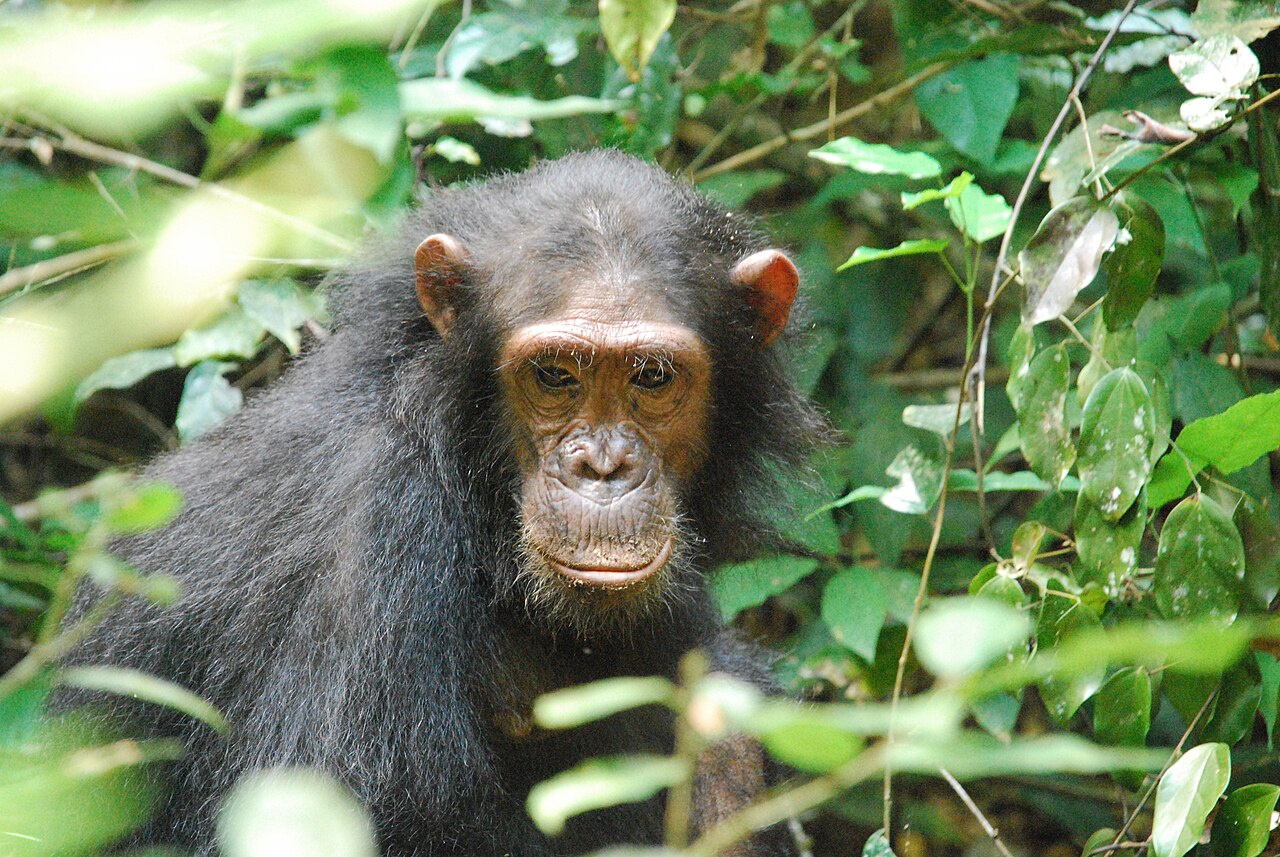
Where: forested valleys and slopes. ID: long arms, dark coat, expressive face. Behavior: tool use, grooming, hunting and complex social relationships underpin Gombe’s scientific importance.
Olive baboon
Common
Where: shoreline, woodland and trails. Behavior: large adaptable troops; long-term baboon research also continues at Gombe.
Red-tailed monkey
Forest canopy
Where: fruiting forest trees. ID: reddish tail and facial markings. Gombe is notable for research on hybridization with blue monkeys.
Blue monkey
Forest canopy
Dark forest guenon often found feeding in the canopy; Gombe populations are scientifically important for hybridization research.
Red colobus
Canopy specialist
Leaf-eating monkey of forest canopy; also an important prey species in documented chimpanzee hunting behavior.
Vervet monkey
Open edges
More associated with open woodland, shoreline and human-adjacent areas than the deeper forest guenons.
Bushbuck
Secretive
Small forest antelope using dense understory and valley vegetation; often detected by movement rather than long open views.
Bushpig
Secretive
Strong-bodied forest pig that uses dense ravines and can leave obvious rooting signs along trails.
Thomas’s dwarf galago
Nocturnal
JGI research detected this tiny nocturnal primate in the Gombe region; not a realistic daytime trek target.
Greater galago
Night
Large-eyed nocturnal primate associated with woodland and forest; more often heard after dark.
African civet
Nocturnal
Secretive omnivore of forest and woodland edges; tracks and droppings are more likely than daytime sightings.
Genet
Nocturnal
Slender spotted carnivore active mainly after dark.
African palm civet
Arboreal
Tree-associated nocturnal carnivore of wooded habitat.
Fruit bats
Evening
Important seed dispersers; most noticeable around dusk and fruiting trees.
Small forest rodents
Ecological role
Diverse small mammals contribute to seed, insect and predator food webs even though visitors rarely identify them to species.
Rock hyrax
Localized
Potential on rocky escarpment habitat; easier to detect by calls and basking behavior where suitable rock faces occur.
12 birds worth learning in Gombe
Lake, forest, woodland and escarpment habitats sit very close together, making Gombe rewarding even when chimp trekking is the main goal.
African fish eagle
Lake Tanganyika shoreline; listen for the carrying call before scanning tall trees.
Pied kingfisher
Common over open lake water and near shore, often hovering before a dive.
Malachite kingfisher
Small brilliant kingfisher along sheltered edges and streams.
Great blue turaco
Large canopy fruit-eater; watch treetops around fruiting forest.
Ross’s turaco
Colorful forest bird with a loud presence in dense vegetation.
Crowned eagle
Powerful forest raptor; scan above ridges and listen for calls.
Black-and-white-casqued hornbill
Large fruit-eating hornbill of forest canopy.
Yellow-rumped tinkerbird
Small forest barbet best located by repetitive calls.
African pied wagtail
Shoreline, streams and visitor areas; constantly wagging tail.
Village weaver
Common around open edges; woven nests can occur in colonies.
Red-chested cuckoo
Often heard in wetter months; repetitive call carries through forest.
African paradise flycatcher
Shaded woodland and forest edge; males have striking elongated tails.
Flora: riverine forest, woodland and escarpment
Gombe rises sharply from Lake Tanganyika through lower deciduous woodland into forested ravines and higher slopes. Jane Goodall described the park’s riverine valleys as dense, fertile forest corridors inside a broader woodland matrix.
Trees & shrubs
Key fruit resources for chimpanzees, monkeys and birds.
Localized in wetter low areas and human-influenced landscapes.
Large canopy trees contributing shade and forest structure.
Tall forest trees in richer valley soils.
Moist-valley trees with fruit used by wildlife.
Shrubs/small trees of woodland edges.
Common component of drier woodland.
Thorny woodland trees on more open slopes and edges.
Localized near moist drainage and shoreline settings.
Woody climbers linking canopy layers and creating classic tangled chimp habitat.
Understory, ferns & grasses
Moist ravines and waterfall approaches.
Damp shaded ground and rock surfaces.
Shade-adapted plants beneath closed canopy.
Broad-leaved herbs in moist forest openings.
Large-leaved understory plants in humid valleys.
More common on open slopes and fire-influenced habitats.
Stream edges and wet pockets.
Localized near shoreline and stream mouths.
Open slope plants respond quickly to rain.
Humid rocks, trunks and shaded waterfall habitat.
Best things to do in Gombe
The defining experience, always ranger-guided and subject to strict primate-health rules.
A classic forest hike and useful second activity after chimp trekking.
Steep ascent for forest and lake views; only attempt with current ranger guidance.
Understand how decades of observation at Gombe changed primatology and conservation.
Boat excursions and permitted water activities add a very different dimension to the forest trek.
Slow forest walks can produce red-tailed monkeys, blue monkeys, baboons and excellent canopy birds.
What rules matter most when viewing Gombe chimpanzees?
Protecting chimp health is the priority. TANAPA’s published chimpanzee-viewing guideline requires at least 10 m distance, masks when chimps are seen, no eating or drinking near them, no tracking when you have an infectious illness, low voices, no flash, and no mimicry of chimp calls.
Gombe National Park FAQ
Is Gombe National Park worth visiting?
Yes, especially if chimpanzee behavior, Jane Goodall’s research history and a small forest-and-lake park appeal to you more than a conventional vehicle safari.
How do you reach Gombe National Park?
Reach Kigoma first, then travel by boat along Lake Tanganyika. TANAPA states that there is no road into the park.
Can you see chimpanzees in Gombe?
Yes. Gombe’s habituated chimpanzees are viewed on ranger-guided forest treks, subject to health, distance, group and time rules.
How close can you get to chimpanzees?
TANAPA’s published guideline specifies at least 10 metres. If chimpanzees move closer, follow the ranger’s instructions and back away calmly where possible.
What is the minimum age for chimp trekking?
TANAPA’s published chimp guideline says participants must be older than 12 years.
What is the best time to visit Gombe?
June to October is generally easiest for drier trail conditions, while the wetter months offer lush forest and stronger waterfalls.
Gombe or Mahale for chimp trekking?
Choose Gombe for a compact park closer to Kigoma and strong research history. Choose Mahale for a much larger, more remote mountain-and-beach wilderness and a longer stay.
Can you swim or snorkel in Lake Tanganyika at Gombe?
TANAPA material describes lake excursions and snorkeling as visitor activities. Use only current designated areas and follow park/lake safety instructions.
How this Gombe guide was checked
Access, park history, activities and terrain were checked against TANAPA Gombe materials and the current TANAPA trip-planning/tariff pages. Chimpanzee health and viewing rules were checked against TANAPA’s published chimpanzee-viewing guidelines. Research context was checked against the Jane Goodall Institute’s Gombe Stream Research Center material. Wikimedia/OpenStreetMap-based public coordinates were used for selected exact points; approximate trail landmarks are labelled as such.