
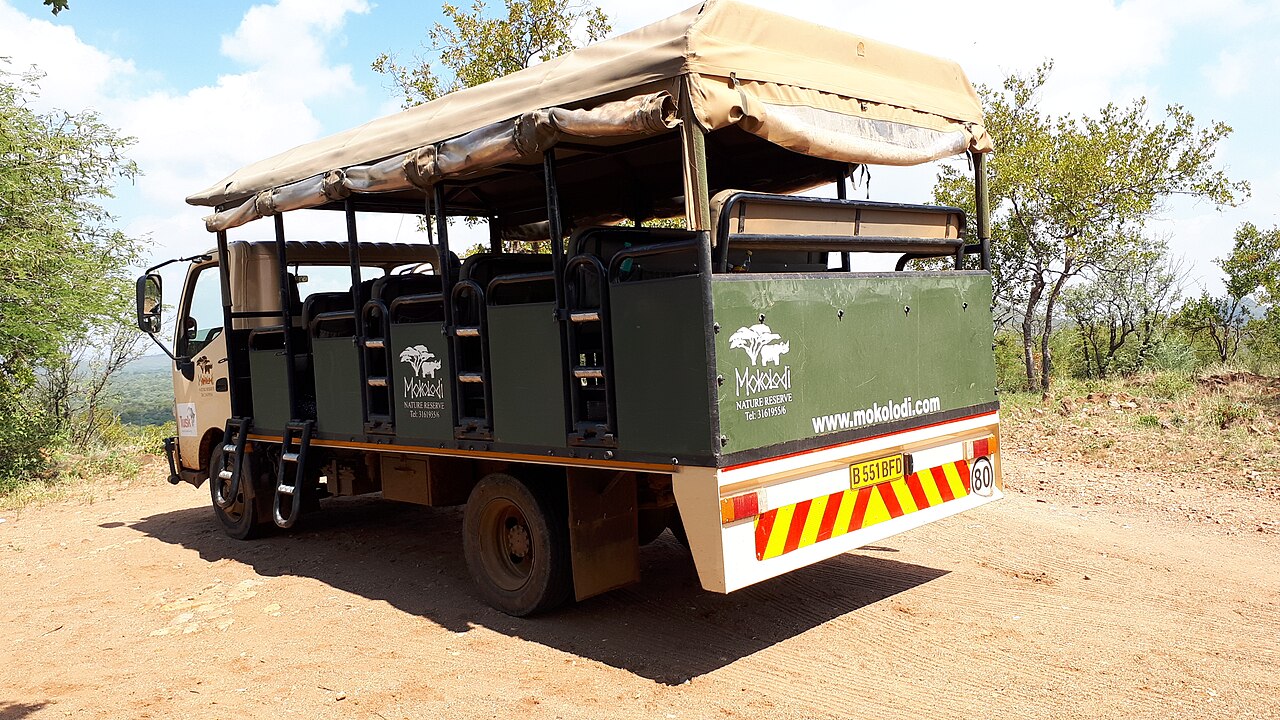
Mokolodi Nature Reserve Guide
The practical 2026 guide to Mokolodi near Gaborone: white rhino and giraffe tracking, guided game drives, Lake Gwithian, activities, map, wildlife, accommodation and day-trip planning.
Mokolodi Nature Reserve at a glance
Mokolodi Nature Reserve is a 3,700-hectare non-profit private reserve roughly 10–15 km south of Gaborone. Founded in 1994 on donated bushveld land, it combines conservation, tourism and environmental education. Mokolodi’s current official website says more than 9,000 schoolchildren attend its education programmes each year and the reserve receives more than 60,000 visitors annually.
What is the best time to visit Mokolodi?
May to September is the easiest period for comfortable wildlife viewing, while November to March is greener and stronger for summer birding. Winter mornings can be cold on an open vehicle; late spring becomes much hotter before the rains.
May–August
Cool, dry and comfortable for game drives, tracking and hiking. Bring layers for the first departure.
September–October
Dry and increasingly hot. Early morning is the most comfortable time for active experiences.
November–February
Summer storms green the bush and increase bird activity; heat and muddy patches can affect plans.
March–April
A useful shoulder period with greener scenery and increasingly settled conditions.
How much does Mokolodi cost?
Mokolodi publishes a dedicated 2026 tourism price list, but activity pricing and self-drive access depend on the product or membership. Because the current official price list is published as image sheets and can be updated independently, check it directly before booking rather than relying on an old copied tariff.
| Experience | Current official format | Planning note |
|---|---|---|
| Game drive | 2 hours | Minimum 4 people; daily at 07:30, 10:30, 14:00 and 16:00. |
| Rhino tracking | 3–5 hours | 07:30; reservation only; minimum age 12 with guardian. |
| Giraffe tracking | 3–5 hours | 07:30; reservation only. |
| Reptile park | 30–45 minutes | Current tours 09:30, 13:00 and 15:00; closed Monday and Tuesday. |
| Friends membership | Annual programme | Includes unlimited reserve access for self-drive, cycling and unguided walking according to the current activities page. |
How do you get to Mokolodi Nature Reserve?
Mokolodi is one of the easiest wildlife reserves to reach from Gaborone. The reserve lies south of the capital along the main road toward Lobatse. The current official website lists opening hours of 07:00–18:00 and booking contact via bookings@mokolodi.co.bw / +267 71 321 021.
From central Gaborone
Drive south toward Lobatse and follow current Mokolodi signage to reception. Allow extra time for city traffic and activity check-in.
Activity check-in
Rhino/giraffe tracking and many organised activities require reservations. Arrive before your stated meeting time rather than at the nominal departure.
Vehicle choice
Reserve roads include easy tracks and rougher 4×4 sections on the older official map. Follow the current route instructions given at reception.
Without your own car
Because Mokolodi is close to Gaborone, a taxi/transfer to reception plus a booked reserve activity can work well.
Mokolodi Nature Reserve map
The map uses fixed facility coordinates published on Mokolodi’s reserve map: reception, Lake Gwithian picnic area, World’s View, 100 Kraal, the self-catering chalets and Bushy Farm Waterhole. The optional day-trip line is a planning sequence, not turn-by-turn navigation; follow the current reserve map and instructions.
How should you plan a Mokolodi day trip?
1. Book the anchor activity
For a first visit, choose either the 07:30 tracking experience or one of the four daily game drives.
2. Use Lake Gwithian
Water and open views make the lake area useful for birds, scenery and a slower break between activities.
3. Add a short family stop
The reptile park fits well around a game drive; remember its current Monday/Tuesday closure.
4. Active visitors
Cycling and hiking are available on designated trails; current rules require at least two people for safety.
5. Finish at the restaurant
Mokolodi’s restaurant/teagarden makes the reserve easy to combine with lunch or a late-afternoon activity.
6. Keep the day simple + save it offline
Rhino or giraffe tracking can take 3–5 hours, so treat either as the main event. Screenshot your booking details, reserve map and reception contact before leaving Gaborone.
Which mammals can you see at Mokolodi?
White rhino, giraffe, zebra, kudu and antelope are the most useful first-visit targets. Mokolodi’s published species material also documents a much broader community, including nocturnal predators and rare species that most day visitors will not see.
White rhinoceros
Mokolodi’s flagship conservation species. The reserve’s white rhino programme contributes to Botswana’s wider rhino recovery; guided rhino tracking is the specialist way to look for them.
Giraffe
Common and easy to recognize in open woodland. Mokolodi also offers guided giraffe tracking on foot.
Burchell’s zebra
Regular on open grassland and near water. Family groups often mix with wildebeest and antelope.
Greater kudu
A classic browser of denser bush. Mature males have long spiral horns and can disappear quickly into woodland.
Common warthog
Often seen grazing short grass or trotting with the tail upright, including around more open visitor areas.
Common duiker
A small antelope of thicker vegetation; usually solitary and quick to vanish into cover.
Steenbok
Small, usually solitary and easy to miss. Scan open scrub carefully for large ears and reddish-brown coat.
Blue wildebeest
A grazing antelope of open areas, often seen alongside zebra.
Gemsbok
A dry-country antelope with long straight horns and bold black-and-white face markings.
Impala
Common along woodland edges. Alarm calls can point toward predators or other disturbance.
Waterbuck
Most likely near wetter areas, dams and greener drainage lines.
Chacma baboon
Troops use rocky hills, woodland and visitor areas. Secure food carefully around accommodation.
Vervet monkey
Often around woodland and water; smaller and more arboreal than baboons.
Mountain reedbuck
Look on rocky hillsides and open slopes rather than the flat grasslands.
Common eland
Africa’s largest antelope; often moves through open woodland in small groups.
Bushbuck
A shy browser associated with thicker riverine vegetation and cover.
Leopard
Free-roaming leopard are documented, but sightings are rare. Early, late and nocturnal periods offer the best chance.
Hippopotamus
Associated with larger permanent water, historically including Lake Gwithian. Never approach water edges on foot without guide instruction.
Brown hyena
A secretive nocturnal scavenger. Tracks and signs are more likely than daylight sightings.
Temminck’s ground pangolin
Rare and mostly nocturnal. Any sighting is exceptional; do not disturb or handle the animal.
Aardvark
A nocturnal burrower; fresh diggings and tracks are easier to find than the animal itself.
Caracal
A secretive medium-sized cat with long black ear tufts; usually a bonus sighting.
Which birds should you look for at Mokolodi?
Mokolodi’s older reserve map lists roughly 300 bird species, while habitats range from rocky hills and woodland to Lake Gwithian and seasonal waterholes. The profiles below prioritize conspicuous or useful beginner species.
African hoopoe
Often feeds on open ground, probing for insects with a long curved bill; the crest is unmistakable when raised.
Arrow-marked babbler
A social woodland bird usually found in noisy groups moving through thickets.
Crested barbet
Colourful and chunky, often detected by its rolling call before it is seen.
Great egret
Look around Lake Gwithian and other water for this tall all-white heron.
Hamerkop
A waterside specialist with a hammer-shaped head profile; often seen around dams and shallow water.
Grey heron
Large grey waterbird found around dams and wet margins, usually standing patiently at the edge.
Southern yellow-billed hornbill
A conspicuous dry-woodland bird, frequently seen feeding on the ground or perched beside tracks.
Hadada ibis
Large dark ibis often heard giving its loud ‘haa-daa-daa’ call near lawns and water.
Pied kingfisher
Black-and-white kingfisher that hovers above water before plunging for fish.
Yellow-billed kite
A common summer raptor; forked tail and easy soaring flight make it conspicuous above the reserve.
Spotted eagle-owl
A nocturnal owl of rocky and wooded areas, with ear tufts and orange-yellow eyes.
Blacksmith lapwing
Common around water and open ground; listen for the sharp metallic call.
White-backed vulture
A conservation-significant scavenger. Scan thermals and large trees; Mokolodi supports vulture conservation work.
Common ostrich
The reserve’s largest bird and an easy open-country sighting.
What grows in Mokolodi Nature Reserve?
A published vegetation survey recorded 44 woody species and 69 herbaceous species in its sampled plots, showing that Mokolodi is much more botanically diverse than a quick game drive suggests.
Trees & shrubs
Sickle bush
The densest woody species in a published Mokolodi vegetation study. The two-coloured flower spikes are distinctive.
Red bushwillow
One of the reserve’s dominant woody species; four-winged fruits and reddish leaves are useful field marks.
African star-chestnut
A visually striking tree of rocky savanna and one of the dominant woody species recorded in Mokolodi research plots.
Umbrella thorn
A classic flat-topped savanna tree and one of the frequently recorded acacia-type trees in the reserve.
Common guarri
A dense evergreen shrub/tree with dark leaves; one of the highest-density woody plants measured in the reserve.
White raisin
A common shrub/small tree in dry woodland, providing browse and small fruits for wildlife.
Velvet raisin
A widespread dryland shrub with edible berry-like fruits, recorded frequently in Mokolodi.
Weeping wattle
A broad-crowned savanna tree with yellow flowers, recorded throughout the vegetation study.
Jacket plum
A small-to-medium woodland tree whose fruit attracts birds and mammals.
Buffalo thorn
A thorny tree with paired straight and hooked thorns; common in southern African woodland.
Grasses, flowers & understory
Lehmann lovegrass
The herbaceous species with the highest measured ground cover in a published Mokolodi vegetation study.
Small carrot-seed grass
A small dryland grass that was among the most abundant herbaceous cover species in the reserve study.
Lovegrass
Another important grass in Mokolodi’s sampled ground layer, with fine branching seed heads.
Sleepy morning
A low herb/shrub with soft grey-green leaves and small yellow flowers, recorded at relatively high cover.
Guinea grass
A taller productive grass of more fertile or shaded places, formerly widely known as Panicum maximum.
Tassel three-awn
A wiry grass of dry open ground with three-awned seeds; prominent in the Mokolodi vegetation survey.
Couch grass
Low mat-forming grass that thrives on disturbed and grazed ground, especially near moisture.
Devil thorn
A low summer herb with yellow flowers; hard spiny fruits make sturdy footwear useful after rains.
Wild hibiscus group
Several Hibiscus species occur in the reserve’s herb layer; flowers are easiest to identify after summer rain.
Indigofera
The vegetation study recorded several Indigofera species; these small legumes add colour and nitrogen-fixing value to the ground layer.
Best Mokolodi Nature Reserve experiences
| Experience | Best for | Current timing | Important note |
|---|---|---|---|
| Game drive | First visit / families | 2 hours; 4 departures daily | Minimum 4 people |
| Rhino tracking | Signature experience | 07:30; 3–5 hours | Reservation; age 12+ with guardian |
| Giraffe tracking | Active wildlife walk | 07:30; 3–5 hours | Reservation only |
| Cycling / hiking | Active repeat visitors | Flexible on designated trails | Minimum 2 people; access rules vary |
| Reptile park | Families / short visit | 30–45 min | Closed Mon–Tue |
| Bush braai | Groups / events | 11:00 or 17:00 | Advance booking; minimum 15 guests |
Guided game drives
The simplest way for a day visitor to see the reserve with ranger interpretation.
Rhino tracking
Start in a game viewer, then continue on foot with expert guides once fresh spoor is found.
Giraffe tracking
Another 3–5 hour guided experience combining vehicle access and walking.
Cheetah visit
A drive through the reserve’s cheetah enclosure; this is not a wild cheetah-tracking experience.
Cycling & hiking
Use designated routes and current access rules; minimum two participants for safety.
Reptile park
A short educational tour focused on Botswana reptiles, useful for families and shorter visits.
Can you stay inside Mokolodi?
Yes. Mokolodi currently offers five self-catering Elephant Rock chalets plus campsites and other group facilities. The chalets have kitchens, electricity, braai areas and views toward a nearby waterhole.
Large / family chalets
Three chalets, each accommodating up to four adults and two children according to the current accommodation page.
Small chalets
Two smaller units, each for up to two adults and one child.
Check-in
Current published check-in is 12:00–18:00, with check-out at 10:00.
Food + baboon note
The chalets are self-catering. Mokolodi specifically warns guests to secure food and close windows when away because baboons pass through the area.
Which Mokolodi rules matter most?
Use current access rules
Self-drive and unguided walking are not something day visitors should assume; the current Friends programme specifically includes those privileges.
Stay on marked routes
Mokolodi’s published reserve map warns against off-road driving and marks some tracks as 4×4-only or no-entry.
Only leave vehicles where allowed
Use designated areas and follow ranger/reception instructions around wildlife.
Do not feed wildlife
Feeding changes natural behavior and can create dangerous habituation, especially around accommodation and picnic sites.
Tracking is guided
Rhino and giraffe tracking are controlled guided experiences. Follow the tracker’s instructions immediately and quietly.
Current local instructions win
Weather, animal movements, road conditions and conservation operations can change access at short notice.
Mokolodi Nature Reserve FAQ
How big is Mokolodi Nature Reserve?
3,700 hectares according to Mokolodi’s current official About page.
How far is Mokolodi from Gaborone?
Roughly 10–15 km south of Gaborone, along the Lobatse road.
What are the current opening hours?
07:00–18:00 on Mokolodi’s current official About page.
Can you see rhinos at Mokolodi?
Yes. White rhino are a flagship conservation species, and Mokolodi offers guided rhino tracking.
How long is rhino tracking?
About 3–5 hours. It currently departs at 07:30, is reservation-only and has a minimum age of 12 when accompanied by a guardian.
How long is a game drive?
Two hours. Current departures are 07:30, 10:30, 14:00 and 16:00, with a minimum of four people.
Can ordinary day visitors self-drive?
Confirm before travel. Mokolodi’s current site specifically includes unlimited self-drive access as a Friends of Mokolodi membership benefit rather than listing it as a normal day activity.
Can you stay overnight?
Yes. Current accommodation includes five self-catering chalets plus camping/group facilities.
How this guide was checked
See.Africa reviewed time-sensitive information on 23 September 2026. Reserve size, hours, activity times, minimum ages, membership access and accommodation were checked against Mokolodi’s current official website. Stable map coordinates and older route rules were cross-checked against Mokolodi’s published reserve map, while tourism context was checked against Botswana Tourism Organisation.