
Gonarezhou National Park Guide
The practical 2026 field guide to Zimbabwe’s “place of elephants”: Chilojo Cliffs, the Runde and Mwenezi rivers, self-drive access, camps, current seasonal closures, 4×4 roads, detailed map, wildlife and wilderness safety.
Gonarezhou National Park at a glance
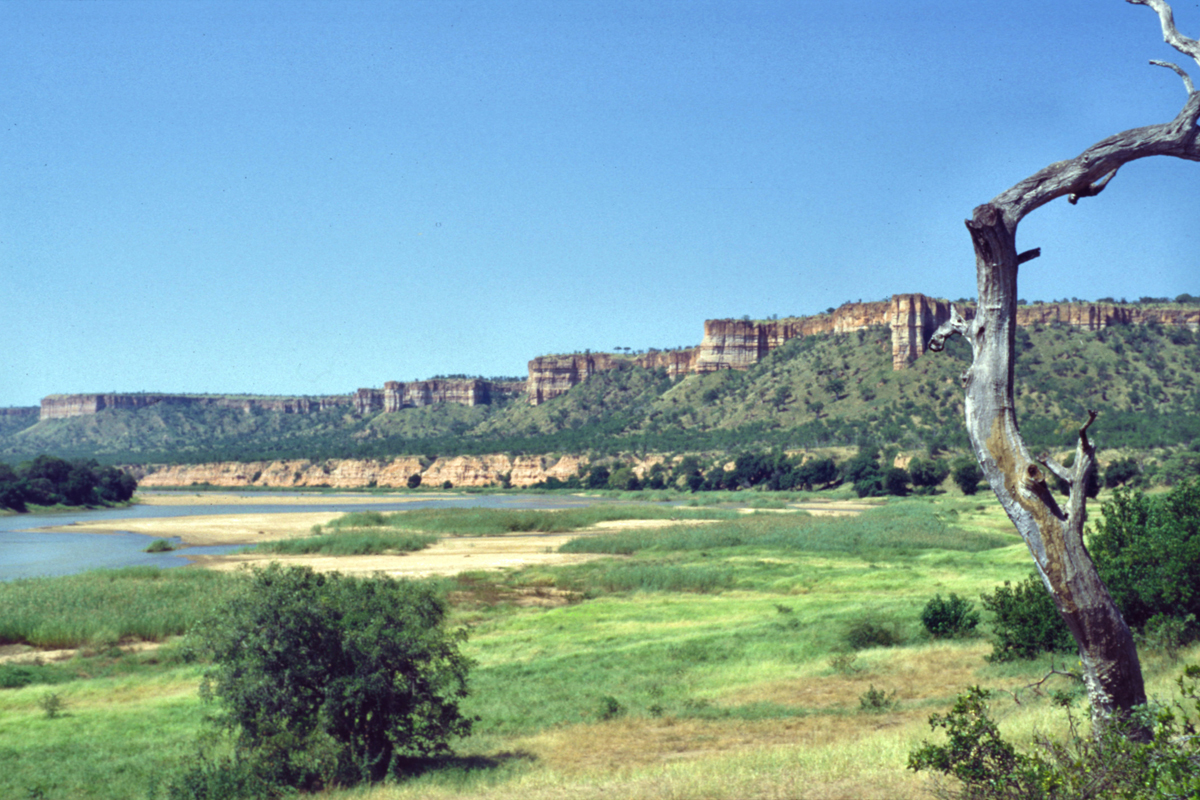
Gonarezhou is Zimbabwe’s second-largest national park, covering 5,053 km² in the remote south-east. Its name is commonly translated as “the place of elephants”, and that is not just branding: the park authority reports more than 11,500 elephants and one of Africa’s highest elephant densities. The landscape ranges from the sandstone Chilojo Cliffs and broad Runde River to mopane woodland, pans, palm forest and the Mwenezi River in the far south.
Which part of Gonarezhou should you explore?
Gonarezhou is too large to treat as one safari loop. The most practical first trip usually concentrates on the Chipinda–Runde–Chilojo landscape, then adds either deeper central wilderness or the southern Mabalauta/Mwenezi sector if time and road conditions allow.
| Area | Best for | Base ideas | Planning reality |
|---|---|---|---|
| Chipinda Pools / north-west | Arrival, river wildlife, first-night logistics | Chipinda Pools campsite/tented camp, Masasani Mananga | Closest park sector to Chiredzi and the easiest place to get current road advice before driving deeper. |
| Runde + Chilojo | Cliffs, elephants, river scenery, photography | Chilojo Bush Camp, Chinguli, Chilojo campsites | Do not treat the cliffs as a quick detour; slow roads and wildlife make the journey part of the safari. |
| Save–Runde / north-east | Pans, quieter wilderness, Save–Runde confluence | Chitove, Machaniwa, Chamuluvati, Gayiseni | Road and river conditions are much more seasonal. Save-Runde access itself requires 4×4. |
| Central sandveld | Remoteness, pans, platforms, low vehicle density | Bhenji, Malugwe, Gorwe; transit/wilderness sites | Plan conservatively: limited signal, few facilities and long recovery times if something goes wrong. |
| Mabalauta / Mwenezi south | Southern landscapes, riverine woodland, quieter long stays | Mabalauta, Swimuwini, Mathuli, Rossi Pools | This is a genuine second safari zone. Combining north and south well usually requires several nights and a transfer day. |
Best time to visit Gonarezhou
April to September is the best overall window for most self-drivers and campers. The official conservation site describes May–August as the cool-dry season, September–October as hot-dry, and November–April as hot-wet. Mean annual rainfall is about 466 mm and falls mainly from November to March.
April–August
Best default. Cooler days and drying tracks make remote self-drive far more manageable. River crossings still need a same-day check.
September–October
Peak dry-season wildlife. Water becomes increasingly important, but daytime heat rises sharply. Start early, rest midday and carry more drinking water than you think you need.
November–March
Green but operationally difficult. Thunderstorms, river levels and muddy tracks reduce access. Remote camps close seasonally and the full tourist closure applies 10 January–1 March.
Gonarezhou fees, camping rates and gate times
A current public 2026 park-entry tariff is not clearly published on the park website, so this guide does not copy old entry-fee sheets. Ask reservations for the current conservation fee, community levy and vehicle charge in writing. Current accommodation and campsite pages do publish several live minimum charges, however.
| Current published product | Local | SADC | International | Basis |
|---|---|---|---|---|
| Developed campsite — Chipinda / Chinguli / Mabalauta | US$55 | US$66 | US$104 | Current minimum charge shown by park; park/conservation fees separate. |
| Exclusive bush campsite | US$95 | US$120 | US$180 | Current minimum charge; basic bush loo + firepit, no drinking water. |
| Wilderness campsite | US$63 | US$80 | US$120 | Current minimum charge; no electricity/drinking water/attendant. |
| Transit campsite | US$50 | US$60 | US$100 | Current minimum charge; maximum two-night stay. |
| Starbed platform | US$60 | US$80 | US$120 | Current minimum charge for Bhenji / Malugwe / Gorwe platforms. |
2026 gate hours
November–March
06:00–18:30 on the official 2026 tourist map. The January–March annual park closure overrides these hours when in effect.
April–October
06:30–17:30 on the 2026 tourist map. Plan to be back well before closing rather than using the final minute as your target.
How to get to Gonarezhou—and what vehicle you need
For most first-time visitors, Chiredzi → Chipinda Pools is the simplest approach. The park’s visitor material lists access in both northern and southern sectors, while its current FAQ specifically describes Chipinda Pools, Save-Runde Basecamp, Boli, Sango and Malipati as principal tourist entrances. Always ask reservations which gate is operating for your route because wet-season conditions change access.
| Access | Best for | Vehicle / admin | Key warning |
|---|---|---|---|
| Chipinda Pools | Chiredzi arrivals, north/central safari | High-clearance minimum; 4×4 recommended | Use reception to check current river crossings and closures before committing to Chilojo or eastward roads. |
| Save-Runde Basecamp | Mahenye / north-east entry | 4×4 required | Includes a sand crossing over the Save River; unsuitable as a casual wet-season shortcut. |
| Boli Gate | Southern sector from Mwenezi | Report to Mabalauta office before proceeding | Road conditions vary; confirm current tourist routing. |
| Sango Gate | Mozambique / Sango Border side | Report to Mabalauta office | International border paperwork is separate from simply entering the national park. |
| Malipati Gate | Far south / Sengwe-Tshipise corridor | Remote approach | Long gravel sections and limited services make fuel and tyre planning essential. |
Road classes on the 2026 map
40 km/h maximum
Maintained gravel, generally passable in most conditions. High clearance is required in dry season; the official map specifies high-clearance 4×4 in wet conditions.
30 km/h maximum
Seasonal roads, mainly May–November. High clearance is the minimum and a high-clearance 4×4 is preferred.
Slow seasonal driving
Unsurfaced bush tracks, mainly May–November, for high-clearance 4×4 vehicles. Expect rough surfaces and slow progress.
June–November window
Rough, minimally maintained routes requiring a capable 4×4 and recovery gear. Do not enter because the line exists on a map—check the route first.
Gonarezhou map: camps, platforms, cliffs and safari zones
This map now reflects the scale of the park instead of showing only a handful of pins. The camp coordinates below are converted from the UTM positions printed on the official 2026 Gonarezhou tourist map. Chilojo Cliffs uses a public field-record coordinate. Use this for trip orientation, not as a replacement for the official map and current road advice.
Map points for camps are based on official 2026 UTM coordinates converted to latitude/longitude. Roads and river crossings remain dynamic. The optional planning line is a sequence between known areas, not turn-by-turn road geometry.
Gonarezhou camps: developed, exclusive, wilderness and self-catering
The accommodation system is one of Gonarezhou’s strongest features because it lets travellers choose how remote they want the safari to feel. Developed campsites offer water and ablutions; exclusive/wilderness sites deliberately offer very little; self-catering and bush camps add beds, fridges and structured facilities without turning the park into a resort.
| Option | Good for | Facilities | Reality check |
|---|---|---|---|
| Chipinda Pools campsite | First night, families, river setting | 9 sites, shared ablutions, running untreated water, rondavel, braai | Bring drinking water; use reception for current road intelligence. |
| Chinguli campsite | Runde / Chilojo region | 5 sites, ablutions, running untreated water, braai/rondavel | Excellent central location but still unfenced wilderness. |
| Mabalauta campsite | Southern Mwenezi sector | 5 sites, shared ablutions, running untreated water | Best treated as a southern base, not a quick add-on from Chipinda. |
| Exclusive bush campsites | Privacy near prime landscapes | Bush loo + firepit; no drinking water/electricity | Booked exclusively; current park page lists 7 sites. |
| Wilderness campsites | Remote self-sufficient camping | Bush loo + firepit only | 11 sites; bring all water, food, lighting and recovery gear. |
| Starbed platforms | Waterhole watching, immersive overnight | Simple raised platform / boma depending on site | Bhenji, Malugwe and Gorwe are remote and have no drinking water. |
| Masasani / Mathuli Mananga | Low-footprint self-catering | Ensuite rooms, central kitchen/dining/boma, fridge/freezer, charging | Unfenced; untreated water. |
| Chipinda / Chipale tented camps | More comfortable self-drive base | Ensuite furnished tents + kitchenette | Chipale is positioned close to Chilojo Cliffs; charges exclude park fees. |
| Swimuwini Rest Camp | Southern self-catering | Chalet-style accommodation | Useful for a multi-day Mabalauta/Mwenezi safari. |
Top 3 places to stay for Gonarezhou
Choose by safari style and park access, not just accommodation type. Compare all 10 Gonarezhou lodges and camps →
Guided lodge on the eastern park edge, outside the park boundary.
View official booking ↗Equipped tented camp inside northern Gonarezhou.
View official booking ↗Equipped chalets in the far southern sector.
View official booking ↗Photographs are illustrative park scenery. Verify operating dates, park fees, transfers and seasonal roads with the operators.
How to plan a Gonarezhou safari day—and a 5-night first trip
The daily rhythm
Dawn: stay local first
Use the first cool hours around your camp’s river, pan or woodland instead of immediately starting a long transfer. Elephants, wild dogs and predators are easier to read before heat builds.
Morning: one major objective
Choose Chilojo, a pan system or a defined river corridor—not three distant targets. Remote-road speed limits and wildlife stops make paper distances misleading.
Midday: designated stop only
Use an authorised picnic site or return to camp. No fires are permitted at picnic/day-visitor sites, and riverbanks require crocodile/hippo awareness.
Afternoon: protect the return margin
Do not gamble on gate/camp times. Turn around earlier than you would in a compact park because a slow elephant encounter or rough crossing can consume your buffer.
A sensible 5-night first itinerary
Chipinda Pools
Arrive with daylight, confirm road conditions, set up and use nearby Runde/Guluji loops. This is the right day to discover a tyre or food problem—not at Chilojo.
Chipinda / central
Use a full day for Chilojo Cliffs and west/east viewpoints if roads are open. Do not stack a far-eastern pan onto the same day.
Chinguli / Chilojo zone
Move base closer to the cliffs/Runde so dawn and sunset are wildlife time rather than commuting time.
Return or second zone
Either return toward Chipinda for an easy exit or, if you have more nights, begin a properly planned central/southern extension.
Mabalauta / south
Add the Mwenezi sector only when access, fuel and camp bookings are confirmed. The north-to-south crossing is a safari transfer in its own right.
Remote platforms / sandveld
Use these for deliberate solitude with full self-sufficiency, not because you want to “cover” more of the map.
22 mammals to know in Gonarezhou
The park authority lists 89 large mammal species plus 61 small mammals. Gonarezhou is especially important for elephants and African wild dogs, while successful black-rhino restoration and the 2025 white-rhino reintroduction have restored the Big Five.
African bush elephant
With 11,500+ elephants reported by the park, encounters are frequent. Give herds a wide exit, never pressure them with your vehicle and be especially conservative around calves or tight river approaches.
African buffalo
Large herds use rivers, pans and better grazing, particularly as the dry season advances. Old bulls may be solitary and are easy to miss in dense mopane.
Lion
Search open riverbeds, floodplains and shade near prey concentrations at dawn and late afternoon. Gonarezhou is vast, so sightings can feel far more private than in compact safari parks.
Leopard
Riverine woodland, rocky drainage and large trees are better search habitat than open mopane. Alarm calls and tracks often reveal more than random scanning.
African wild dog
Gonarezhou is described by its management as a wild-dog stronghold. Packs range widely and move fast, so an encounter can appear and disappear within minutes.
Black rhinoceros
Reintroduced in 2021 after a 27-year absence. Treat any sighting as highly sensitive: do not publish a live pin, route clue or identifiable location.
White rhinoceros
White rhino returned in April–May 2025, restoring a viable population after roughly a century without one. Location sensitivity applies exactly as it does for black rhino.
Spotted hyena
Listen at unfenced camps after dark and scan tracks on sandy roads at first light. They are capable hunters, not merely scavengers around lion kills.
Hippopotamus
Runde, Save and Mwenezi pools hold hippos. Never walk casually on river sand or between water and grazing areas, especially near dusk.
Greater kudu
Dense jesse and mixed woodland suit kudu. Large spiral-horned bulls can disappear almost completely once they step off an open track.
Common waterbuck
The white rump ring is the fastest field mark. Look around river terraces, pans and floodplains, especially during the dry season.
Eland
Africa’s largest antelope. Bulls are massive with a heavy dewlap, while mixed herds can move surprisingly quickly through open woodland.
Show 10 more Gonarezhou mammals
Impala
Common mixed feeder of woodland edges and river systems. Large herds are useful predator indicators because many eyes notice danger before visitors do.
Plains zebra
Most visible on open grassland and floodplains. Zebra distribution can shift dramatically as water and grass conditions change.
Nyala
Strongly associated with denser riverine vegetation. Bulls are dark with pale vertical stripes; females are smaller and warm chestnut.
Bushbuck
Usually solitary and close to dense water-edge cover. Early morning around Chipinda’s riverine vegetation can be productive habitat.
Common warthog
Often grazes on short lawn-like areas near water. The upright tail when running is one of southern Africa’s easiest safari field marks.
Chacma baboon
Large social troops use woodland and riverine zones. Secure food carefully around camps and never encourage animals by feeding them.
Vervet monkey
Common around riverine trees and some camp areas. Alarm calls can reveal snakes or predators, but food-conditioned monkeys quickly become a nuisance.
Side-striped jackal
Heavier and more woodland-associated than black-backed jackal. Dawn road sightings are possible but never guaranteed.
Ground pangolin
Gonarezhou runs a long-term pangolin rehabilitation/release project. Chance visitor sightings are rare; never share live locations for this heavily trafficked species.
Sable antelope
A low-density specialist that the park specifically asks visitors to report when encountered. Dark mature bulls with sweeping horns are unmistakable.
12 Gonarezhou birds worth learning
Gonarezhou reports more than 450 bird species. The mix of major rivers, mopane, alluvial woodland, palms, cliffs and open pans makes this much more than a “big mammal” park.
Lappet-faced vulture
Gonarezhou describes itself as a stronghold for this threatened vulture. Scan thermals and carcass gatherings; its large size and bare pinkish head stand out.
African fish eagle
Listen first along the Runde, Save and Mwenezi. Adults often perch openly above deep pools and quiet river bends.
Southern ground hornbill
Large family groups walk through open woodland searching for reptiles, insects and small vertebrates. Low booming calls carry far in the morning.
Saddle-billed stork
Huge black-and-white stork with a red-and-black bill. Best in shallow river edges, pans and receding wetland margins.
Bateleur
Short tail and rocking flight make this raptor distinctive overhead. Adults cover wide areas and can appear almost anywhere over open woodland.
Martial eagle
One of Africa’s largest eagles. Scan large trees and high thermals; sightings are more likely when you remember to look up rather than only at mammals.
Lilac-breasted roller
Common roadside perch-hunter in open woodland. The turquoise wings are most obvious when it drops from a branch after insects.
Grey go-away-bird
One of the characteristic sounds of dry woodland. The nasal call often reveals birds hidden in mopane or mixed woodland.
African jacana
Long toes let jacanas walk over floating vegetation in quiet pools and wetland edges. Adults are surprisingly colourful at close range.
Pied kingfisher
Easy to identify by its black-and-white plumage and hovering fishing style over river channels and larger pools.
Southern yellow-billed hornbill
Common dry-woodland bird that often forages on the ground beside roads. The curved yellow bill is a beginner-friendly field mark.
White-crowned lapwing
A river specialist of broad sandy channels. Look on sandbanks and exposed river edges rather than in dense wetland vegetation.
Gonarezhou flora: mopane, alluvial forest, palms and seasonal grasslands
The park’s detailed conservation page currently records more than 493 plant species, including 333 woody and 160 herbaceous species. Geology strongly controls the vegetation: basalt and sedimentary soils support different woodlands, while the major rivers carry distinctive alluvial forest.
Trees & shrubs
Mopane
The dominant tree over large parts of the park. Butterfly-shaped leaves fold in heat; elephants feed heavily on both leaves and branches.
Leadwood
Dense, slow-growing tree of alluvial and mixed woodland. Ancient dead trunks can persist for decades and are important habitat structures.
Winter thorn
Important riverine tree whose nutrient-rich pods attract herbivores in the dry season. Large specimens create cool shade on alluvial terraces.
Sausage tree
Large hanging fruits make this riverine tree easy to identify. Flowers and fruit attract insects, bats and mammals.
Wild mango
One of the notable alluvial-woodland trees named by the park authority along major river systems.
Nyala berry
Large evergreen riverine tree associated with fertile alluvial soils; its fruit and dense canopy support many birds and mammals.
Ilala palm
Distinctive fan-palm patches occur near the Save–Runde junction and add a very different visual habitat from central mopane country.
False mopane
The central Malvernia Beds support mature false-mopane woodland, part of Gonarezhou’s unusually diverse geology-driven vegetation mosaic.
Miombo woodland trees
Isolated miombo patches occur in suitable parts of the park, contrasting with the dominant lowveld mopane systems.
Iroko
The park authority notes a unique stand of giant iroko trees in the Nyahungwe area below Chilojo Cliffs.
Grasses, herbs & wetland plants
Guinea grass
Tall productive grass of shaded fertile ground and riverine margins, important to grazers after good rainfall.
Red grass
A classic southern African grass whose reddish seed heads are most noticeable later in the growing season.
Finger grass
Productive grazing grass in open woodland and better soils, especially after rain.
Spear grass
Twisted awns are a distinctive field clue and readily catch on fur or clothing.
Sedges
Wetland and channel-edge sedges become conspicuous where water persists or retreats slowly from pans and rivers.
Water lilies
Floating leaves and flowers occur in suitable quiet pools and wetland systems when water conditions allow.
Wild hibiscus
Seasonal herbs can flower rapidly after rains, adding colour to road verges and open woodland.
Morning-glory vines
Fast-growing vines respond to wet-season moisture on floodplains and disturbed ground.
Hydromorphic grasses
The Save–Runde area contains unusual hydromorphic grasslands tied to seasonally saturated soils.
Annual pan herbs
Temporary pans can shift from bare mud to dense short-lived vegetation after rain, changing food availability for insects, birds and grazers.
Best things to do in Gonarezhou
1. Chilojo Cliffs day
The essential scenic objective. Leave enough time for elephants and other stops along the Runde rather than treating the cliffs as a photo-and-return point.
2. Slow self-drive safari
Gonarezhou works best when you drive fewer roads more slowly. Use current park mapping, stop at pans and let remote wildlife come into view.
3. Guided game drive
The park and registered operators offer guided drives. Local route knowledge is particularly valuable where crossings and seasonal roads determine what is realistically reachable.
4. Birding
450+ bird species make rivers, palms, cliffs and mopane worth dedicated time instead of treating birds as a backup when mammals are quiet.
5. Fishing
Allowed only at designated sites for overnight visitors and requires a permit. The park promotes catch-and-release and limits fishing zones to protect fish stocks and visitor safety.
6. Starbed platform
Bhenji, Malugwe and Gorwe put you directly beside remote wildlife water sources. These are stripped-back wilderness stays, not serviced lodge experiences.
7. Photography
Red cliffs, dry river channels, dust, elephant herds and dramatic wet-season skies make landscape photography as important as portrait wildlife.
8. Cultural experience
The park works closely with Shangaan communities and can arrange community-linked cultural experiences. Choose programmes with clear local participation and benefit.
9. Southern-sector safari
For longer trips, Mwenezi, Mabalauta and Rossi Pools provide a different Gonarezhou from the iconic Chilojo circuit.
Gonarezhou rules that actually matter
Stay on designated roads
The official 2026 map states no off-road driving under any circumstances. Do not follow tracks made by other vehicles off a mapped road.
Respect the road class
Primary 40 km/h; secondary 30 km/h. Tracks are slower still. A speed limit is a maximum, not the correct pace through a rough river approach.
Carry in, carry out
The park has a strict rule that all rubbish must leave with you. Remote camps are not serviced disposal points.
Do not collect firewood
The 2026 map explains that dead logs are habitat, seed traps and erosion control. Buy firewood at authorised points instead.
No fire at picnic sites
Picnic/day-visitor sites are for stopping and eating, not braais or campfires.
Treat rivers as dangerous
Hippos, crocodiles, deep sand and changing water levels all matter. Never assume a familiar crossing remains safe after rain.
Give elephants space
The park explicitly advises keeping an escape route, staying calm, avoiding revving/hooting and never pushing elephants into reacting.
Protect rhino locations
Never publish real-time black- or white-rhino coordinates, track photos with obvious location clues or a detailed route to a sighting.
Be self-sufficient
Food, drinking water, first aid, spare tyres, compressor, recovery gear and offline navigation are core safari equipment here, not optional adventure accessories.
Gonarezhou National Park FAQ
What is the best time to visit Gonarezhou?
April to September is the best overall period for most self-drive visitors. Roads are more dependable, temperatures are cooler and camping is easier. September–October can produce excellent waterhole wildlife but becomes very hot.
Does Gonarezhou close in the rainy season?
Yes. The current official FAQ states that the whole park closes to tourists from 10 January to 1 March every year. Some remote camps also close from late November into March/April because access becomes impossible.
Do I need a 4×4 for Gonarezhou?
A high-clearance vehicle is the minimum, and a high-clearance 4×4 is the sensible default. The official 2026 map requires 4×4 on rough tracks and in wet conditions; remote sand-river routes may justify travelling with two vehicles.
How long does it take to drive from Chipinda Pools to Chilojo Cliffs?
Plan about two to two-and-a-half hours each way before substantial wildlife stops. The official 2026 map gives about 37 km / 2 hours, while the day-visitor page describes the cliffs as roughly 2½ hours from Chipinda Pools Gate.
Can I see rhino in Gonarezhou?
Both black and white rhino are now present. Black rhino were reintroduced in 2021 and white rhino in 2025. Sightings are not guaranteed and precise locations should never be shared.
Are Gonarezhou camps fenced?
Most are not. The park FAQ says campsites are unfenced and most self-catering facilities are also open to wildlife. Use a light after dark, store food correctly and follow camp staff guidance.
Can I buy food or fuel inside Gonarezhou?
Do not plan on convenience shopping inside the park. The official FAQ says there are no convenience facilities and recommends resupplying in Chiredzi. Confirm the latest fuel situation before entry and carry a realistic fuel margin.
Can day visitors reach Chilojo Cliffs?
Yes when roads are open and you start early. It is a long remote day rather than a short sightseeing loop, and current river/road advice should determine whether you attempt it.
Is Gonarezhou good for elephants?
Yes—elephants are the defining wildlife experience. The park currently reports more than 11,500 elephants. Give them space and follow the park’s calm-driving guidance instead of crowding or revving.
How this guide was checked
See.Africa reviewed this guide on 1 September 2026 against current Gonarezhou Conservation Trust first-party pages and the official 2026 tourist map. Time-sensitive items include the annual closure, gate hours, road classes, accommodation rates, airstrip procedures and current activity rules. Official park staff, booking conditions and same-day road information override this web guide.
Hero photo: Ralf Ellerich via Wikimedia Commons, CC BY-SA 3.0. Existing featured-image attachment and URL retained.