
Karoo National Park Guide
Explore Karoo National Park with a detailed map, conservation fees, Klipspringer Pass, fossil interpretation, wildlife, camping and Beaufort West travel advice.
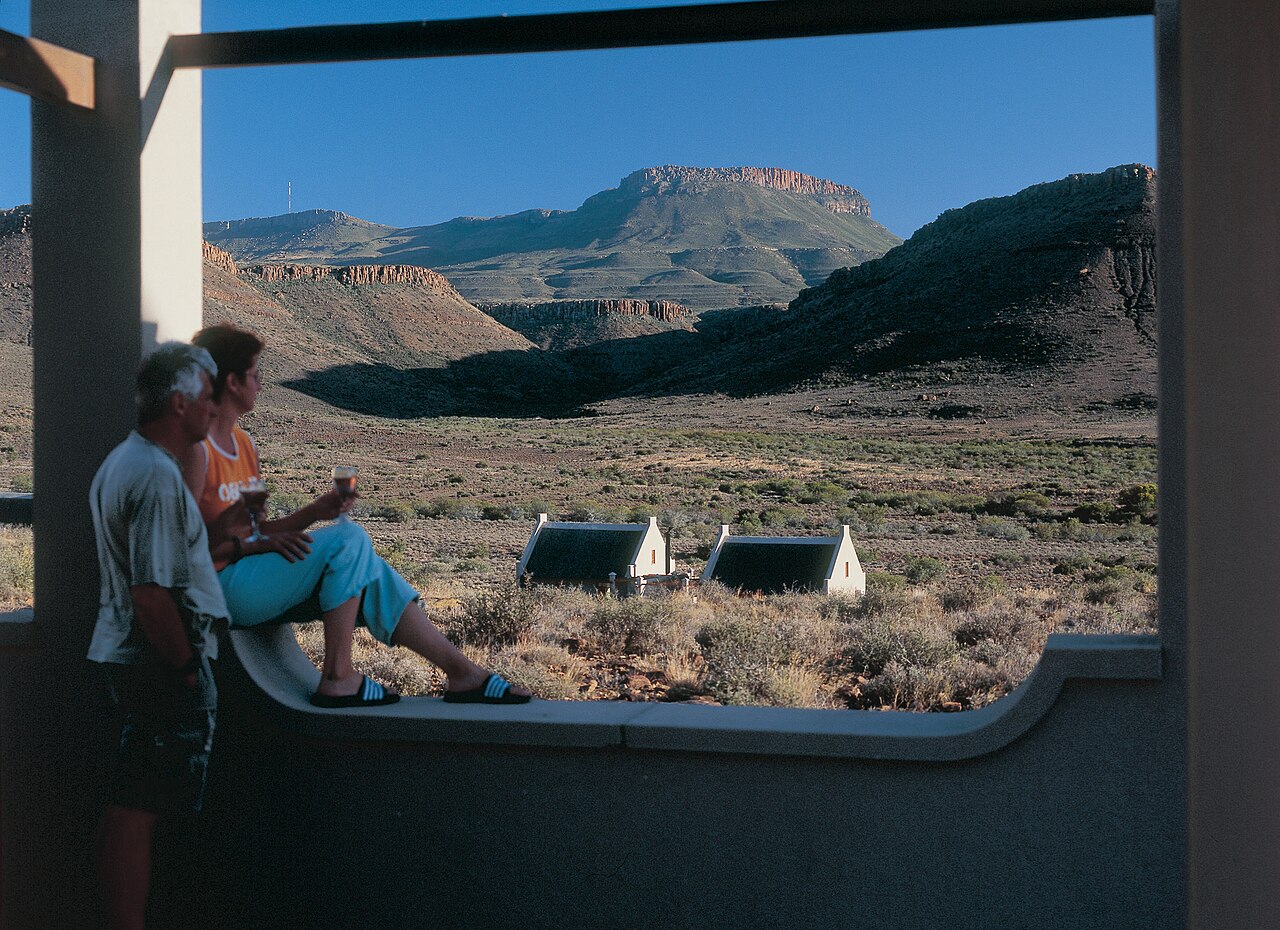
Visitor terrace overlooking the landscape in Karoo National Park. Photo: South African Tourism from South Africa · CC BY 2.0. Resized and cropped for this layout.
.jpg)
Karoo National Park at a glance
Karoo National Park makes an unusually worthwhile pause on the N1 near Beaufort West. You can reach a landscape of escarpments, dry plains and grazing antelope without a long wilderness transfer, yet the best experience comes from slowing down for at least two nights. Mountain zebra and springbok give the plains their movement, rocky slopes shelter different animals, and the fossil displays put the living landscape into a much longer history. The park is distinct from Tankwa Karoo National Park. Check which destination your booking names before choosing a route or accommodation.
Official sources · checked 9 September 2026: SANParks: Karoo National Park overview · SANParks: current visitor notices. Confirm arrangements for your travel date.
When is the best time to visit Karoo?
Autumn and spring are often comfortable for a first Karoo visit. Winter can provide crisp skies, cold nights and a welcome opportunity to spend longer outside at permitted places. Summer days can become very hot, making early drives, shade and a substantial water supply especially useful. Rain is variable: a dry-looking landscape can change quickly after a storm, while a wet patch near town says little about a remote track. Match the day to the weather rather than a rigid timetable. Use the exposed pass in clear conditions and reserve the camp’s interpretation or a shorter plains route for the harsher part of the day. Warm clothing remains useful on an open-vehicle drive even after a hot afternoon.
Typical seasonal pattern, not a forecast or a guarantee of road access. Current local conditions take priority.
Which Karoo area suits your trip?
| Area | Best for | What to expect | Planning point |
|---|---|---|---|
| Lammertjiesleegte plains | A first wildlife circuit | Open habitat gives a practical introduction to grazing animals near the main visitor base. | Allow time to stop; the published 13 km route is more than a distance to cover. |
| Klipspringer Pass | Escarpment scenery and rocky habitats | The climb changes the scale of the landscape and offers chances to look for slope specialists. | Use safe designated stopping places and respect the road’s bends and gradients. |
| Potlekkertjie Loop | A longer varied scenic outing | A broader circuit adds habitat contrasts beyond the easiest plains drive. | Check the road and your return time before setting off. |
| Rest camp and Fossil Trail | Interpretation, birding and a gentler interval | Camp trees and the fossil displays add detail often missed by visitors who only drive. | Use the designated pedestrian areas; the rest-camp visit does not authorise walking into the game area. |
| Afsaal and Embizweni-side country | A specifically planned remote stay | Quieter accommodation and rougher routes suit visitors who prepare for limited services. | Confirm vehicle requirements, key collection, provisions and the minimum stay. |
Karoo entry fees, permits and opening hours
These are daily conservation fees per person for 1 November 2025–31 October 2026, as displayed by SANParks when reviewed. Adult rates apply from age 12; child rates apply at ages 2–11. Bring the identity or residency documents needed for your category and a payment card. Accommodation, guided activities and any equipment or transport are separate. A 1% community fund is added to accommodation and activity reservations. If you hold a Wild Card, check that its membership category covers the park and all travellers; bring the current membership confirmation and identification. For visits from 1 November 2026, use the next tariff rather than extending these prices.
| Visitor category / section | Adult | Child (2–11) |
|---|---|---|
| South African citizens and residents | R73 | R37 |
| SADC nationals | R149 | R74 |
| Other international visitors | R325 | R163 |
Official sources · checked 9 September 2026: SANParks: current conservation fees · SANParks: current visitor notices. Confirm arrangements for your travel date.
Opening hours
SANParks publishes main-entrance hours of 05:00–22:00 throughout the year. Game-area gates operate 07:00–18:00 in April–September and 06:00–19:00 in October–March. These are separate permissions: a later entrance opening serves accommodation access, not independent night wildlife driving. Contact reception in advance about late arrival or early departure and follow the agreed instructions.
Official sources · checked 9 September 2026: SANParks: current visitor notices · SANParks: entrance hours · SANParks: access and directions. Confirm arrangements for your travel date.
How do you get to Karoo?
The signed approach from the N1 outside Beaufort West makes Karoo convenient on a long-distance drive, but plan the visit as a separate stop rather than a last-minute detour after fatigue sets in. Buy fuel, drinking water and the supplies your accommodation needs in town. Check the main-gate and reception arrangements when estimating arrival, and give yourself daylight to learn the park roads. Remote cottages and 4×4 routes require their own directions and equipment. A straightforward approach to the main camp says nothing about access to every part of the park. If combining Karoo with Mountain Zebra, allow a proper transfer day and resist scheduling a guided activity immediately after a long road journey.
Official sources · checked 9 September 2026: SANParks: current visitor notices · SANParks: access and directions. Confirm arrangements for your travel date.
Karoo map: 15 useful places
Use this map to compare bases and understand the landscape. Search by place or filter by type. All locations are approximate orientation points; current park, guide and lodge directions override the map.
Loading map near this section. All places are also listed below.
All 15 map places and access notes
- Main entrance gate · Gates & visitor centresVisitor access point. Confirm the correct entrance, current hours and onward directions before arrival. Published facility coordinate; approximate orientation only. Map source. Approximate.
- Main rest-camp accommodation area · Camps & lodgesAccommodation reference. Book ahead and obtain the correct reception, arrival route and current facilities from the operator. Published facility coordinate; approximate orientation only. Map source. Approximate.
- Karoo National Park Camp Site · Camps & lodgesAccommodation reference. Book ahead and obtain the correct reception, arrival route and current facilities from the operator. Map source. Approximate.
- Karoo National Park Interpretive Centre · Gates & visitor centresVisitor access point. Confirm the correct entrance, current hours and onward directions before arrival. Map source. Approximate.
- Viewpoint Klippspringer Pass · ViewpointsUse the designated viewpoint or hide only when open. Follow the current visitor route and keep clear of edges and wildlife. Map source. Approximate.
- Rooivalle Viewpoint · ViewpointsUse the designated viewpoint or hide only when open. Follow the current visitor route and keep clear of edges and wildlife. Map source. Approximate.
- Waterhole Viewpoint · ViewpointsUse the designated viewpoint or hide only when open. Follow the current visitor route and keep clear of edges and wildlife. Map source. Approximate.
- Spookbos · Areas & trail referencesLandscape or trail reference. This pin is not a trailhead or a verified route; obtain the current authorised map and advice. Map source. Approximate.
- Embizweni Cottage · Camps & lodgesAccommodation reference. Book ahead and obtain the correct reception, arrival route and current facilities from the operator. Map source. Approximate.
- Afsaal Cottage · Camps & lodgesAccommodation reference. Book ahead and obtain the correct reception, arrival route and current facilities from the operator. Map source. Approximate.
- Bird Hide · Areas & trail referencesLandscape or trail reference. This pin is not a trailhead or a verified route; obtain the current authorised map and advice. Map source. Approximate.
- Afsaal Waterhole · Water featuresGeographic water-feature reference, not a launch, swimming or direct driving destination. Use only authorised visitor access. Map source. Approximate.
- Walker’s Dam — eastern landscape reference · Water featuresGeographic water-feature reference, not a launch, swimming or direct driving destination. Use only authorised visitor access. Map source. Approximate.
- Tafelberg — mountain reference · Areas & trail referencesLandscape or trail reference. This pin is not a trailhead or a verified route; obtain the current authorised map and advice. Map source. Approximate.
- Beaufort West Museum — outside park · Areas & trail referencesTown heritage stop outside the national park. Confirm its own opening and admission arrangements. Map source. Approximate.
Map references include official park material where specified below, plus OpenStreetMap contributors, checked 9 September 2026. Selected and labelled by See.Africa. Waterbody-centre pins and summits are geographic references, not destinations for direct navigation. Accommodation and airstrip operation must be confirmed. No live animal locations or verified driving route is shown.
A practical Karoo itinerary
One night: make the stop count
Arrive early enough for a short plains drive, then settle into camp. The next morning, choose either the pass or a local birding and fossil session according to your onward distance. Keep departure realistic; a roadside overnight need not become a rushed attempt to see the whole park.
Two nights: plains and escarpment
Use arrival afternoon near camp. On the full day, take a scenic circuit in the better light, pause at an authorised picnic place and return for interpretation or rest. A shorter late drive lets you compare animal behaviour at another time of day.
Three nights: a more attentive safari
Add a booked guided drive and devote another outing to smaller antelope and birds. Repeated observation makes it easier to learn how animals use shade, slopes and open ground. This extra time also gives flexibility for wind, heat or road restrictions.
Remote cottage visit
Build the route around the confirmed accommodation and vehicle requirements. Carry food and water reserves, collect keys as instructed and ask about communications. Do not assume the final route will take the same time as a normal rest-camp approach.
Where should you stay in Karoo?
The main rest camp suits most first visits because it keeps accommodation, camping, interpretation and the principal circuits together. Compare chalet or cottage facilities against your group’s needs, including whether meals are included in the quoted booking. Campers should check the pitch, power connection and shared facilities instead of inferring them from a scenic photograph. Afsaal and Embizweni cottages offer a different, more secluded experience; the published booking information specifies minimum two-night stays. Confirm current access requirements and what you must bring. Beaufort West is an outside alternative, but staying there means building each park visit around the game-area hours rather than the hotel’s breakfast schedule.
Karoo mammals to look for
The visible grazers are a good starting point, but use the landscape to decide where to look. Plains hold a different mix from the rocky pass and denser drainage lines. Small or nocturnal mammals are much less obvious than an open view might suggest. The field cards include elusive species to aid an encounter, not to create a checklist that every visitor should expect to complete.

Cape mountain zebra
Look for a small throat dewlap, narrow body stripes and a pale belly. These clues help distinguish mountain zebra from plains zebra. Watch a family group negotiate slopes, and compare animals from a stopped vehicle rather than following a herd uphill.
_(31707282834).jpg)

Plains zebra
Look beyond the stripes: herd spacing, ears and alarm behaviour can tell you what is happening in a grassland. Foals may rest while adults stand watch. Scan the edges of a herd for predators without losing sight of the zebras’ own social interactions.


Springbok
The dark flank stripe, pale face and white rump stand out against dry grassland. Groups can rest almost invisibly during the hottest hours. Watch their heads and ears for alert behaviour and allow animals to cross the road without splitting the herd.


Red hartebeest
An elongated face, high shoulders and angular horns give this reddish antelope a distinctive silhouette. Compare its body shape with nearby wildebeest or blesbok. A standing lookout may reveal a group concealed in a fold of the grassland.


Common eland
Africa’s largest antelope has a deep body, a dewlap and gently spiralling horns. Its size does not prevent it from moving gracefully through open woodland. Watch mixed-age groups at a respectful distance and distinguish it from buffalo by its lighter build and horn shape.


Greater kudu
Large ears, narrow pale body stripes and the male’s long spiral horns help identify this woodland browser. Kudu can freeze and blend into scrub remarkably well. Scan the shady side of thickets; a pair of ears is often the first thing you notice.


Klipspringer
A compact antelope of rocky slopes, often seen in pairs. Its specialised hooves allow precise movement over boulders. Use binoculars to inspect rocky outcrops from the road and do not climb after it; the surrounding terrain may also conceal larger wildlife.
_male_Serengeti.jpg)

Gemsbok
Long straight horns and bold black-and-white facial markings distinguish this dry-country antelope. Both sexes have horns. Observe how animals use shade and open ground through the day; an impressive pair of horns is a reason to give plenty of space.
_male.jpg)

Steenbok
A small reddish antelope with large ears and a pale underside. Individuals often stand still near low cover and can disappear after only a few steps. Stop gently and observe from the road instead of driving toward the spot where one hid.
.jpg)

Caracal
Long dark ear tufts and a plain tawny coat are the best clues to this secretive cat. It can remain hidden in low vegetation close to a road. An encounter is a bonus, not a routine expectation; give it space to continue moving naturally.
_(cropped).jpg)

Bat-eared fox
Oversized ears, dark legs and a lightly built body distinguish this insect-eating fox. Watch for a pair listening and searching close to the ground in suitable open habitat. Avoid following animals with a vehicle or directing bright light at them independently.

Karoo birds and habitat clues
Look for larks and larger ground birds on the plains, raptors above the escarpment and a different community around camp trees. SANParks highlights the rest-camp area as particularly useful for birding. A short quiet session there can be more productive than covering another long road at speed. Do not approach cliffs or place yourself between birds and a water source.

Verreaux’s eagle
A large dark eagle associated with rocky landscapes. Adults show a pale back marking and contrasting wing panels, although distance and strong backlight can hide them. Watch the shape and soaring pattern with binoculars. Cliff nesting birds should be observed from public routes without approaching ledges.
,_Aquila_verreauxii,_at_Walter_Sisulu_National_Botanical_Garden,_Gauteng,_South_Africa_(28825027073).jpg)

Pale chanting goshawk
A pale grey raptor with long orange-red legs, often seen on an exposed perch in dry country. Watch how it surveys the ground, then follows prey on foot or with a short flight. A stationary vehicle makes a better observation platform than a close approach.


Ludwig’s bustard
A large, well-camouflaged bustard of dry open country. Its long neck and deliberate walk may reveal it among low shrubs. Use binoculars before assuming that an apparently empty plain holds no birds, and give feeding or displaying individuals an undisturbed route.


Namaqua sandgrouse
Cryptic plumage makes a resting group difficult to pick out on stony ground. Listen for calling birds in flight and watch from existing roads near appropriate habitat. Do not occupy a drinking edge or block birds from reaching water.


Acacia pied barbet
A compact black-and-white barbet with a red forehead and sturdy bill. Search wooded camp margins and listen before looking into the canopy. Natural fruiting trees and quiet observation provide better views than feeding birds at a picnic table.


Cape robin-chat
An orange breast, dark face and pale eyebrow make this familiar southern African bird a useful one to learn. Listen around shaded shrubs and camp gardens. Watch natural foraging at the vegetation edge, keeping food away even when a bird seems unusually confident.
2.jpg)

Pale-winged starling
Dark glossy plumage can look plain until flight reveals pale wing patches. Rocky landscapes, cliffs and suitable buildings provide perches. Observe from approved stopping places and resist feeding a confident bird that approaches a visitor area.


Common ostrich
The immense size, long bare neck and powerful legs are unmistakable. Males are predominantly black and white, while females are browner. Give adults and chicks a wide margin, particularly on foot; apparent familiarity with visitors does not make an ostrich tame.
.jpg)
Karoo plants and habitats
Nama Karoo shrubland
Low shrubs and grasses respond to variable rainfall. Open ground can look empty at first, but small differences in cover and fresh growth influence where grazers feed.
Escarpment vegetation
Altitude, slope and shallow soils create a different setting from the plains. View plants from authorised stops; the pass is a road through wildlife habitat, not an informal walking trail.
Drainage-line woodland
More sheltered, moister lines support trees and browse. Compare bird activity here with the open plateau and scan shaded ground without leaving the vehicle.
Fossils and living landscapes
The interpretation trail provides a way to connect the present environment with the region’s deep geological past. Treat fossils as protected scientific heritage and leave discoveries undisturbed.
Plant identification may require leaves, flowers, fruit and a knowledgeable guide. Do not collect plants or leave authorised routes to inspect them.
What can you do in Karoo?
Drive Klipspringer Pass patiently
Stop where permitted, look back across the plain and scan nearby rocks with binoculars. The changing landscape is part of the experience even when large animals are not immediately visible.
Visit the Fossil Trail
Give the displays time and use the interpretation to understand what a fossil records. Check current access and opening arrangements at reception, particularly if mobility needs affect your route.
Watch camp birds
Take an unhurried circuit within the permitted pedestrian area. Natural food sources and shaded vegetation can reveal birds missed during a vehicle drive.
Book a guided drive
A guided outing adds identification and interpretation, especially for less obvious animals. Confirm departure, duration, clothing, minimum ages and the return arrangement directly with the park.
Rules and practical precautions
Use designated roads and respect the posted 40 km/h limit. Do not treat long main-entrance hours as permission to drive after the wildlife gates close. Get out only at authorised places, protect food from wildlife, and leave plants, rocks and fossils undisturbed. A designated 4×4 trail is not an alternative route for an unsuitable rental vehicle.
Give wildlife space
Never feed, surround or block an animal. Keep food secure, voices low and movements predictable. Your guide or ranger’s instructions take priority over a desired photograph.
Prepare for your actual activity
Bring water, sun or rain protection as appropriate, suitable footwear and charged equipment. Tell the operator about relevant mobility needs before booking so the route and vehicle can be matched to you.
Official sources · checked 9 September 2026: SANParks: Karoo National Park overview · SANParks: current visitor notices. Confirm arrangements for your travel date.
Karoo travel FAQ
Where is Karoo National Park?
It is beside Beaufort West in the Western Cape, with access from the N1. It is a different destination from Tankwa Karoo National Park.
How long should I stay?
Two nights is a useful first visit, allowing a full day for scenic drives, wildlife and fossil interpretation.
Can I drive in the wildlife area at night?
Independent wildlife driving follows the game-area gate hours. A later main-entrance opening or booked late check-in does not change that rule.
What are the international conservation fees?
SANParks lists R325 per adult and R163 per child aged 2–11 per day for 1 November 2025–31 October 2026.
Can I collect a fossil?
No. Leave fossils and other natural material where they are, and use the park’s displays and interpretation trail to learn about them.
Do remote cottages need extra planning?
Yes. Confirm vehicle requirements, minimum stays, supplies, keys and communications for the exact accommodation booked.
Sources, method and review date
This guide combines official park and operator information with editorial planning advice. Operational details were checked on 9 September 2026. Season descriptions are typical patterns, and suggested stays are planning recommendations. Wildlife profiles explain identification and habitat; they do not promise sightings.
Wildlife and image references
Species names and identification photographs were checked against the linked reference and image records. Photographs are identification examples and may have been taken elsewhere. Each image carries its own creator and licence credit.
Species reference links
Cape mountain zebra · Plains zebra · Springbok · Red hartebeest · Common eland · Greater kudu · Klipspringer · Gemsbok · Steenbok · Caracal · Bat-eared fox · Verreaux’s eagle · Pale chanting goshawk · Ludwig’s bustard · Namaqua sandgrouse · Acacia pied barbet · Cape robin-chat · Pale-winged starling · Common ostrich