
Kgalagadi Transfrontier Park Guide
The practical 2026 guide to the Kalahari’s red dunes and dry riverbeds: best time, conservation fees, border rules, camps, waterholes, long-distance self-drive planning, interactive map, mammals, birds and desert safety.
Kgalagadi Transfrontier Park at a glance
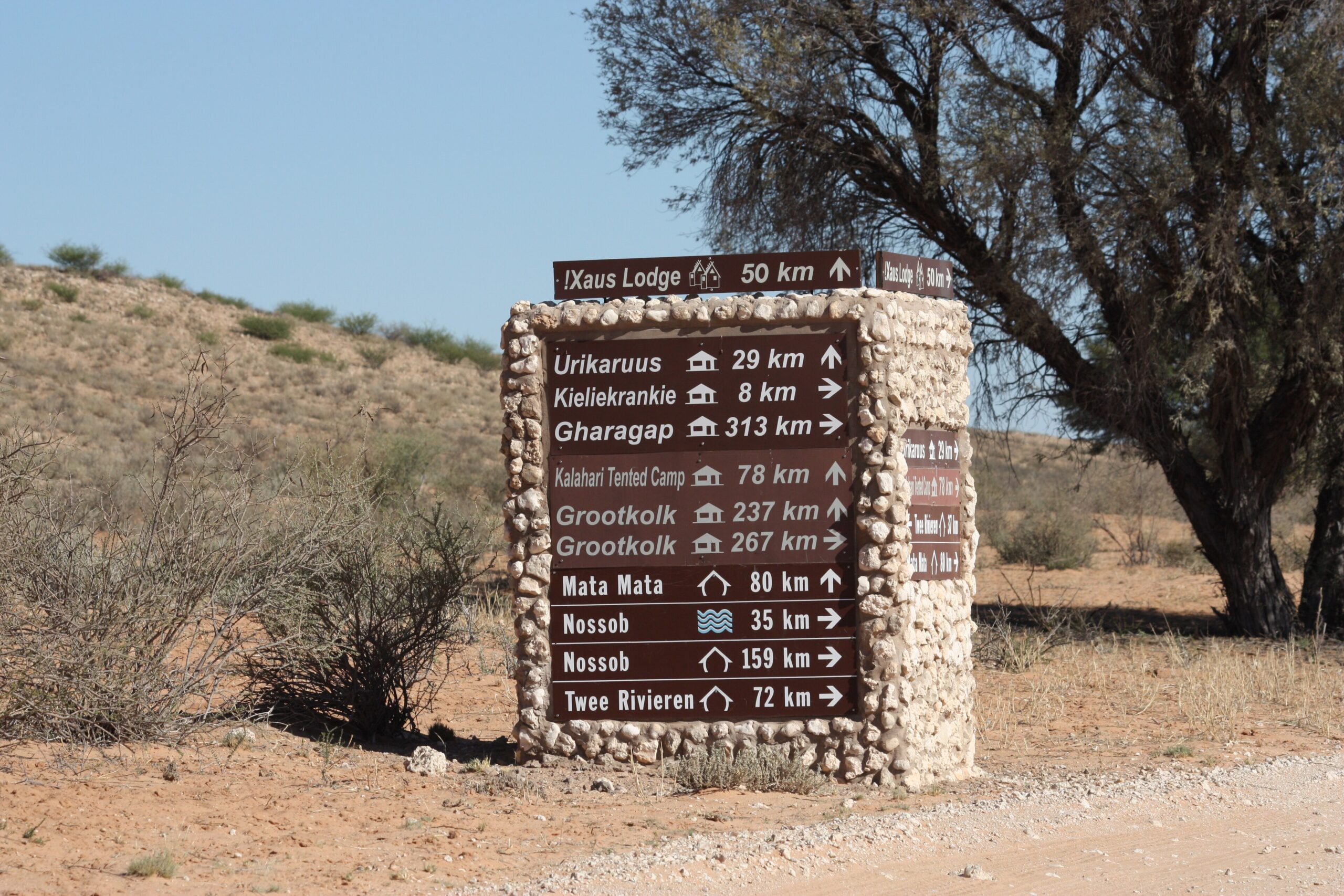
Kgalagadi Transfrontier Park is a vast semi-arid conservation landscape shared by South Africa and Botswana. Most first-time self-drivers enter at Twee Rivieren and follow the two great dry riverbeds—the Auob toward Mata-Mata and the Nossob toward Nossob and the far north. Sparse vegetation and water-dependent wildlife make patient scanning unusually rewarding.
Which Kgalagadi area should you stay in?
A balanced first trip uses more than one base. Twee Rivieren is the logistical hub; the Auob gives classic waterhole-and-giraffe country toward Mata-Mata; Nossob is the predator-focused heart of the eastern riverbed; the far north rewards visitors who can accept long transfer times and fewer services.
| Area / base | Best for | Services | Planning note |
|---|---|---|---|
| Twee Rivieren & south | First night, supplies, interpretation, shorter loops | Reception, fuel, shop, restaurant, pool, 24-hour electricity and cell reception | Best place to arrive, orient yourself and recover from the road from Upington. |
| Auob / Mata-Mata | Waterhole watching, giraffe, cheetah country, raptors | Mata-Mata has fuel, shop, reception and pool; several unfenced wilderness camps lie along the corridor | Use the riverbed slowly; do not sprint from waterhole to waterhole. |
| Nossob corridor | Predators, dry-riverbed wildlife, access to deeper north | Nossob has fuel, shop, pool and Predator Centre | Excellent 2-night anchor because both dawn and evening can be spent close to camp. |
| Far north | Remoteness, quiet waterholes, desert atmosphere | Grootkolk/Gharagab are small, unfenced and self-catering | Twee Rivieren–Grootkolk is officially budgeted at 7½ hours; Gharagab cannot be reached from Twee Rivieren in one day. |
| Botswana side | Remote 4×4 travel and wilderness camping | More limited; camps include Rooiputs, Polentswa, Two Rivers and Mabuasehube | A 4×4 is necessary on the Botswana side; some Botswana routes require at least two vehicles. |
Best time to visit Kgalagadi Transfrontier Park
May to September is the easiest all-round period for a first self-drive. Days are generally more comfortable, vegetation is dry and the riverbeds remain productive wildlife corridors. The trade-off is cold: SANParks records winter-night extremes as low as −11°C. Summer can produce dramatic storms, green dunes, young animals and strong birding, but shade temperatures can reach about 42°C.
May–September
Best default. Cooler days suit long drives and water-dependent wildlife is often easier to read. Pack serious winter layers for pre-dawn starts.
January–April
Green-season drama. Most rain falls in this period, peaking around March. Thunderstorms can transform the dunes and trigger insect and bird activity.
October–December
Hot shoulder into summer. Expect long, bright days and rising heat. Plan midday rest rather than forcing all-day driving.
Kgalagadi fees and gate hours
The current SANParks daily conservation tariff below is valid 1 November 2025 to 31 October 2026. Accommodation, Botswana-side charges, activities and border costs are separate.
| Visitor category | Adult / day | Child age 2–11 / day |
|---|---|---|
| South African citizen / resident | R129 | R64 |
| SADC national | R263 | R132 |
| International visitor | R576 | R288 |
Why gate hours need a live check
SANParks publishes monthly entry/exit times and explicitly warns that they may change without notice. Published 2026 tables show closing times moving roughly between 18:00 and 19:30 depending on month and the selected gate/camp schedule. Your day therefore changes materially between a June visit and a December visit.
Winter planning
Shorter daylight and earlier closing times make long transfers more unforgiving. Build a margin rather than planning to arrive at the exact official closing time.
Summer planning
Longer operating windows do not remove heat risk. Wildlife activity can drop sharply around midday, making split morning/afternoon drives more comfortable.
How to get to Kgalagadi—and cross borders correctly
Upington → Twee Rivieren
Upington is the nearest airport and the standard supply point. The park is about 250 km away; SANParks describes the Upington–Askham route as the better tar-road approach.
Upington Airport
Hire a suitable vehicle in Upington. The Twee Rivieren landing strip is restricted to overnight park guests and requires arrangements with reception at least 72 hours ahead.
Gravel + corrugations
SANParks states that park roads are gravel and not sedan-friendly; some roads can become inaccessible when wet. High clearance is far more important here than motorway comfort.
The five official access gates
| Gate | Country side | Best use | Important note |
|---|---|---|---|
| Twee Rivieren | South Africa | Main first-time entrance, admin and immigration | Use this for formalities when entering one country and exiting another. |
| Mata-Mata | Namibia | Cross-border Auob itinerary | Passport/border rules apply; Namibia and South Africa can differ by one hour seasonally. |
| Two Rivers | Botswana | Botswana counterpart to Twee Rivieren | Border and booking procedures differ from a normal South African domestic visit. |
| Mabuasehube | Botswana | Eastern wilderness / pans | Remote 4×4 access; plan fuel, water and reservations conservatively. |
| Kaa | Botswana | Remote north-east access | For experienced 4×4 itineraries rather than a quick add-on to a South African loop. |
Kgalagadi map: camps, waterholes, picnic sites and access
This map is deliberately denser than a simple “three camps” map. It shows the places that actually shape a self-drive day: major rest and wilderness camps, picnic/rest points, visitor centres, the Twee Rivieren airstrip and a selection of named waterholes along the Auob and Nossob corridors.
The soft green/brown bands mark the broad Auob and Nossob visitor corridors—not live animal locations. The optional route is a planning sequence, not turn-by-turn navigation.
Kgalagadi rest camps and wilderness camps compared
Your camp choice determines far more than comfort—it determines which wildlife corridor you can reach at dawn and how much of each day is lost to transfers. The three main rest camps are the service anchors; the small wilderness camps trade facilities for isolation.
| Camp | Type | Best for | Logistics |
|---|---|---|---|
| Twee Rivieren | Main rest camp | Arrival/departure, supplies, south loops | Reception, shop, fuel, restaurant, pool; only camp with 24-hour electricity and cell reception. |
| Mata-Mata | Main rest camp | Auob wildlife, giraffe, raptors | Fuel, shop, pool, Raptor Centre; border access to Namibia. |
| Nossob | Main rest camp | Predators, Nossob riverbed, north access | Fuel, shop, pool, Predator Centre; no phone reception. |
| Kalahari Tent Camp | Unfenced tented camp | Quiet Auob base near Mata-Mata | Waterhole; bring own drinking water and wood. |
| Urikaruus | Unfenced wilderness camp | Auob atmosphere and waterhole watching | About 2½ hours from Twee Rivieren by SANParks planning time; bring supplies. |
| Kieliekrankie | Unfenced wilderness camp | Dune views and quiet first/last night | About 1½ hours from Twee Rivieren; waterhole; check in at Twee Rivieren. |
| Bitterpan | 4×4 wilderness camp | Dune crossing between Nossob and Auob | Strict one-way 4×4 route; not a casual detour. |
| Grootkolk | Unfenced wilderness camp | Far-north solitude | About 3 hours from Nossob / 7½ hours from Twee Rivieren by official planning time. |
| Gharagab | Unfenced 4×4 wilderness camp | Remote northern dunes | Cannot be reached from Twee Rivieren in one day; 4×4-only one-way access. |
How to plan a Kgalagadi safari day—and a 6-night first trip
On a broader Northern Cape journey, Augrabies Falls National Park adds the Orange River gorge, while Mokala National Park offers a different mix of woodland, antelope and camps. These need separate travel time and bookings; they are additional destinations rather than quick Kgalagadi day trips.
The daily rhythm
Dawn: commit to one corridor
Leave when your camp schedule allows and work either the Auob or Nossob slowly. Predators, jackals and hyenas are more active in the cooler hours, and low light reveals tracks and movement.
Morning: wait at productive waterholes
Do not assume motion equals sightings. Pick a few waterholes with shade, open sightlines and recent wildlife activity; spend enough time for the landscape to change.
Midday: reduce effort
Heat shimmer can make scanning difficult even outside peak summer. Use a designated picnic site or camp break, refuel when possible and protect camera gear from dust.
Late afternoon: stay close enough
Return to a productive waterhole or riverbed section without gambling on the closing time. The final wildlife stop is not worth arriving late at camp.
A sensible 6-night first itinerary
Twee Rivieren
Arrive early, fill fuel and water, visit the Interpretation Centre and do a short south-riverbed orientation drive if time permits.
Mata-Mata / Auob
Spend one transfer morning moving slowly north-west, then one full day repeating the best Auob waterholes instead of chasing distance.
Nossob
Use the dune road transfer as part of the safari. Give Nossob a full day so predator country is not reduced to a single pass.
Twee Rivieren
Return south with enough margin for wildlife stops. A final night near the exit removes pressure from departure-day timing.
Grootkolk / far north
Add this only if you can spare the time. The north is valuable because it is remote—not because it should be ticked off quickly.
Bitterpan / Botswana
Use only with the required 4×4, bookings and route rules. These are separate wilderness experiences, not normal scenic loops.
22 mammals to know in Kgalagadi
SANParks lists 59 mammals. These 22 are selected because they are especially useful for first-time identification, predator watching or understanding how desert wildlife uses the Auob and Nossob riverbeds.
Lion
Kgalagadi is famous for dark-maned males, but mane colour varies. Scan dry riverbeds, camelthorn shade and waterhole approaches in the cool hours rather than only looking on the road.
Cheetah
Open Auob and Nossob terrain gives cheetahs long sightlines for hunting springbok. Look for animals walking the riverbed margins or using slight rises to scan.
Leopard
Leopards are easier to miss than lions because they use trees, dunes and shaded banks. Scan large camelthorns carefully, especially around water and denser riverbed vegetation.
Brown hyena
Long shaggy fur and a sloping back separate it from spotted hyena. Early mornings around waterholes offer the best realistic chance for a brief encounter.
Spotted hyena
A powerful hunter as well as scavenger. Dawn road encounters and waterhole patrols are common contexts; listen at night from camp as well.
Black-backed jackal
One of the easiest carnivores to learn. Watch pairs around waterholes and predator activity; their alert posture often points toward something larger nearby.
African wildcat
Looks deceptively like a long-legged domestic tabby. The reddish backs of the ears, leg barring and wary behaviour are useful field clues.
Caracal
A tall, muscular cat with black ear tufts. Encounters are often brief, so scan dune shoulders and scrub edges rather than expecting it beside busy waterholes.
Cape fox
Small silver-grey fox with a dark tail tip. Mostly nocturnal and crepuscular, but cool early mornings can produce roadside sightings.
Bat-eared fox
Huge ears are used to locate insects underground. Pairs or family groups often forage with heads down, pausing to listen before digging.
Gemsbok
The defining large antelope of Kgalagadi. Both sexes carry long straight horns; animals tolerate heat remarkably well but still concentrate around favourable forage and water.
Springbok
Large herds can transform a seemingly empty riverbed. Watch their body language: sudden staring or bunching often signals a predator before you see it.
Show 10 more Kgalagadi mammals
Blue wildebeest
Seasonal movements track forage and water. Herds often share open riverbeds with springbok and red hartebeest, creating productive predator-scanning areas.
Red hartebeest
Reddish body, long face and strongly sloping back make this one of the easiest antelopes to separate at distance. Small herds range widely after rainfall.
Eland
Africa’s largest antelope can cover surprising distances in arid landscapes. Bulls are massive with a heavy dewlap; cows and younger animals look much lighter.
Steenbok
Small, solitary and often frozen beside the road before suddenly disappearing into cover. Large ears and an orange-brown coat are good beginner clues.
Giraffe
Most strongly associated with camelthorn-rich Auob country. Their height makes them excellent “spotters”—giraffes staring fixedly into scrub may be watching a predator.
Cape ground squirrel
Social colonies live around burrow systems. The broad tail can be held over the body like a parasol, a memorable adaptation to intense sun.
Meerkat / suricate
Family groups forage while one or more animals stand sentinel. Do not expect the habituated close-up experience seen at specialist meerkat projects elsewhere.
Honey badger
A powerful digger with a broad pale mantle. When one appears, watch patiently: its digging can attract jackals or raptors looking for displaced prey.
Aardvark
More often detected by burrows and tracks than by the animal itself. Cool winter afternoons occasionally improve daylight chances, but never plan a trip around seeing one.
Ground pangolin
SANParks lists pangolin among the park specials, but visitor sightings are exceptional. Never share a live location publicly; illegal wildlife trade makes location sensitivity important.
12 Kgalagadi birds worth learning
Raptors are a major part of the Kgalagadi experience, while rain can trigger an influx of larks, seed-eaters and migrants. The dry Auob and Nossob riverbeds are especially useful because camelthorns provide hunting and nesting perches.
Pygmy falcon
A tiny raptor strongly associated with sociable-weaver colonies. Check the outer chambers and nearby perches of huge communal nests.
Sociable weaver
Its enormous grass apartment nests are among the park’s most obvious structures. Colonies modify whole camelthorn trees and provide shelter used by other species.
Pale chanting goshawk
One of the easiest Kalahari raptors to learn because it frequently hunts from exposed roadside perches. Pale grey adults show long orange-red legs.
Bateleur
Watch for the very short tail and rocking flight. Adults cover large areas and are often seen gliding low while searching for carrion.
Lappet-faced vulture
A huge, powerful vulture and an important conservation species. Scan thermals and carcass gatherings; its heavy bill allows it to open tough hide.
Martial eagle
Less common than some other raptors but unforgettable when seen. Look on large camelthorns and high thermals rather than only near waterholes.
Secretarybird
Long-legged terrestrial raptor of open riverbeds and plains. Scan far ahead for the distinctive silhouette walking through short vegetation.
Kori bustard
SANParks describes it as common along both Auob and Nossob riverbeds. Its large size and slow walk make it an ideal first Kalahari bird to learn.
Namaqua sandgrouse
Morning drinking flights can bring fast-moving flocks to waterholes. Males can carry water in specialised belly feathers for chicks.
Crimson-breasted shrike
Glossy black-and-crimson plumage stands out against pale thornveld. Listen for pairs calling from dense scrub when the bird itself is hidden.
Southern yellow-billed hornbill
A familiar ground-foraging hornbill around dry woodland and camps. The curved yellow bill and bounding flight make identification straightforward.
Verreaux’s eagle-owl
A massive owl best searched for at dawn around large roost trees or on guided night drives. Pink eyelids are a remarkable close-view field mark.
Flora of Kgalagadi: trees, shrubs, grasses and desert plants
The park is visually sparse but botanically structured: camelthorn-lined drainage systems, dune grasslands, thorn scrub and seasonal flushes after thunderstorms all change where animals feed and rest.
Trees & shrubs
Camelthorn
The defining riverbed tree. Deep roots reach moisture below dry sand; large crowns provide shade and hunting perches for eagles, owls and leopards.
Grey camelthorn
A paler thorn tree of sandy Kalahari country. Learn it together with camelthorn rather than treating every acacia-shaped tree as the same species.
Shepherd’s tree
The pale trunk and evergreen crown can stand out against red dunes. It provides shade and browse during difficult dry periods.
Black thorn
Dense thorny growth creates cover for small mammals and birds. Thickets can make otherwise open desert surprisingly difficult to scan.
Three-thorn
A characteristic Kalahari shrub whose yellow flowers can become conspicuous after rain, briefly changing the colour of dune slopes.
Wild raisin
Multi-stemmed shrub producing fruit used by wildlife and people. It is common in dry scrub and helps create denser feeding patches.
Brandy bush
A hardy browse shrub of dry woodland and thickets. Look at leaf shape and growth form rather than relying on fruit alone.
Buffalo thorn
Straight and hooked paired thorns are a useful field clue. It favours better-watered drainage lines and protected microsites.
Witgat
Small hardy tree or shrub suited to arid conditions. Its subdued appearance makes it easy to overlook beside larger camelthorns.
Saltbush
Pale, salt-tolerant foliage occurs around saline ground and pans. Species-level identification may require closer botanical work.
Grasses, herbs & seasonal plants
Bushman grass
Tufted grass adapted to deep sand and drought. Its structure helps stabilise dunes and provides cover for insects and small mammals.
Kalahari sand quick
An important grazing grass that responds quickly after rain, helping explain sudden seasonal movements of antelope.
Gha grass
Coarse clumps cope with deep sand and aridity. Grazing pressure and rainfall strongly influence how conspicuous it becomes.
Silky bushman grass
Fine seed heads catch low morning and evening light—one reason the dunes can look dramatically different after a wet season.
Lovegrass
Several species respond to moisture in riverbeds and disturbed ground. Fresh growth can concentrate grazers after rain.
Couch grass
Short mats persist around wetter or disturbed sites such as waterhole margins, creating locally attractive grazing.
Devil’s thorn
Low-growing herb with hard spiny fruits. Wear shoes around camps and picnic areas rather than walking barefoot.
Tsamma melon
Wild melons can appear after rain and provide valuable moisture in a landscape where free water is scarce.
Hoodia
Leafless succulent adapted to arid ground. Photograph rather than collecting plants; protected-area vegetation should remain where it grows.
Kalahari truffle
An underground fungus associated with sandy soils after favourable rain and an important traditional food resource in the Kalahari.
Best Kgalagadi experiences beyond “drive farther”
1. Waterhole stake-out
Choose one or two waterholes and wait. The Kalahari rewards observation: sandgrouse, jackals, antelope and predators can all use the same small area at different times.
2. Guided morning or sunset drive
SANParks offers guided drives from Twee Rivieren, Nossob, Mata-Mata and Kalahari Tent Camp, subject to staffing and minimum numbers; children under six are not permitted.
3. Leeudril 4×4 Loop
A bookable one-way 13.2 km off-road loop north of Leeuwdril, forming roughly a 50 km outing from Twee Rivieren and back. Low range and reduced tyre pressure are part of the official rules.
4. Birding one riverbed slowly
Make raptors, sociable-weaver nests, bustards and sandgrouse the main objective for half a day rather than treating birds as filler between lion sightings.
5. Interpretation stops
Use the ǂKhomani-focused Interpretation Centre at Twee Rivieren, Predator Centre at Nossob and Raptor Centre at Mata-Mata to add ecology and cultural context.
6. Desert night sky
Remote camps have very little artificial light. Spend time outside your unit where camp rules permit—but remember that several wilderness camps are unfenced.
Kgalagadi rules and safety that actually change your trip
Carry emergency water
Keep at least 10 litres in the vehicle. Wilderness camps do not provide potable water, so your trip water and emergency reserve are separate calculations.
Stay in a broken vehicle
SANParks explicitly advises remaining in your vehicle during a breakdown. Walking for help exposes you to heat and wildlife.
Respect darkness
No normal self-drive travel is allowed after dark. Strict camp/gate times mean late wildlife stops can become a real operational problem.
Use the right vehicle
Main roads are not described as sedan-friendly, and specialised routes have stricter 4×4 requirements. Do not confuse “road shown on map” with “easy road.”
Treat unfenced camps differently
Use a headlamp, check outside before stepping from a unit and follow local staff instructions. Predators and snakes are not excluded by a symbolic camp boundary.
Do not collect firewood
Bring or buy the wood you need. Dead wood is still habitat and nutrient material inside a protected ecosystem.
Protect tyre and suspension
Corrugations tempt drivers to go too fast. Reduce speed, keep a pressure plan suitable for your vehicle and remember that wildlife can step into the road suddenly.
Prepare for temperature extremes
SANParks records extremes from about −11°C to 42°C in shade. Winter bedding and summer heat management are both genuine safety considerations.
Do not publish sensitive wildlife locations
Share the experience, not a real-time pin for rare species such as pangolin. Location restraint supports conservation and reduces disturbance.
Kgalagadi Transfrontier Park FAQ
How many days do you need in Kgalagadi?
Five nights is a practical minimum for a first multi-base safari; six or seven nights is better. The park’s official transfer times are long, so extra nights create actual wildlife-watching time rather than just more kilometres.
What is the best time to visit Kgalagadi?
May to September is the easiest all-round period for most first-time visitors. Days are cooler and wildlife is easier to scan in dry conditions, but winter nights can be extremely cold.
Do you need a 4×4 for Kgalagadi?
SANParks recommends a 4×4 with high ground clearance and low range. Main tourist roads are gravel and described as not sedan-friendly, while several wilderness routes require a proper 4×4.
Can you cross from South Africa to Namibia through Mata-Mata?
Yes, with the required border process. If you enter in one country and exit in another, immigration formalities are completed at Twee Rivieren/Two Rivers and SANParks requires a minimum two-night Kgalagadi stay for the Mata-Mata crossing.
How long is Twee Rivieren to Nossob?
SANParks’ official planning time is about 4½ hours. That is before long wildlife stops, so treat it as a transfer day rather than scheduling a tight second activity.
How long is Twee Rivieren to Mata-Mata?
Allow about 3½ hours by SANParks’ travel-time guidance. The Auob road is itself a productive game-viewing route, so many visitors take longer.
Which camp is best for a first visit?
No single camp covers Kgalagadi well. Twee Rivieren is best for logistics, Mata-Mata for the Auob corridor and Nossob for central predator country. Combining at least two bases is much better than commuting from one.
Is Kgalagadi good for lions?
Yes—the park is particularly renowned for predator watching, including lion, cheetah, leopard and both brown and spotted hyena. No species is guaranteed, and slow riverbed/waterhole strategy beats rushing between reported sightings.
Is there drinking water in Kgalagadi?
Main camps have drinking water, although SANParks notes that it is very mineralised; wilderness camps do not provide potable water. Carry your own drinking supply plus an emergency reserve of at least 10 litres in the vehicle.
How this guide was checked
See.Africa reviewed this guide on 1 September 2026 against current SANParks first-party pages for fees, gate access, transfer times, roads, border crossings, camps, activities, mammals, birds, climate and visitor safety. Approximate small-map points are for orientation only. Current park staff, road signs, official maps, booking conditions and border officials override this web guide.
Hero photo: Malapo Country Lodge via Wikimedia Commons, CC BY-SA 4.0. Featured-image attachment and original URL retained.