
Central Kalahari Game Reserve Guide
The practical 2026 guide to Central Kalahari Game Reserve: best time to visit, Deception Valley, gates, pans, interactive map, wildlife, self-drive camping and how to plan a remote Kalahari safari.
Central Kalahari Game Reserve at a glance
Central Kalahari Game Reserve (CKGR) is one of Africa’s great wilderness reserves: an immense protected landscape of fossil river valleys, open pans, grassland, scrub and Kalahari sandveld in central Botswana. Botswana Tourism Organisation gives the reserve an area of about 52,800 km² and describes it as the second-largest wildlife reserve in the world. The reserve was established in 1961 and is especially famous for Deception Valley, black-maned Kalahari lions, vast skies and remote self-drive camping.
Best time to visit Central Kalahari Game Reserve
For wildlife concentration and green Kalahari scenery, the strongest broad window is usually December to April after useful summer rain. Botswana Tourism Organisation notes that the northern grasslands can teem with springbok, gemsbok, wildebeest, hartebeest, eland and giraffe during and shortly after good rains. The dry season is cooler and easier for road predictability, but wildlife can be more dispersed.
For plains game + predators
January–March is a strong target after useful rains. Fresh grass draws herbivores into northern valleys and pans, which in turn attracts lions, cheetahs and hyenas.
For cooler camping
May–August brings dry winter conditions and cold nights. The landscape is less green but road conditions can be easier to judge than after heavy rain.
For birding + storms
November–March brings summer migrants, breeding activity and dramatic cloudscapes. Heat and thunderstorms require flexible driving plans.
Which Central Kalahari safari area is best?
For a first visit, focus on the northern reserve around Deception Valley, Sunday Pan and Leopard Pan. This area combines classic Kalahari scenery with the reserve’s best-known wet-season game concentrations and the easiest access from Matswere Gate. Longer expeditions can push west to Passarge, south to Piper Pan or across to Xade.
| Area | Best for | Main character | Planning note |
|---|---|---|---|
| Deception Valley | First safari, lions, open grassland | Fossil valley with productive seasonal grazing | Classic northern base close to Matswere access and multiple campsites. |
| Sunday + Leopard Pans | Plains game, predator tracking | Open pans and surrounding grassland | Easy to combine with Deception on a northern circuit. |
| Passarge Valley | Remoteness, long wilderness drives | Broad fossil valley and sparse traffic | Requires more fuel, water and time than the northern Deception loop. |
| Piper Pan | Remote camping, solitude | Large pan system farther south | Best for experienced self-drivers building a multi-night expedition. |
| Xade / western side | Cross-reserve expeditions | Very remote western access | Do not treat it as a casual day extension from Deception Valley. |
Central Kalahari entrance fees and camping costs
Verify the live Department of Wildlife and National Parks tariff before paying for a 2026 CKGR trip. Botswana reviewed tourism and wildlife user fees during 2026. In February, government discussed proposed increases including a non-resident park-entry change from P380 to P500, but in April the Ministry stated that tourism-sector user-fee increases had not yet been implemented and that consultation was ongoing.
Park entry + vehicle
Expect protected-area entry and vehicle charges to be separate from camping. Check the current DWNP or authorised booking channel rather than copying an old online tariff.
Camping
Public campsite reservations are separate from reserve access. Prime northern sites around Deception, Sunday and Leopard can be highly sought after in popular travel periods.
How to get to Central Kalahari Game Reserve
Matswere Gate
Matswere on the eastern side is the logical entrance for Deception Valley, Sunday Pan and Leopard Pan. It is the standard choice for a northern CKGR itinerary.
Xade Gate
Xade serves the western reserve and is relevant to trans-reserve or deep-wilderness routes. It should be treated as a separate expedition plan rather than an add-on to Deception.
Tsau Gate
Tsau is another official CKGR gate. Confirm the current approach, track condition and campsite plan before choosing it over Matswere.
Central Kalahari map: gates, pans and safari areas
Use this map to understand CKGR’s scale and the relationship between major northern and central safari areas. Several coordinates are approximate planning references and are not navigation-grade.
The optional line is a sample northern planning sequence, not turn-by-turn navigation. Follow current gate, campsite, ranger and road information on the ground.
How to plan a Central Kalahari safari day
Dawn: work open valley edges
Use the coolest hours around Deception Valley or a productive pan. Lions, jackals and cheetahs are easier to find when prey is active and temperatures are lower.
Morning: stay with one system
Rather than driving huge distances for radio reports, work one valley or pan carefully. Scan shade lines, fresh tracks, springbok behaviour and elevated predator viewpoints.
Midday: protect your reserves
Heat can be severe. Use camp time for water, tyre checks, fuel calculation and offline navigation review. In CKGR, mechanical and hydration margins matter as much as wildlife strategy.
Late afternoon: finish near camp
Return to open grazing areas as temperatures fall, but avoid planning a long unfamiliar transfer near dark. Public-reserve night driving is not permitted.
20 mammals to know in Central Kalahari
CKGR wildlife is adapted to arid conditions and broad seasonal changes. The most memorable sightings often come from reading open pans, grassland edges and predator-prey behaviour rather than expecting constant high densities.
Kalahari lion
CKGR is famous for dark-maned male lions. Search open grazing systems and shade near productive prey areas.
Cheetah
Excellent open-country predator. Scan pans and short grass where visibility and hunting space are greatest.
Brown hyena
A characteristic Kalahari carnivore, usually less conspicuous than spotted hyena and more active in low-light hours.
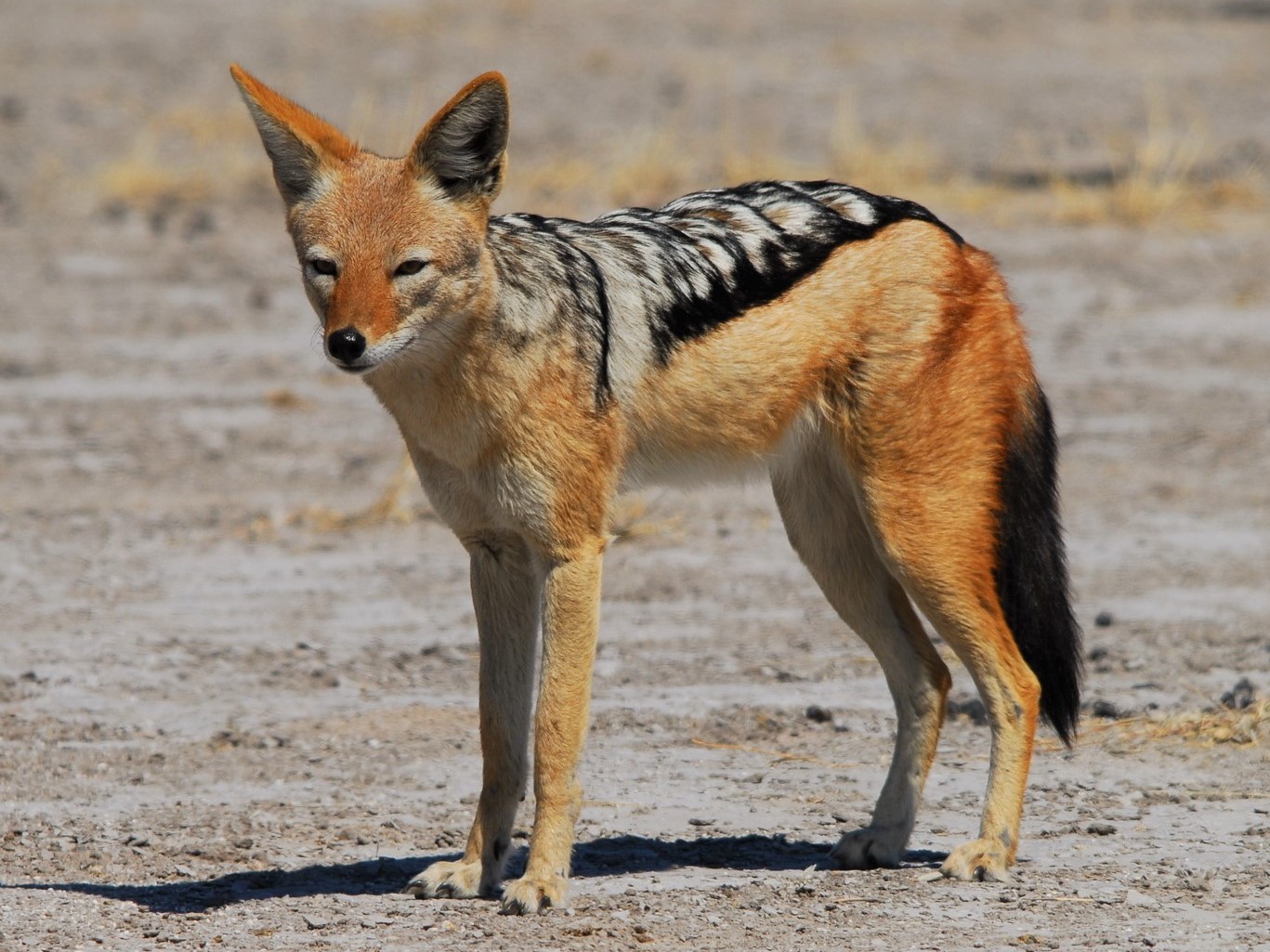
Black-backed jackal
One of the easiest Kalahari carnivores to see, particularly around open pans and predator activity.
Bat-eared fox
Huge ears help locate insects below ground. Look for pairs or family groups on open short grass.
Aardwolf
A small hyena relative that feeds heavily on termites. Most sightings are opportunistic at dawn or dusk.
Springbok
Can gather in impressive numbers after good rain when fresh Kalahari grazing develops.
Gemsbok
One of the defining Kalahari antelope, superbly adapted to heat and scarce free water.
Blue wildebeest
Numbers increase in productive northern grazing after rains, particularly around valley systems and pans.
Red hartebeest
Long-faced, sloping-backed antelope well suited to broad open country.
Show 10 more Central Kalahari mammals
Giraffe
Browsers of acacia and taller woody vegetation; often conspicuous across flat Kalahari horizons.
Common eland
A very large antelope that can move long distances between favourable grazing areas.
Greater kudu
More associated with thicker bush and woodland than the barest pans.
Steenbok
Small solitary antelope of dry scrub and grassland; easy to overlook beside larger game.
Honey badger
A tough, wide-ranging omnivore; sightings are unpredictable but memorable.
Caracal
A medium-sized cat of open scrub and grassland, usually difficult to find deliberately.
African wildcat
A subtle, striped wild cat of dry country; low-light drives near open pans offer occasional sightings.
Aardvark
Mostly nocturnal and rarely seen by day, but its burrows and digging signs are common evidence of its presence.
Cape porcupine
Large nocturnal rodent whose quills and tracks may be found around camps and feeding areas.
Leopard
Present but generally less predictable than lion or cheetah; thicker valley-edge vegetation can provide cover.
10 Central Kalahari birds worth learning
Kori bustard
A huge ground bird of open Kalahari grasslands and one of the reserve’s most characteristic beginner IDs.
Common ostrich
Easy to spot across open pans and plains; breeding males become particularly striking.
Secretarybird
Long-legged terrestrial raptor walking open country in search of snakes, insects and small vertebrates.
Bateleur
Short-tailed eagle often seen cruising broad areas on rocking wings.
Tawny eagle
A common large raptor and scavenger around carcasses and open savanna.
Pale chanting goshawk
A classic dry-country raptor often perched conspicuously on roadside trees.
Red-crested korhaan
Listen for its calls and watch for dramatic breeding display flights in suitable season.
Northern black korhaan
Strongly associated with dry open country and often detected first by voice.
Sociable weaver
Famous for huge communal nests built in sturdy Kalahari trees and structures.
Crimson-breasted shrike
A striking black-and-red bird of Kalahari scrub, often easier to hear than photograph.
Trees, shrubs and grasses of the Central Kalahari
The reserve is dominated by Kalahari sandveld, scrub and grassland rather than true shifting desert dunes. Botswana Tourism Organisation specifically notes silver Terminalia, Kalahari sand acacias and Kalahari apple-leaf among the dominant woody plants.
Key trees & shrubs
Camel thorn
Iconic Kalahari tree with deep roots and nutrient-rich pods used by wildlife.
Silver cluster-leaf
A widespread sandy-soil tree with pale foliage, strongly associated with Kalahari sandveld.
Kalahari apple-leaf
A characteristic woody plant of dry Kalahari habitats and part of the reserve’s dominant vegetation mosaic.
Shepherd’s tree
Hardy evergreen tree whose pale trunk and dense crown stand out in dry country.
Velvet raisin
A common Kalahari shrub producing edible berries and useful browse.
Sickle bush
Dense thorny shrub that can form thickets in disturbed or favourable sites.
Black thorn
A common thorny Kalahari shrub of sandy bushveld; dense stands can provide shade and cover for smaller animals.
Sandpaper raisin
A woody shrub recorded in northern Kalahari savanna, recognised by rough leaves and small edible fruits.
Kalahari rhigozum
A thorny shrub associated with pan-edge and dry Kalahari habitats in Central Kalahari vegetation studies.
Trumpet thorn
A distinctive dryland shrub occurring in pockets around Kalahari pan edges, with showy trumpet-shaped flowers after favourable rain.
Grasses, forbs & low plants
Sand grass
A valuable grazing grass in Kalahari systems, especially after good rain.
Silky bushman grass
A common arid-zone grass adapted to sandy soils and low rainfall.
Lehmann lovegrass
Fine-leaved perennial grass found in dry southern African grasslands.
Devil’s thorn
Low-growing plant with hard spiny fruits; a practical reason to watch tyres and footwear around disturbed ground.
Wild melon
Trailing cucurbit relatives occur in Kalahari habitats and can provide moisture to wildlife when conditions permit.
Three-awn grasses
Dry-country grasses common across sandy savanna; species-level identification can be difficult outside flowering season.
Herringbone grass
A native grass recorded in Central Kalahari herbaceous surveys, especially on sandy disturbed and open sites.
Southern three-awn
A dry-country grass recorded in CKGR vegetation studies; its fine awns are easiest to notice once seed heads develop.
Bushy signal grass
A native seasonal grass documented in CKGR herbaceous communities and most noticeable after useful rain.
Devil’s claw
A low Kalahari forb with distinctive hooked fruits; it is one of the better-known medicinal plants of the region.
Best Central Kalahari safari experiences
1. Deception Valley game drive
The classic CKGR experience: broad views, open grassland, springbok and the chance of black-maned lions.
2. Sunday + Leopard Pan circuit
A productive northern circuit that complements Deception Valley without requiring an extreme transfer.
3. Remote self-drive camping
CKGR’s scale and isolation are central to the experience. Plan conservative fuel, water and recovery margins.
4. Kalahari birding
Slow down for kori bustards, ostriches, korhaans, eagles and dry-country specialists rather than focusing only on predators.
5. Stargazing
Minimal light pollution and immense horizons make CKGR one of Botswana’s great night-sky destinations from camp.
6. San/Basarwa cultural walk
Where offered through an authorised lodge or community-led operator, guided walks can introduce traditional ecological knowledge and Kalahari survival skills.
Rules that matter in Central Kalahari
No night driving in the public reserve
Botswana Tourism Organisation states that night driving is prohibited in official national parks and reserves. Build your day around permitted daylight travel.
Stay on permitted tracks
Off-road driving is prohibited in official parks and reserves. Do not cut across pans or grassland to reach wildlife.
Carry your own survival margin
Water, fuel, food, tyres, recovery gear and offline navigation are basic requirements in a reserve this remote.
Never approach predators or water casually
Camps are unfenced wilderness. Follow campsite and ranger instructions, keep food secure and do not walk away from camp without authorised guidance.
Central Kalahari Game Reserve FAQ
What is the best time to visit Central Kalahari Game Reserve?
December to April is particularly rewarding after good summer rains. Fresh grass can draw large herbivore concentrations into the northern reserve, followed by predators. May to August is cooler and drier for camping.
How big is Central Kalahari Game Reserve?
Botswana Tourism Organisation gives the reserve an area of about 52,800 km². Its scale is one reason routes and fuel planning must be treated conservatively.
What is the best area for a first CKGR safari?
Deception Valley, Sunday Pan and Leopard Pan are the best first-trip focus. They combine classic scenery and wildlife with comparatively practical access from Matswere Gate.
Can you self-drive Central Kalahari?
Yes, but CKGR is serious remote four-wheel-drive travel. Deep sand, long distances, extreme heat and limited services require experience, recovery equipment and generous fuel and water reserves.
What are the main gates of Central Kalahari?
Matswere, Xade and Tsau are the three main gates identified by Botswana Tourism Organisation. Matswere is the most practical for a first Deception Valley itinerary.
Can you see black-maned lions in Central Kalahari?
Yes. CKGR is one of Botswana’s best-known landscapes for dark-maned Kalahari lions, especially around productive northern valleys and pans, although sightings are never guaranteed.
Can you night drive in Central Kalahari?
Not in the public reserve. Botswana Tourism Organisation states that night driving and off-road driving are prohibited in official parks and reserves.
How many nights should you spend in CKGR?
Three nights is a useful minimum for a northern first trip, while four or more nights is better. Extra time gives you flexibility for wildlife, weather and slow remote-road travel.
How this guide was checked
See.Africa reviewed time-sensitive information on 16 September 2026 against Botswana Tourism Organisation and Botswana Government material. Map pins are orientation aids; current DWNP, ranger, campsite and operator instructions override approximate road or access guidance.