
Bwindi Impenetrable National Park Guide
A phone-first guide to gorilla trekking in Uganda: choose the right sector, understand current permit rules, plan your arrival, prepare for trek day and use the interactive sector map on the road.
Bwindi at a glance
Bwindi Impenetrable National Park protects a steep, exceptionally biodiverse rainforest on the Albertine Rift in south-western Uganda. It became a UNESCO World Heritage Site in 1994. For most visitors, the key planning decision is not simply “Bwindi” — it is which trekking sector your permit is for.
Bwindi quick answers
- Gorilla permit
- US$800 foreign non-resident; US$600 in April, May and November under UWA’s 2026 low-season rate.
- Best time
- June–September and December–February are generally drier, but rain is possible year-round.
- Trekking sectors
- Buhoma, Ruhija, Rushaga and Nkuringo.
- Typical trek
- About 2–7 hours, depending on gorilla movements and terrain.
- With gorillas
- Up to 1 hour with your assigned habituated group.
- Minimum age
- 15 years for gorilla tracking.
- Northern fly-in
- Kihihi Airstrip for Buhoma and northern Bwindi.
- Southern fly-in
- Kisoro Airstrip for Rushaga and Nkuringo.
Best time to visit Bwindi
Bwindi is rainforest: rain is possible in every month. The generally drier windows around June–September and December–February can make forest trails and mountain roads more manageable, while wetter periods often mean muddier trekking. The trade-off is that popular drier months can be busier.
Season labels are planning shorthand, not a weather guarantee. Pack for rain even in a drier month.
Gorilla permits in 2026
For most months in 2026. UWA introduced a lower-season rate of US$600 for foreign non-residents during April, May and November.
UWA’s lower-season rate is US$500 for foreign residents during April, May and November.
UWA’s February 2026 tariff notice also states that the old seven-day unpaid reservation window was suspended from 1 March 2026: operators secure permits on full payment. Rates and booking rules can change, so verify the live tariff before sending money.
Which Bwindi sector should you choose?
Uganda Wildlife Authority identifies four main trekking sectors: Buhoma, Ruhija, Rushaga and Nkuringo. There is no universally “best” sector; logistics matter more than chasing a supposed easier trek because gorilla groups move.
| Sector | Best for | Main access | Fly-in | Terrain / planning note |
|---|---|---|---|---|
| Buhoma | First Bwindi visit; Queen Elizabeth / Ishasha combinations | North, commonly via Kihihi | Kihihi | Hilly forest; established northern gateway |
| Ruhija | Birding, forest scenery, eastern approach | Kabale / eastern side | Road transfer | Higher-altitude, winding mountain access |
| Rushaga | Southern itineraries; habituation option when available | Kisoro side | Kisoro | Hilly roads; confirm tracking vs habituation permit |
| Nkuringo | Views and active travelers | Kisoro side | Kisoro | Steep terrain and gradients |
Buhoma
The long-established northern gateway and the most natural fit if your Uganda itinerary connects with Queen Elizabeth National Park / Ishasha or Kihihi.
- Best access: Kihihi side
- Good for: classic first Bwindi visit
- Useful pairing: Ishasha / Queen Elizabeth
Ruhija
A higher-altitude eastern trailhead with forested ridge scenery. It is commonly approached from the Kabale side and is particularly attractive to travelers who also care about birding and forest walks.
- Best access: Kabale / eastern side
- Good for: scenery and birding
- Roads: allow generous transfer time
Rushaga
One of the southern bases, normally approached via Kisoro. Rushaga is also associated with the Gorilla Habituation Experience; confirm the current activity and permit sector with UWA before booking accommodation.
- Best access: Kisoro side
- Good for: southern Bwindi itineraries
- Check: tracking vs habituation permit
Nkuringo
A dramatic southern sector on steep, scenic terrain. It works well for travelers approaching from Kisoro who are comfortable with hilly roads and walking.
- Best access: Kisoro side
- Good for: views and active travelers
- Terrain: expect hills and gradients
Getting to Bwindi
Think of access by sector, not by the park name alone.
Fly to Kihihi
UWA lists scheduled flights from Entebbe to Kihihi Airstrip for the northern side, followed by a road transfer to your lodge.
Fly to Kisoro
UWA lists scheduled flights from Entebbe to Kisoro Airstrip for the southern sectors, followed by a 4WD road transfer.
By road, the final approaches are often winding, unpaved mountain roads. UWA explicitly recommends a 4WD on several common routes. Build buffer time into arrival day rather than planning to reach the trailhead just before dark.
Mobile sector map
The map loads automatically and is designed for orientation between the four trekking sectors. Use the access-guide toggle to show the main planning connections from Kihihi, Kabale and Kisoro; they are not turn-by-turn road traces.
Sector and arrival markers are for trip orientation. Final approach roads can be steep, unpaved and weather-sensitive; confirm the exact UWA briefing point and current road advice with your lodge or operator.
Trek-day phone checklist
Tip: take a screenshot of this section before you leave Wi-Fi.
- Permit / payment confirmation
- Passport or required ID
- Water
- Packed lunch/snacks if advised
- Rain jacket or poncho
- Long trousers
- Grippy hiking shoes/boots
- Light gloves for vegetation
- Sun protection
- Camera/phone battery charged
- No flash photography
- Small waterproof bag/cover
Before the briefing
Arrive at the correct sector early enough for registration and briefing. If you are unwell with a potentially infectious illness, tell the ranger team rather than risking transmission to gorillas.
Mammals of Bwindi
Bwindi is far more than a gorilla destination. UWA lists about 120 mammal species, while UNESCO highlights the forest’s exceptional mammal diversity. These are some of the most useful species for visitors to know.
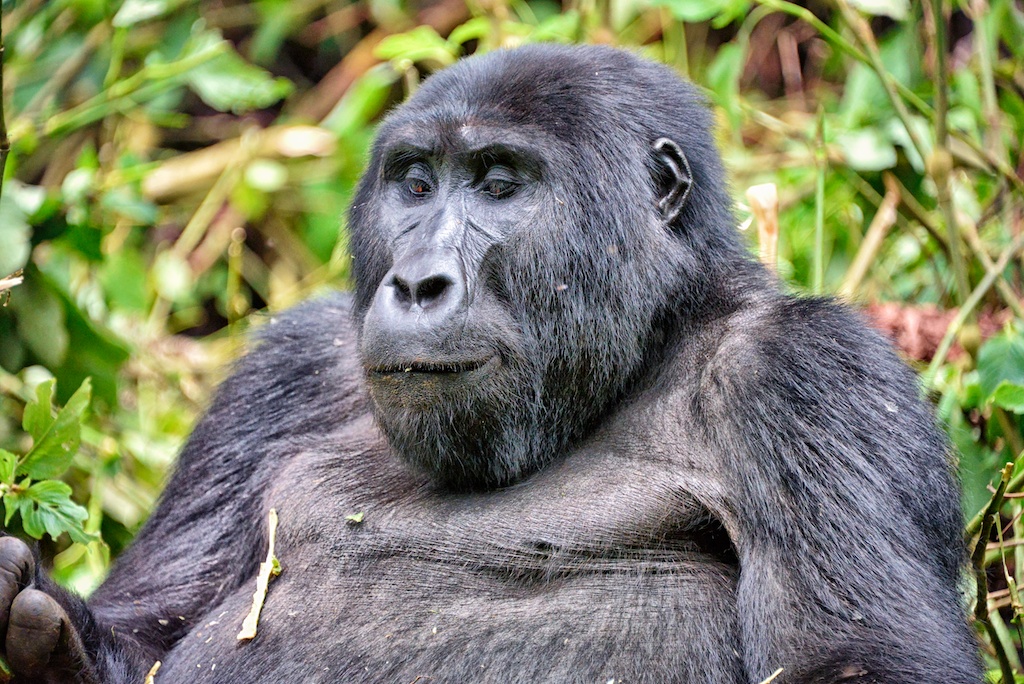
Mountain gorilla
The park’s signature species. Habituated groups are visited only under ranger guidance and strict viewing rules.
Chimpanzee
Present in Bwindi but much less predictable for visitors than gorillas. Calls and movement in the canopy may be the first clue. Freshness note: a UWA-supported 2025 census estimated about 426 chimpanzees across Bwindi, with results announced in February 2026.
L’Hoest’s monkey
A characteristic Albertine Rift forest primate, dark-coated with a pale throat and often seen moving low through dense forest.
Blue monkey
An arboreal forest monkey frequently associated with mature canopy and fruiting trees.
Red-tailed monkey
A small, active monkey identifiable by the reddish tail and contrasting facial markings.
Black-and-white colobus
Look high in the canopy for bold black-and-white coats and long white tail plumes.
Olive baboon
More likely around edges and access areas than deep forest. Keep food secured and never feed wildlife.
African elephant
Forest-dwelling elephants occur in Bwindi, but sightings on normal visitor routes are uncommon.
Bushpig
A nocturnal forest pig that roots through leaf litter and dense vegetation.
Giant forest hog
A very large dark forest pig; usually shy and far less commonly seen than primates.
Black-fronted duiker
A small forest antelope adapted to dense vegetation and wet forest floors.
Yellow-backed duiker
One of Africa’s larger duikers, named for the yellowish patch across the rear of its back.
African civet
Mostly nocturnal; tracks or camera-trap records are more likely than a daytime sighting.
Side-striped jackal
A shy canid associated more with forest edges and surrounding mosaics than dense interior forest.
African clawless otter
Associated with streams and wet habitats; sightings are uncommon but the park’s river network provides suitable habitat.
African golden cat
A secretive forest cat. Direct encounters are exceptional.
Birds to look for
UNESCO records 347+ forest bird species in Bwindi and highlights the park as one of the Albertine Rift’s most important bird sites. UWA lists more than 350 bird species and many Albertine Rift endemics.
African green broadbill
One of Bwindi’s headline birding targets and an Albertine Rift specialty.
Grauer’s swamp warbler
A threatened Albertine Rift bird associated with highland wet habitats.
Shelley’s crimsonwing
A rare, highly sought-after forest finch of the Albertine Rift.
Chapin’s flycatcher
A scarce montane forest flycatcher highlighted by UNESCO among Bwindi’s threatened birds.
Turner’s eremomela
A threatened canopy bird recorded in Bwindi’s rich forest avifauna.
Great blue turaco
A spectacular large forest bird; often easier to hear first and then locate in the canopy.
Black-billed turaco
A colorful forest turaco found in the region’s mature forests.
White-tailed blue flycatcher
An active montane forest bird often seen in mixed feeding flocks.
African emerald cuckoo
Bright green males are striking, but the call is often the easiest way to detect the species.
Yellow-eyed black flycatcher
A dark Albertine Rift montane flycatcher with a conspicuous pale-yellow eye.
Rwenzori turaco
An iconic Albertine Rift bird associated with montane forest.
Grey crowned crane
Uganda’s national bird is more associated with open wetlands and agricultural mosaics around the broader region than deep Bwindi forest.
Trees and signature plants
UNESCO describes Bwindi as exceptionally rich botanically, with 200+ tree species and about 104 fern species. These are useful names to recognize on guided forest walks.
Red stinkwood / African cherry
A large montane tree whose bark has long been valued medicinally.
Newtonia
A major canopy tree in parts of Bwindi’s mid-elevation forest.
Symphonia
A tropical forest canopy species with distinctive flowers and fruit.
East African yellowwood
Evergreen conifers associated with montane forest zones.
Hagenia
A highland tree recognizable by its spreading crown and large compound leaves.
Brown mahogany
A notable lower-elevation forest tree recorded from Bwindi’s northern flora.
Parinari
A dominant canopy tree in some lower-elevation parts of the forest.
Chrysophyllum
A montane canopy species important in higher parts of Bwindi.
Highland bamboo
Forms distinctive bamboo zones and provides seasonal food resources for forest wildlife.
Wild date palm
Associated with wetter riverine and swampy habitats.
Flowers, ferns and forest-floor plants
The forest’s plant diversity is much easier to appreciate when you look below the canopy. Exact species identification can be difficult, so use a local guide for precise IDs.
Forest balsams
Colorful moisture-loving flowers found in shady forest and streamside habitats.
Forest begonias
Shade-loving herbs that thrive in humid understory conditions.
Wild gingers
Large-leaved forest herbs with flowers close to the ground and aromatic fruits in some species.
Wild orchids
Both terrestrial and epiphytic orchids occur in the humid forest; many are easiest to notice when flowering.
Ferns
UNESCO records about 104 fern species, from small understory ferns to larger tree-fern forms.
Mosses
Moss-covered trunks, rocks and fallen logs are a defining visual feature of Bwindi’s wet forest.
Lichens
Common on bark and exposed surfaces in the cool, humid forest environment.
Myrianthus
A lower-canopy/understory forest plant with fruit used by wildlife.
Neoboutonia
A fast-growing forest tree frequently associated with disturbed gaps and regenerating areas.
Xymalos
A characteristic evergreen forest tree of East African montane habitats.
Things to do in and around Bwindi
1. Gorilla tracking
The signature experience. Your sector, permit and ranger briefing determine where the day starts.
2. Gorilla habituation experience
A different permit/product from standard tracking. Confirm current availability, sector and rules directly with UWA.
3. Guided forest walk
Best for seeing the forest as an ecosystem: trees, butterflies, monkeys, waterfalls and smaller wildlife.
4. Birding
Bwindi is one of Africa’s most important Albertine Rift birding sites. A specialist guide adds enormous value.
5. Waterfall / river walks
Selected guided trails reach streams and waterfalls through mature forest; trail options depend on your sector and current conditions.
6. Community experiences
Choose community-led visits with clear local benefit and follow guidance on photography and cultural etiquette.
Beyond gorillas
Bwindi is not simply a gorilla enclosure. UNESCO describes it as a major biodiversity hotspot, and UWA lists birding and guided nature walks among the park activities. If your schedule allows, an extra day gives the forest more room to be the destination rather than only the backdrop to a single trek.
Birding & forest walks
Especially worthwhile for travelers interested in Albertine Rift species and the forest itself.
Community experiences
Choose experiences with clear local participation and benefit-sharing, and follow local guidance around photography and respectful visits.
Rules that matter
Minimum age: 15
UWA’s published gorilla-tracking rules set a minimum age of 15 years.
Maximum 8 visitors
Standard gorilla groups are visited by no more than eight tourists at a time.
Keep your distance
Follow the ranger’s spacing instructions and never move closer to a gorilla because it appears calm.
No flash
Disable flash before the encounter. Keep camera and phone sounds low.
Do not trek when ill
Respiratory and other infectious illnesses can threaten gorillas. Tell the ranger team if you are unwell.
Follow the ranger
Terrain, gorilla movement and forest conditions change daily; ranger instructions override any online guide.
Frequently asked questions
How long does gorilla trekking in Bwindi take?
UWA says the activity may last roughly 2–7 hours. The actual time varies because gorillas move and trekking terrain differs from day to day.
How long can I stay with the gorillas?
Standard tracking allows up to one hour with the assigned habituated gorilla group, subject to ranger instructions and animal welfare considerations.
Which are the four Bwindi trekking sectors?
Buhoma, Ruhija, Rushaga and Nkuringo.
Can I stay in any Bwindi lodge regardless of my permit sector?
Technically you can stay where you choose, but it can create a very long or impractical morning transfer. Match your accommodation to the sector on your permit whenever possible.
Is Bwindi suitable for a self-drive trip?
It can be, but approach roads can be mountainous and unpaved. UWA recommends 4WD on several common routes. Road conditions can change after rain, so check locally before driving.
What is the minimum age for gorilla trekking?
UWA’s published gorilla tracking rules state a minimum age of 15 years.
How this guide was checked
See.Africa checks time-sensitive park information against first-party sources such as Uganda Wildlife Authority and UNESCO. Permit prices, access, trekking rules and map notes in this guide were reviewed on 12 August 2026. Approximate map points are for orientation only; UWA ranger instructions and current local road advice take priority.
Primary sources & live checks
This guide prioritizes first-party sources for rules, access and conservation information. Prices are especially time-sensitive.