
Kibale National Park Guide
The practical 2026 guide to Uganda’s premier chimpanzee forest: permits, best time, Kanyanchu treks, map, primates, birds, access and trip planning.
Kibale National Park at a glance
Kibale is Uganda’s flagship chimpanzee-tracking park and one of Africa’s richest primate forests. The official UWA brochure and management material put the protected area at about 795 km², with moist evergreen and semi-deciduous forest, swamp, grassland and regenerating woodland. UWA records 13 primate species, 71 mammal species, more than 370 bird species and roughly 350 tree species.
Source note: UWA’s older official brochure and management plan consistently state 795 km²; the current live park page displays a conflicting 321 km² figure. See.Africa uses 795 km² and flags the live-page discrepancy rather than presenting the newer number as settled.Best time to visit Kibale National Park
December to February and June to August are the easiest default periods for firmer forest trails and simpler road transfers. Kibale remains a rainforest destination: showers can occur in any month, trail mud is normal, and chimpanzees move according to food rather than a visitor calendar. March–May and September–November are generally wetter, greener and quieter.
Source context: rainfall timing checked against UWA’s Kibale brochure and recent official environmental material on 2 Sep 2026. Local storms and trail conditions can differ sharply from monthly averages.Easiest trekking
June–August and December–February usually offer firmer paths, but popular permits and lodges book earlier.
Lower permit months
UWA’s 2026 notice lists discounted foreign-visitor chimp permits in April, May and November. Those months are wetter and the discounted permits cannot be rescheduled.
Best for birders
Forest birding is productive year-round. Green-season activity can be excellent, but visibility, rain and trail noise vary daily.
Which Kibale area should you choose?
Kanyanchu is the best base for a first chimp trek, Sebitoli adds accessible northern forest, and Bigodi is the strongest community-run wetland complement outside the park. Research zones such as Kanyawara and Ngogo are not interchangeable with standard tourist tracking areas.
| Area | Best for | Main experience | Planning note |
|---|---|---|---|
| Kanyanchu | First chimp trek | UWA briefings, habituated chimp tracking, guided forest walks | Main tourist hub; choose a lodge that can manage your reporting time and permit logistics. |
| Sebitoli | Northern forest + birding | Regenerating and mature forest, primates, roadside access from Fort Portal | Activities and check-in arrangements can differ from Kanyanchu; confirm locally. |
| Bigodi Wetland | Community walk + birds | Papyrus, swamp edge, primates, turacos and village landscape | Community-managed and outside the national park; book with the local sanctuary. |
| Fort Portal / crater lakes | Arrival night + scenery | Town services, crater-lake drives, wider Tooro landscape | Useful circuit stop, but not a substitute for staying close to an early Kanyanchu departure. |
Kibale chimpanzee permits, sessions and 2026–27 changes
For standard visits in 2026, UWA lists Kibale chimpanzee tracking at USD 250 for foreign non-residents, USD 200 for foreign residents and UGX 180,000 for East African citizens. Kibale’s tracking price includes the guide and that day’s park entry. UWA’s 26 February 2026 notice introduced lower FNR/FR prices for April, May and November and announced a revised structure from 1 January 2027.
| Product / period | FNR | FR | Rest of Africa | EAC | What matters |
|---|---|---|---|---|---|
| Chimp tracking — standard 2026 | USD 250 | USD 200 | Confirm with UWA | UGX 180,000 | Guide and Kibale park entry included; permit required. |
| Low season — Apr, May, Nov 2026 | USD 200 | USD 150 | Not listed in notice | Not listed in notice | Effective immediately in UWA notice; low-season permits cannot be rescheduled. |
| Chimp habituation — 2026 | USD 300 | USD 250 | Confirm with UWA | UGX 250,000 | Longer experience; guide and park entry included. |
| Chimp tracking — from 1 Jan 2027 | USD 300 | USD 200 | USD 100 | UGX 180,000 | Published revised structure; confirm against your travel date. |
| Chimp habituation — from 1 Jan 2027 | USD 400 | USD 300 | USD 250 | UGX 250,000 | Published revised structure; advance booking essential. |
Current Kanyanchu tracking sessions
08:00
Classic morning departure. Reporting and briefing are earlier than the forest departure time shown.
11:00
Useful when morning logistics or permit allocation make the first session impractical.
14:00
Afternoon option; protect enough daylight and avoid planning a tight onward road transfer.
How to get to Kibale National Park
Road from Kampala
UWA’s live page gives approximately 326 km and six hours via the Kampala–Fort Portal highway. Traffic, stops, weather and your lodge location can push the day longer.
From Fort Portal
UWA describes the transfer to the park as roughly one hour. Sebitoli is nearer; Kanyanchu and Bigodi are farther south.
By scheduled air
UWA says there are no direct scheduled flights into Kibale. Kasese is the practical regional airfield, followed by an approximately two-hour road transfer.
By charter
UWA lists charter options to Fort Portal at about 1 hour 30 minutes, then a road transfer. Confirm runway, baggage and transfer details with the operator.
Kibale National Park map
This map shows the main visitor corridor and useful circuit points. Pins are approximate and not a navigation authority; park boundaries, trail access and road conditions must be confirmed locally.
How to plan a Kibale stay
One night
Only sensible with a secure permit, an early arrival and a lodge close to Kanyanchu. It leaves little weather or transfer margin.
Two nights
The best minimum: one chimp trek plus Bigodi, birding or a shorter guided forest experience.
Three nights
Best for photographers, birders and travellers adding habituation, a second forest morning or crater-lake time.
A strong two-night sequence
| Day | Morning | Afternoon | Key decision |
|---|---|---|---|
| Arrival | Travel via Fort Portal | Check in before dark; permit and gear check | Keep the road day separate from your trek. |
| Forest day | Kanyanchu chimp trek | Rest, Bigodi or a gentle bird walk | Do not overbook after a physically variable trek. |
| Departure | Birding, community activity or transfer | Continue toward Queen Elizabeth or Fort Portal | Build buffer for rain and road conditions. |
Mammals and primates of Kibale National Park
Kibale’s wildlife experience is about forest behaviour, sound and brief openings—not a savanna checklist. Chimpanzees are the principal draw, but red colobus, mangabeys, guerezas, forest antelopes and nocturnal primates create exceptional depth. Every species below is a possibility, not a promise.
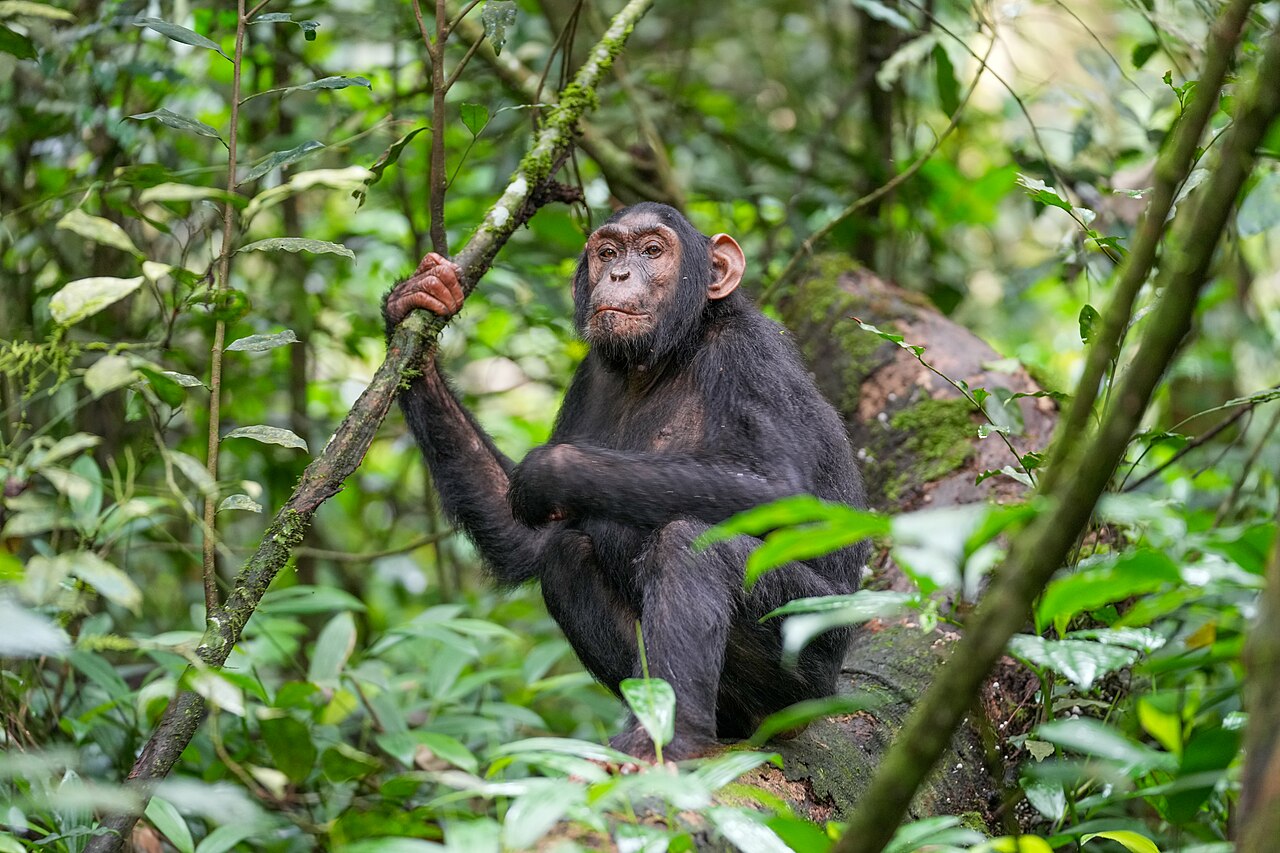
Eastern chimpanzee
Kibale’s headline species. Habituated communities are visited only with UWA guides; sightings and trek duration vary with the animals’ movements.
Ugandan red colobus
An endangered canopy specialist and one of Kibale’s most important primates. Look for agile groups feeding high in mature forest.
Uganda mangabey
A dark, long-limbed monkey closely associated with Uganda’s forests. Its loud calls may reveal a group before the animals are visible.
L’Hoest’s monkey
A handsome forest monkey with a white throat ruff. It often uses lower forest levels and can be easier to see near clearings.
Mantled guereza
The black-and-white colobus is conspicuous when it leaps between crowns; long white mantle hair makes adults easy to recognize.
Red-tailed monkey
A common mixed-forest monkey with a rusty tail and pale cheek markings, frequently encountered around Kanyanchu.
Blue monkey
Despite the name, its coat is mostly slate-grey. It favours forest canopy and often joins mixed primate feeding groups.
Vervet monkey
Most likely around woodland edges, open ground and human-modified habitat rather than deep closed forest.
Olive baboon
A terrestrial, adaptable primate often seen along access roads and forest margins. Never feed or approach habituated roadside troops.
Demidoff’s dwarf galago
A tiny nocturnal primate better detected by sound and eye-shine on a properly guided night walk.
Potto
A slow-moving nocturnal primate of dense vegetation. Sightings are uncommon and depend on skilled guiding after dark.
African forest elephant
Forest elephants and elephant populations with complex regional ancestry move through Kibale. Encounters are rare; give any elephant ample space.
African buffalo
Usually associated with grassland, swamp edges and forest openings. A buffalo on foot is potentially dangerous and must never be approached.
Giant forest hog
Africa’s largest wild pig occurs in forest and edge habitat. Quiet early-morning drives or walks offer the best chance.
Bushpig
A mostly nocturnal forest-edge pig that roots through leaf litter and dense cover; tracks are seen more often than the animal.
Harnessed bushbuck
A shy, striped antelope of forest margins and thickets, sometimes seen at dawn in grassy openings.
Blue duiker
A very small forest antelope that slips through thick understory. Brief path crossings are more typical than prolonged views.
African golden cat
A secretive forest cat recorded in Kibale but rarely seen by visitors. Treat it as a conservation highlight, not an expected sighting.
Birds to know in Kibale
Kibale is a sound-first birding destination with more than 370 recorded species. The forest floor, canopy, edges and nearby wetlands hold different communities. A specialist local guide is especially valuable for pittas and quiet undergrowth birds.
Green-breasted pitta
A prized forest-floor bird. Local calls and a specialist guide matter far more than walking quickly through the forest.
African pitta
A colourful seasonal forest visitor and one of Kibale’s most sought-after birds; timing and recent local records are essential.
Great blue turaco
A huge canopy bird with a resonant call, often seen gliding heavily across gaps and fruiting trees.
African grey parrot
Fast, vocal flocks may pass high overhead. The species is globally threatened by habitat loss and illegal trade.
Black bee-eater
A sleek forest bee-eater with a scarlet throat, typically watched from clearings, tracks and canopy gaps.
Crowned eagle
A powerful forest raptor whose ringing calls often carry farther than the bird can be seen.
Blue-breasted kingfisher
A rich-blue forest kingfisher that often hunts away from open water from shaded perches.
Yellow-rumped tinkerbird
A small barbet whose repetitive call is a characteristic sound of fruiting forest.
Red-faced woodland warbler
An Albertine Rift-region speciality best searched for in active canopy and mid-storey feeding parties.
Dusky crimsonwing
A shy undergrowth finch of montane and highland forest; sightings in the wider region are always special.
Eastern nicator
A skulking green-and-yellow forest bird more often detected by its emphatic voice than by sight.
African blue flycatcher
A graceful blue forest-edge bird that sallies for insects and often travels with mixed feeding flocks.
Trees, wetland plants and understory
Kibale’s biological richness depends on its habitat mosaic: mature high forest, logged and regenerating forest, swamp, grassland and community-managed wetland on the edge. These cards are recognition cues, not a complete botanical checklist.
Prunus africana
A conservation-important evergreen tree whose bark has been heavily exploited elsewhere; mature specimens belong to Kibale’s high-canopy forest.
Parinari excelsa
A major mature-forest tree, especially in northern sectors such as Sebitoli.
Piptadeniastrum africanum
A towering emergent capable of rising above the main canopy and anchoring mature forest structure.
Newtonia buchananii
A large leguminous forest tree contributing broad crowns and wildlife feeding habitat.
Ficus trees
Figs are ecological keystones because different species fruit at different times, feeding primates, hornbills and turacos.
Celtis trees
Common components of semi-deciduous forest and an important source of fruit and cover.
Olea welwitschii
A tall African olive of moist forest, often associated with older forest stands.
Albizia trees
Light-crowned legumes frequent in gaps, secondary forest and edges; flowers attract insects and birds.
Markhamia
Trumpet-flowered trees and shrubs of forest edge and regenerating habitat.
Aframomum
Ginger-family herbs forming dense patches in forest gaps; fruits and cover are used by several mammals.
Forest ferns
Shade-loving ferns occupy damp banks, stream edges and the humid understory.
Lianas and epiphytes
Climbers and plants growing on trunks connect forest layers and create nesting, feeding and hiding places.
Papyrus
A signature plant of the community-managed Bigodi wetland outside the park boundary.
Elephant grass
Tall grass of disturbed edges and open areas, creating dense cover for buffalo, bushbuck and smaller wildlife.
Forest-edge sedges
Sedges occupy swamp margins and wet hollows, supporting insects, frogs and specialist birds.
Seasonal wildflowers
Short-lived flowers become conspicuous in openings after rain; composition varies sharply with site and season.
Best experiences in and around Kibale
1. Chimpanzee tracking
Join a scheduled UWA trek from Kanyanchu for a guided search and controlled viewing period with a habituated community.
2. Chimpanzee habituation
Choose the longer experience when behaviour and photography matter more than a compact safari schedule; permits are limited.
3. Bigodi wetland walk
Add a community-run walk for turacos, monkeys, papyrus habitat and village-edge conservation outside the park.
4. Specialist birding
Target forest-floor, canopy and edge birds separately, using current local knowledge for pittas and other seasonal specialities.
5. Guided forest walk
Slow down for trees, insects, tracks, calls and smaller primates that disappear when every outing is treated as a chimp race.
6. Nocturnal walk
Where currently offered, guided night activity can reveal galagos, potto, insects and forest sounds. Confirm the present schedule.
7. Fort Portal crater lakes
Use an extra half day for the rolling crater-lake landscape and Tooro foothills rather than squeezing it into trek morning.
8. Western Uganda circuit
Continue to Queen Elizabeth, Bwindi or north toward Murchison Falls.
Rules and safety points that matter
Follow the age rule
UWA’s live page states a minimum age of 16 for chimpanzee tracking. Confirm the rule before buying family travel arrangements.
Do not trek when ill
Chimpanzees are vulnerable to human respiratory disease. Report symptoms honestly and follow UWA’s current health instructions.
Keep the instructed distance
Your ranger’s live briefing overrides any number remembered from an old article. Never crowd, surround or block a chimpanzee.
No flash or loud playback
Use quiet camera settings and follow photography rules. Avoid flash, food and sudden movement around primates.
Stay with the ranger
Forest elephants, buffalo, steep ground and poor visibility make independent walking unsafe and generally unauthorized.
Prepare for mud and rain
Move at the guide’s pace, use secure footwear and protect electronics. A porter can make the trek safer and more comfortable.
Kibale National Park FAQ
What is Kibale National Park famous for?
Kibale is famous for chimpanzee tracking and its exceptional primate diversity. UWA records 13 primate species, while the wider forest mosaic also supports hundreds of bird species.
What is the best time to visit Kibale National Park?
Kibale is open year-round, but December to February and June to August are the easiest default periods for forest walking. March to May and September to November are wetter and greener.
How many days do you need in Kibale National Park?
Two nights is the practical minimum for one chimpanzee trek and a second activity such as Bigodi, birding or a forest walk. Three nights gives useful weather and wildlife flexibility.
How much is chimpanzee tracking in Kibale in 2026?
UWA’s tariff lists USD 250 for foreign non-residents, USD 200 for foreign residents and UGX 180,000 for East African citizens in 2026. A special April, May and November rate lists USD 200 and USD 150 for the two foreign categories.
When do Kibale chimpanzee treks start?
UWA’s live Kibale page lists Kanyanchu departures at 08:00, 11:00 and 14:00. Arrival and briefing times may be earlier, so confirm the exact reporting time on your permit.
What is the minimum age for chimpanzee tracking in Kibale?
UWA’s live Kibale page states a minimum age of 16 years. Confirm the rule before booking because permit conditions can change.
Can you fly to Kibale National Park?
There are no direct scheduled flights into Kibale. UWA says travellers can fly to Kasese and continue by road for about two hours, or use a charter to Fort Portal and transfer by road.
How this guide was checked
See.Africa reviewed time-sensitive information on 2 September 2026 against Uganda Wildlife Authority’s live Kibale page, conservation tariff material, the 26 February 2026 tariff notice, the official Kibale brochure, management material and recent UWA environmental publications. Approximate map points are for orientation only; UWA, ranger and local operator instructions override this guide.