
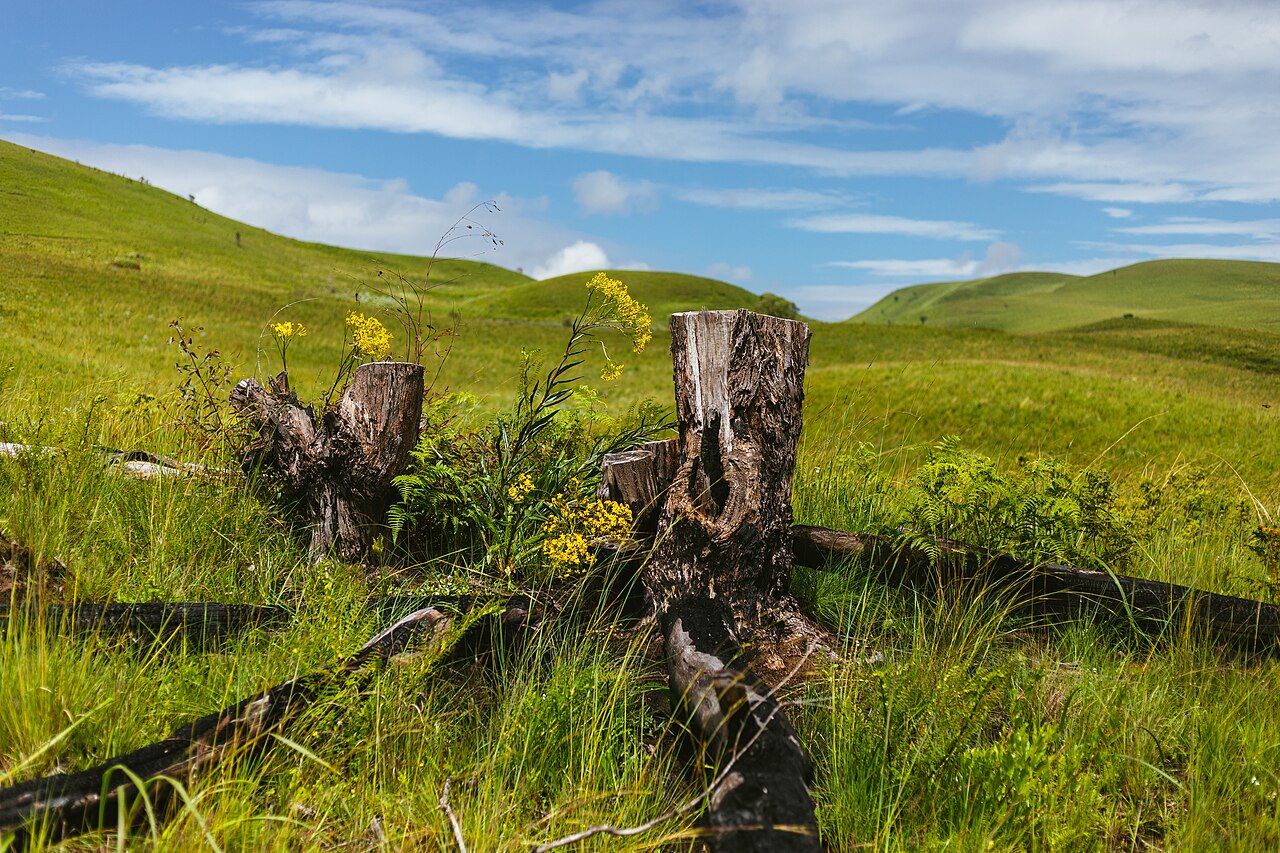
Kitulo National Park Guide
Kitulo is Tanzania’s high-altitude “Garden of God”: a montane grassland park where the main safari is on foot, among orchids, wildflowers, misty ridges, waterfalls and rare highland birds. This 2026 guide focuses on flower timing, hiking, access, map orientation and the wildlife that actually fits this unusual park.
Information checked 6 September 2026Kitulo National Park at a glance
Kitulo protects one of Tanzania’s most important montane grassland and floral communities at roughly 2,600 m in the Southern Highlands. TANAPA’s 2024 general brochure gives the park as 413 km² and says it became a national park in 2005; a newer 2026 TANAPA feature again emphasizes the wet-season flower spectacle from November to April.
Sources: TANAPA general brochure 2024, Kitulo pp. 14–15 · TANAPA Tourism Splash 2026Quick Answers
For a southern-circuit contrast, compare Kitulo with our Ruaha National Park guide and the forest-heavy Udzungwa Mountains guide. Browse all National Park Guides.
What is the best time to visit Kitulo?
December to April is the main flower window. TANAPA’s 2024 brochure says flowers carpet the plateau in this period. It also warns that May–August often brings mist and cloud that can reduce visibility, while September–November tends to bring clearer mountain views before the main flower display builds.
Source: TANAPA 2024 brochure, pp. 14–15Best for orchids and mass flowering; wetter roads and short-notice weather shifts are the trade-off.
Cooler, often misty/cloudy. Strong atmosphere, but less reliable long-range views.
Often the clearest mountain-view period; ideal for hiking if flowers are secondary.
How much is Kitulo National Park entry in 2026?
Use TANAPA’s live tariff portal before paying. The portal currently lists Kitulo but does not expose a clearly extractable current figure in its public summary. The last explicit official tariff PDF we can verify is the 2023/24 schedule, which listed Kitulo under “other parks” at US$30 for non-resident adults and US$10 for children aged 5–15. Those figures are useful historical context, not a guaranteed 2026 price.
Sources: TANAPA live tariff portal · TANAPA 2023/24 tariff PDFWhich parts of Kitulo matter most?
| Area | Best for | Planning note |
|---|---|---|
| Matamba / HQ approach | Arrival logistics, park contact, basic services and route checks. | Use as the practical road-access anchor. |
| Central Kitulo Plateau | Main grassland flower spectacle, walking and broad views. | Go slowly: many orchids/flowers are small and close to the ground. |
| Nhumbe Valley | Waterfall, viewpoint and hiking. | TANAPA cites a ~100 m waterfall; conditions can be wet/slippery. |
| Mtorwi sector | Summit hiking and floral change with altitude. | TANAPA gives 2,961 m; public mapping sources vary on elevation, so use ranger guidance. |
| Dhambwe crater-lake sector | Waterbirds, bamboo and a shorter walk. | Older official Kitulo material describes a ~3 km trail from the Kimodo–Kikondo road. |
| Livingstone Forest | Kipunji habitat, forest ecology and birding. | Forest wildlife is shy; this is not a guaranteed primate encounter. |
How do you get to Kitulo National Park?
The classic approach is from Mbeya via Chimala and Matamba. TANAPA’s 2024 brochure says Chimala is about 78 km from Mbeya, followed by roughly 42 km of gravel road to Matamba via the famous “Hamsini na Saba” hairpin climb; it then describes the park itself as about 11 km beyond Matamba. Scheduled flights reach Mbeya, but onward ground transport is required.
Source: TANAPA 2024 brochure, Getting thereMain paved approach before turning toward the escarpment and Matamba.
Mountain/gravel approach with many hairpins. Reconfirm wet-season road condition locally.
TANAPA notes another approach via Isyonje from the Mbeya–Tukuyu road.
Kitulo National Park map
This map distinguishes verified public map points from approximate planning zones. Exact public coordinates are used for Nhumbe waterfall/viewpoint, Bamboo Viewpoint, Matamba, Kitulo HQ, Mtorwi, Kitulo National Park’s mapped centre and several nearby localities. Dhambwe and some habitat/flower zones remain broad because reliable visitor-grade public coordinates are weak.
Map references: Nhumbe waterfall / OSM · Nhumbe viewpoint / OSM · Bamboo Viewpoint / OSM · Kitulo HQ / OSM · Mtorwi / GeoNames-OSMHow should you use one full day in Kitulo?
Start with the central plateau while light is soft and wind is usually calmer; spend time looking down, not only across the landscape.
Move toward the Nhumbe viewpoint/waterfall if conditions allow. Carry rain protection and footwear with grip.
Use HQ/vehicle support rather than assuming the exposed plateau will stay dry and wind-free.
Scan grassland and wet areas for bustards, cisticolas, swallows and seasonal migrants.
Only add a summit-style hike if time, weather, route knowledge and ranger advice genuinely support it.
Leave margin for slow mountain roads, rain, fog and photography stops.
12 mammals to know in Kitulo
Kitulo is not a big-game-density park. TANAPA highlights zebra and antelope, while WCS documents the zebra reintroduction and the endangered kipunji in Livingstone Forest. Treat sightings as a bonus to the botanical landscape.
Sources: TANAPA 2024 brochure · WCS zebra reintroduction · WCS KipunjiPlains zebra
Reintroduced
WCS, TANAPA and TAWIRI returned zebra to Kitulo in October 2018 after decades of absence.
Southern reedbuck
WCS reported the species recovering in Kitulo’s grasslands before the zebra reintroduction.
Steenbok
Another grassland antelope WCS reported increasing in the restored highland system.
Common eland
Historically associated with Kitulo’s open grassland; sightings are much less predictable than in major savanna parks.
Common duiker
More likely around cover and forest/grassland edges than on the most exposed plateau.
Abbott’s duiker
Rare forest specialist
Associated with the Livingstone Forest/Mount Rungwe highland forest complex.
Kipunji
Endangered
Rare canopy-dwelling primate of the Livingstone Mountains within Kitulo and nearby Mt Rungwe; not a routine tourist sighting.
Rungwe dwarf galago
Tiny nocturnal forest primate reported from the Livingstone Forest highlands; identification is specialist territory.
Side-striped jackal
Elusive generalist of open/edge habitat; more likely at quiet hours than during busy midday walks.
Slender mongoose
Small, quick carnivore of grassland and scrub edges.
African civet
Nocturnal and secretive; tracks and droppings may be more realistic evidence than a daylight sighting.
Cape porcupine
Mainly nocturnal; look for quills and feeding signs around quieter forest/grassland edges.
12 birds worth learning before Kitulo
Kitulo’s birding is about highland specialists and grassland birds rather than huge species totals. TANAPA specifically names Denham’s bustard, blue swallow, mountain marsh widowbird, Njombe cisticola and Kipengere seedeater. Avibase’s current Kitulo checklist records 81 species.
Sources: TANAPA 2024 brochure · Avibase Kitulo checklist (Clements 2025)Denham’s bustard
Near Threatened
Large grassland bird; scan open ridges and plateaus at distance.
Blue swallow
Highland grassland specialist associated with wet-season conditions.
Njombe cisticola
Southern highland specialist; voice is often more useful than plumage at distance.
Kipengere seedeater
Range-restricted highland finch associated with the Kipengere/Livingstone landscape.
Mountain marsh widowbird
Wet grassland bird best sought around marshier plateau habitat.
Red-winged francolin
Grassland francolin often detected by call before it is seen.
Yellow-billed duck
One of the waterfowl recorded on the Kitulo checklist; Dhambwe/wet areas are logical habitat.
Red-knobbed coot
Another water-associated species on the current checklist.
Lanner falcon
Watch ridge lines and open sky for this powerful falcon.
White-necked raven
Characteristic highland corvid around cliffs and ridges.
Red-backed shrike
Palearctic migrant; seasonal timing matters.
Scarce swift
Fast aerial species on the current Kitulo checklist; best identified carefully in mixed swift groups.
20 Kitulo plants and flower groups to know
Flora is the reason Kitulo exists. TANAPA states that the park supports 350+ plant species and roughly 45 terrestrial orchids. Its 2026 feature specifically mentions geraniums, asters, orchids and the scented Disa fragrans, while older park material emphasizes bamboo forest around Dhambwe and the montane grassland community.
Sources: TANAPA 2024 brochure · TANAPA 2026 feature · TANAPA Kitulo brochureA scented terrestrial orchid TANAPA’s 2026 feature says is typically spotted in March.
Bright ground orchids are part of Kitulo’s signature wet-season display.
Terrestrial orchid genus well represented in southern African highland grasslands.
Ground orchids with often intricate green/white flowers; identification usually requires close floral detail.
Red-hot pokers provide strong orange/yellow flower spikes in the highland grassland.
TANAPA’s 2026 feature explicitly mentions geraniums among the plateau flowers.
A major component of the low, colorful wildflower carpet.
Woody flowering shrubs of highland grassland and rocky slopes.
Succulent rosettes and flower spikes occur in suitable exposed highland sites.
Showy corm-forming flowers of montane grassland.
Highland lobelias add structural variety to wetter grassland and forest-edge habitats.
Balsams favor moist microhabitats and forest edges.
Everlasting-type flowers common in African montane environments.
Small succulents adapted to rocky, exposed ground.
Heath-family shrubs associated with higher, cooler montane habitats.
Mountain bamboo forming dense stands near forest transitions; older TANAPA material notes bamboo on the Dhambwe trail.
East African juniper associated with montane forest patches in the wider Kitulo highlands.
Large Afromontane tree of cool highland forest.
Yellow-flowered St John’s wort relatives common in East African montane vegetation.
Sedges become important in wet grassland, seep and crater-lake margins.
Best things to do in Kitulo
The defining experience from December–April. A knowledgeable guide dramatically improves plant identification.
TANAPA highlights a waterfall of about 100 m in the park; combine it with the nearby viewpoint.
A higher-effort summit objective on the eastern side of the park; TANAPA gives 2,961 m.
Older official park material describes a roughly 3 km walking trail through bamboo toward this small volcanic lake.
Target Denham’s bustard, blue swallow, Njombe cisticola and highland seedeaters.
Use mist, low cloud, flowers and rolling ridges rather than expecting classic safari subjects.
What rules matter most at Kitulo?
Protect the plants first. Stay on approved routes, do not pick or uproot flowers, avoid trampling wet orchid-rich ground, pack out rubbish and follow ranger instructions for hiking. TANAPA’s general park guidance also prohibits off-road driving unless specifically permitted and restricts drone use without prior authorization.
Sources: TANAPA Plan a Trip · TANAPA Guidelines & ProceduresKitulo National Park FAQ
What is Kitulo National Park famous for?
Its high-altitude wildflower and terrestrial-orchid displays. TANAPA says the park has more than 350 plant species and around 45 terrestrial orchid varieties.
When is flower season in Kitulo?
The main display is December to April according to TANAPA’s 2024 brochure; TANAPA’s 2026 feature describes the wider wet-season flowering period as November to April.
How do you get to Kitulo from Mbeya?
The standard road route runs via Chimala and Matamba. TANAPA describes Chimala as about 78 km from Mbeya, then about 42 km of mountain/gravel road to Matamba, with the park beyond.
Can you see zebras in Kitulo?
Yes. WCS, TANAPA and TAWIRI reintroduced zebras to Kitulo in 2018 after they had been absent for decades.
Is Kitulo good for birding?
Yes, especially for highland grassland species such as Denham’s bustard, blue swallow, Njombe cisticola and Kipengere seedeater.
What is the best hike in Kitulo?
Nhumbe waterfall/viewpoint is the easiest signature hiking objective to plan around. Mtorwi is a bigger summit-style option and should be arranged with current local guidance.
What is the Kitulo entrance fee?
Check TANAPA’s live tariff portal. The last clearly verifiable official PDF figure is from 2023/24, so this guide does not present it as a guaranteed 2026 rate.
Can Kitulo be visited as a day trip?
Yes from Mbeya with an early start, but staying near Matamba gives more flexibility for weather, flower walks and hiking.
How this Kitulo guide was checked
This guide cites source pages beside the claims they support. Current flower-season context comes from TANAPA’s 2026 Tourism Splash; core park facts, access and activities come from TANAPA’s 2024 general brochure; Dhambwe/Mtorwi detail comes from Kitulo-specific TANAPA material; zebra and kipunji details are supported by WCS; bird profiles are checked against Avibase. Approximate map zones are labelled as broad planning areas, not navigation-grade positions.