
Mikumi National Park Guide
Mkata Floodplain wildlife, easy Dar es Salaam access and classic southern-Tanzania safari. This 2026 guide covers the best time, current TANAPA fee guidance, Kikoboga airstrip, safari areas, a detailed map, mammals, birds and practical day planning.
Information checked 6 September 2026
Mikumi National Park at a glance
Mikumi National Park is one of Tanzania’s easiest major savannah parks to reach by road from Dar es Salaam. TANAPA currently describes a 3,230+ km² landscape centered on the Mkata Floodplain, where elephants, lions, buffalo, zebra, giraffe and other big game are often visible in open country. The park also forms part of the wider southern Tanzania ecosystem connected toward Nyerere.
Quick Answers
For a larger southern-Tanzania trip, continue with the Nyerere National Park guide and Ruaha National Park guide. For country planning, see the Tanzania travel guide or browse all National Park Guides.
What is the best time to visit Mikumi National Park?
June to October is the easiest recommendation for a first wildlife-focused visit. Dry conditions thin the vegetation and concentrate animals around the Mkata River, pools and seasonal water. November–February brings greener scenery and strong birding. March–May is wetter, so track conditions deserve more attention.
June–October: easier scanning across the floodplain and more dependence on reliable water.
Green-season months bring richer wetland activity, insects and seasonal visitors.
Dry season is the simplest choice when you have only one full game-drive day.
How much does Mikumi National Park cost?
TANAPA’s current Mikumi page displays US$50 for international adults, US$15 for international children and TZS 10,000 for East African residents—but explicitly labels these figures illustrative. Treat them as planning indicators only. Vehicle, accommodation, camping, guiding and activity charges may be separate.
Which Mikumi safari area should you choose?
| Area | Best for | Main access | Planning note |
|---|---|---|---|
| Mkata Floodplain | First visit, lions, elephants, buffalo, zebra | Kikoboga/HQ circuits | Open visibility and the strongest all-round introduction to Mikumi. |
| Hippo Pool + Mwanambogo | Water-dependent wildlife, hippos, birds | Northern visitor circuit | Especially useful as conditions dry and wildlife concentrates near water. |
| Vuma Hills + woodland | Scenery, woodland species, quieter driving | South/east of HQ | Useful contrast with the open floodplain and good for slower scanning. |
| Deeper southern Mikumi | Lower traffic, wilderness, miombo | Longer internal drives | Better suited to multi-night visits; conditions and access should be checked locally. |
How do you get to Mikumi National Park?
Road access from Dar es Salaam via Morogoro is Mikumi’s defining advantage. TANAPA currently gives a broad 3–5 hour road estimate from Dar depending on traffic. The park also has Kikoboga/Mikumi Airstrip for scheduled or charter flights.
Leave early, allow traffic margin and avoid planning your first game drive around an aggressive arrival time.
Mikumi is a natural short-safari extension from Morogoro and a useful staging point for southern-Tanzania routes.
Kikoboga/Mikumi Airstrip sits near the main visitor zone. Confirm flight schedules and lodge transfers before booking.
Mikumi National Park map
This map prioritizes the Mkata visitor zone while still showing how the park extends into hill and woodland country. Exact public coordinates are used where reasonably verified. Points taken from older official visitor maps or general mapping context are explicitly marked approximate and are not navigation-grade.
How should you plan one day in Mikumi?
Start in open floodplain country while lions and hyenas are more active and grazing herds are easy to scan.
Work toward Hippo Pool and Mwanambogo-type water points for hippos, elephants, buffalo and wetland birds.
Use an authorized picnic, lodge or rest area and avoid burning time repeatedly circling the same busy sighting.
Shift habitat to woodland and hill edges for giraffe, kudu, sable and different birdlife.
Return toward productive plains with enough margin for the current gate close—TANAPA currently says typically 18:00.
Screenshot the map, save accommodation contacts, carry water and power, and ask locally which tracks are currently usable.
22 mammals to know in Mikumi National Park
Mikumi’s strength is accessible, classic big game plus several southern woodland specialties. The Mkata plains favor easy viewing; sable, kudu and other woodland animals can demand more patience.
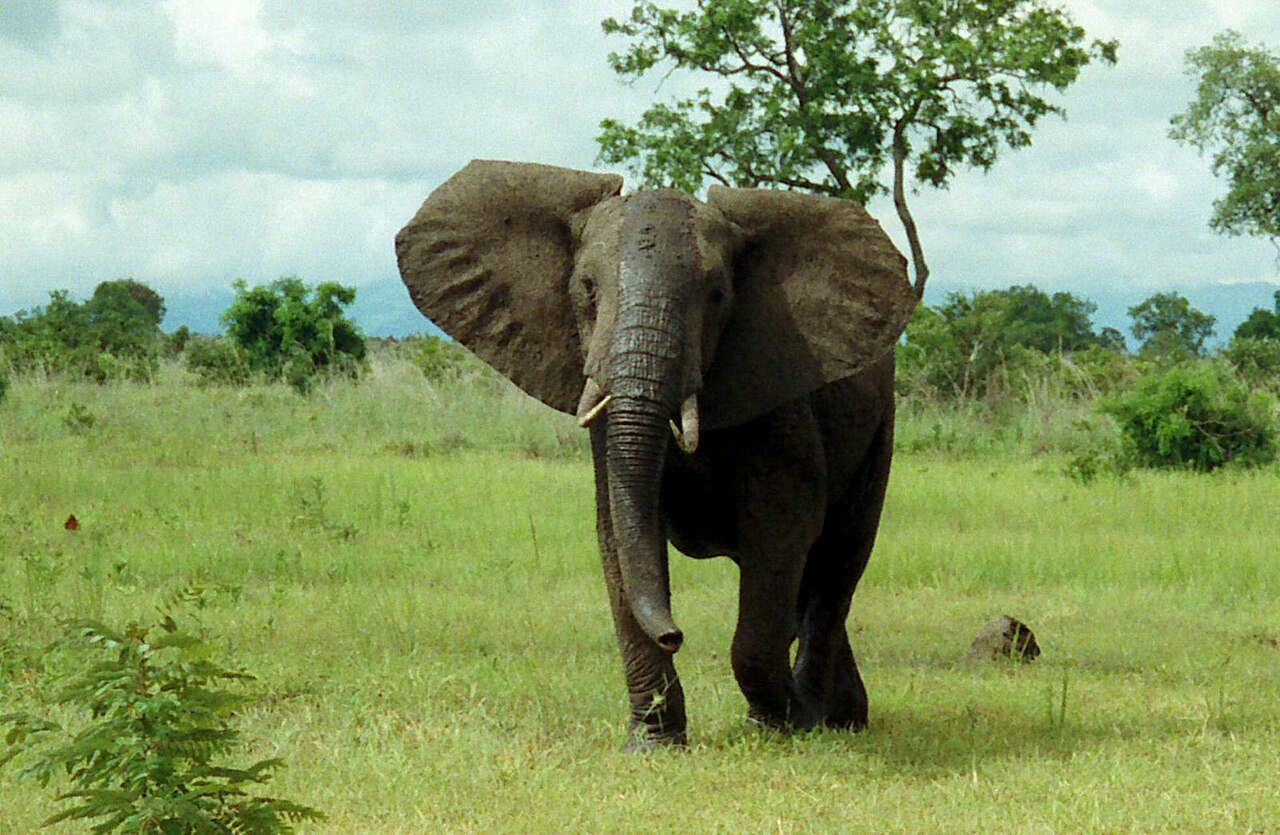
African bush elephant
Very good chance
Where: Mkata plains, waterholes and woodland edges. ID: huge ears, trunk, tusks and columnar legs. Behavior: family herds often move between shade and water; give them generous road space.
Lion
Good chance
Where: floodplain, shade lines and prey-rich open ground. ID: tawny cats; adult males may carry full manes. Behavior: often inactive in midday heat, making dawn and late afternoon more productive.
African buffalo
Very good chance
Where: floodplain grass and dependable water. ID: dark heavy body and broad horn bosses in mature animals. Behavior: large herds may bunch tightly near water in dry conditions.
Masai giraffe
Very good chance
Where: acacia woodland and open savanna. ID: tall browser with irregular star-like patches. Behavior: feeds above the browse line and is often visible from a long distance.
Plains zebra
Very good chance
Where: open Mkata grassland. ID: bold black-and-white stripes. Behavior: commonly mixes with wildebeest and other grazers.
Blue wildebeest
Good chance
Where: open grazing areas and floodplain. ID: sloping back, beard and dark vertical flank stripes. Behavior: uses open country and often associates with zebra.
Hippopotamus
Excellent at pools
Where: Hippo Pool and permanent water. ID: barrel body with eyes and nostrils high on the head. Behavior: spends hot daylight hours in water and grazes mostly after dark.
Leopard
Possible
Where: riverine cover and woodland. ID: rosette-pattern coat and long tail. Behavior: solitary and secretive; scan large branches and dense cover carefully.
Cheetah
Uncommon
Where: open plains with long sight lines. ID: slim build, small head and black tear lines. Behavior: hunts mainly by day and avoids dense woodland.
African wild dog
Rare / rewarding
Where: wide-ranging woodland and corridor habitat. ID: mottled coat, large rounded ears and white-tipped tail on many animals. Behavior: packs cover large distances, so sightings are never predictable.
Common eland
Possible
Where: open woodland and plains. ID: enormous antelope with straight spiral horns and a heavy neck. Behavior: surprisingly mobile despite its size.
Sable antelope
Woodland specialty
Where: wooded country beyond the easiest Mkata circuits. ID: long swept-back horns, strong facial markings and dark adult males. Behavior: usually in small herds.
Greater kudu
Woodland specialty
Where: thickets and broken woodland. ID: vertical white body stripes; males carry long spiral horns. Behavior: shy browser that can disappear quickly into cover.
Lichtenstein’s hartebeest
Possible
Where: woodland-edge and open grassy habitat. ID: high shoulders, long face and curved horns. Behavior: often stands alert in open country.
Defassa waterbuck
Good near water
Where: pools, floodplain edges and greener drainage. ID: shaggy grey-brown coat and white rump patch. Behavior: tends to remain close to reliable water.
Impala
Common
Where: woodland edges and mixed bush. ID: reddish-tan body, black rump marks and lyre-shaped horns on males. Behavior: herds become visibly alert around predators.
Common warthog
Common
Where: short grass and open track margins. ID: facial warts, curved tusks and upright tail when running. Behavior: often kneels on front legs while grazing.
Yellow baboon
Common
Where: woodland, road edges and around the visitor zone. ID: yellow-brown coat and long muzzle. Behavior: large troops forage widely; never feed or encourage animals near vehicles.
Vervet monkey
Common
Where: tree-rich areas around water and camps. ID: grey body with black face framed by pale fur. Behavior: highly social and opportunistic around food.
Spotted hyena
Possible to good
Where: open ground, predator activity and carcass sites. ID: sloping back, rounded ears and spotted coat. Behavior: active at dawn, dusk and night; calls often reveal them first.
Black-backed jackal
Possible
Where: open savanna and floodplain margins. ID: small canid with dark saddle across the back. Behavior: opportunistic hunter and scavenger often seen moving alone or in pairs.
Bushbuck
Possible
Where: riverine thickets and dense cover. ID: compact antelope with variable pale spots/stripes. Behavior: solitary and quick to retreat into vegetation.
12 Mikumi birds worth learning
Mikumi is a strong beginner birding park because open plains, acacia woodland and seasonal pans put very different species close together. TANAPA currently gives an approximate total of 400+ species.
Lilac-breasted roller
Where: exposed perches in open woodland. Brilliant lilac and turquoise plumage makes this one of the easiest safari birds to recognize.
Bateleur
Where: soaring over plains and woodland. Look for very short tail, broad wings and rocking flight.
Yellow-throated longclaw
Where: open grassland, especially damp or productive areas. Yellow throat and breast are striking at close range.
Black-bellied bustard
Where: tall grass and open savanna. Usually detected walking slowly through grass rather than flying.
Southern ground hornbill
Where: open woodland. Huge black terrestrial hornbill often travels in family groups.
Helmeted guineafowl
Where: roadsides and open bush. Noisy flocks with spotted bodies and bare blue heads are hard to miss.
Marabou stork
Where: wetlands, carrion sites and thermals. Giant stork with bare head and heavy bill.
Red-billed oxpecker
Where: on buffalo, giraffe and other large mammals. Watch for small birds clinging directly to hosts.
African fish eagle
Where: larger pools and watercourses. Adults have white head and chestnut body; ringing calls carry far.
Saddle-billed stork
Where: shallow wetlands and pans. Towering black-and-white stork with a red-and-black bill.
African jacana
Where: floating vegetation at pools. Extra-long toes let it walk across lily pads.
White-headed buffalo weaver
Where: dry acacia woodland. Bold white head, dark wings and orange-red rump stand out in social groups.
Flora: floodplain, acacia woodland and miombo
Mikumi’s vegetation changes from seasonally flooded grassland and riverine habitat to dry woodland and hill vegetation. These are field-recognition cues, not a definitive botanical checklist.
Trees & shrubs
Classic flat-crowned savanna tree used by giraffes and many birds.
Massive trunk and sparse crown; scattered in suitable dry woodland.
Large shade tree historically noted in Mikumi vegetation descriptions.
Fan palm associated with parts of the Mikumi landscape and the origin of the local name.
Fan-leaved palm associated with better-watered drainage and floodplain environments.
Common dry-woodland component in southern Tanzanian safari country.
Frequent in mixed woodland and transition areas.
Water-associated tree recognizable by its heavy hanging fruits.
Moist drainage lines and richer soils; fruit can attract birds and primates.
Drought-tolerant woody plants of drier bush and woodland.
Flowers, grasses, reeds & understory plants
Important savanna grazing grass with reddish mature seed heads.
Tall seasonal grasses common in savanna and disturbed areas.
Productive grazing grasses in better-watered floodplain habitats.
Margins of seasonal pans, pools and wet depressions.
Dense cover along permanent and semi-permanent water.
Floating leaves and flowers in suitable quiet pools.
Appear quickly after rain across disturbed ground and grassland edges.
Seasonally flowering herbs and shrubs within the Malvaceae family.
Succulent rosettes in rocky or dry habitats, with conspicuous flower spikes when in bloom.
Higher Malundwe-type mountain habitat supports a very different flora from the Mkata plains.
Best things to do in Mikumi National Park
Use the Mkata Floodplain as the wildlife anchor, then vary habitat rather than circling only the busiest sightings.
TANAPA currently lists guided walks in designated areas. Confirm availability, eligibility and start time in advance.
Combine seasonal pans, open grassland and acacia woodland for rapid habitat turnover.
A useful water-focused stop for hippos, wetland birds and animals coming to drink.
Mikumi’s open plains and mountain backdrops work well for environmental wildlife images.
Continue toward Nyerere or Ruaha for a deeper multi-park Tanzania itinerary.
What rules matter most in Mikumi?
Current TANAPA and ranger instructions always override a saved itinerary. Stay on permitted tracks, leave the vehicle only in authorized places, never feed wildlife and give elephants and buffalo plenty of space. Walking safaris must use the authorized guided arrangements specified by TANAPA.
Mikumi National Park FAQ
Is Mikumi National Park worth visiting?
Yes. Mikumi is especially useful for travelers who want a classic big-game safari that is relatively easy to reach by road from Dar es Salaam or Morogoro.
What is Mikumi National Park famous for?
Mikumi is best known for the Mkata Floodplain, accessible sightings of elephants, lions, buffalo, zebra and giraffe, and its role in Tanzania’s southern safari circuit.
What is the best time to visit Mikumi?
June to October is the easiest wildlife-focused choice because animals are easier to find around water and vegetation is generally thinner.
How many days do you need in Mikumi?
One full safari day can work, but one to two nights is a better first visit because it gives you dawn and late-afternoon game-drive time without rushing the road transfer.
How long is the drive from Dar es Salaam?
TANAPA currently gives a broad estimate of about three to five hours depending on traffic and conditions, so travelers should build in generous time margin.
Can you fly to Mikumi?
Yes. Kikoboga, also known as Mikumi Airstrip, serves the park. Confirm current scheduled or charter services and transfers before booking.
How much is Mikumi National Park entry?
TANAPA’s current Mikumi page displays US$50 for international adults and US$15 for international children but explicitly labels these as illustrative fees. Check the live TANAPA tariff before travel.
Mikumi or Nyerere National Park?
Choose Mikumi for easier road access and a compact classic game-drive safari. Choose Nyerere for a longer wilderness stay with Rufiji River and boat-safari experiences. The two can also be combined.
How this Mikumi guide was checked
Time-sensitive information was checked against current Tanzania National Parks (TANAPA) park, planning and tariff pages. TANAPA’s official Mikumi visitor material was used for park geography and named visitor features; public OpenStreetMap-based mapping was used only where useful for orientation coordinates. Approximate points are labelled. Current official, ranger and local instructions override saved map, road or fee guidance.