
Nyungwe National Park Guide
The practical 2026 guide to chimpanzee trekking, the canopy walk, best time to visit, fees, trails, an interactive map, wildlife and how to plan a Nyungwe trip.
Nyungwe National Park at a glance
Nyungwe National Park is Rwanda’s great rainforest park: a high-elevation Albertine Rift forest in the country’s south-west, best known for chimpanzees, large colobus groups, endemic birds, waterfalls and the canopy walkway. The park covers about 1,019 km² and was inscribed as a UNESCO World Heritage Site in 2023.
Best time to visit Nyungwe National Park
June to September is the best all-round period for most first-time visitors to Nyungwe. Rwanda’s main dry season usually brings easier walking conditions and clearer forest viewpoints. December to February can also be relatively dry. Rain is possible at any time in a montane rainforest, and wetter months can still be rewarding for primates and photography if you accept muddier trails.
For hiking + canopy
June–September is the simplest choice. Trails are generally less slippery and long hikes are easier to plan.
For chimp trekking
Chimp sightings are never guaranteed. Forest food availability and group movement matter more than a neat calendar rule; follow current ranger advice.
For birding
Nyungwe is a serious year-round birding destination. Early starts, slow walking and a specialist bird guide usually matter more than chasing one perfect month.
Best Nyungwe areas for a first trip
Nyungwe is long and mountainous, so location matters. Do not choose a hotel only by distance to “Nyungwe National Park”; match it to your booked activities and reporting point.
| Area | Best for | Main advantage | Planning note |
|---|---|---|---|
| Uwinka | First visit, canopy, central trails | Main visitor hub with access to several hikes | Strongest one-base choice if canopy and hiking are priorities. |
| Gisakura / western side | Chimp logistics, tea-country stays, western trail access | Convenient base near the western forest edge | Confirm exactly where your chimp trek reports; assignments can vary. |
| Cyamudongo | Chimpanzee-focused visits | Small detached forest component with important chimp habitat | Access is separate from central Nyungwe; do not assume Uwinka is the meeting point. |
| Remote trail sectors | Repeat visitors, long hikes, specialist birding | Quieter forest and deeper walking | Guides, transport and trail condition matter more here than hotel star rating. |
Nyungwe fees, chimp permits and canopy tickets
The park’s public booking material separates park entry from special activities such as chimp tracking and the canopy walk. At the time of this review, the latest price sheet publicly linked by the park was still labelled 2025–2026, so treat any figure below as a planning reference and verify the live total before paying.
Park entry
Current published planning rates commonly show USD 100 for one night, USD 150 for two nights and USD 200 for three nights.
Chimp tracking
Current published planning material lists about USD 150 for an international visitor, in addition to applicable park entry.
Canopy walk
Visit Rwanda lists the canopy experience at USD 40 for international visitors; park entry may be separate.
How to get to Nyungwe National Park
Drive via Huye
The classic approach runs south through Huye and then west into the forest. Allow most of a day once stops and mountain roads are included.
Best for the western side
Kamembe near Rusizi is the closest useful airport. Gisakura is roughly an hour by road; Uwinka is around 1½ hours in normal conditions.
Plan around trailheads
Distances look short on a map but the forest road is winding. Early chimp reporting times make accommodation location important.
Nyungwe map: visitor hubs, chimp areas and forest highlights
Use this for orientation, not turn-by-turn navigation. Chimpanzee tracking departure points and trail access are assigned by the park and can change.
Pins are for orientation. Exact public coordinates are used where reasonably verifiable; broader trail, summit and chimp-area points are labelled approximate. Use your permit, guide instructions and lodge transfer plan for the actual meeting point.
How to plan 2–3 days in Nyungwe
Arrival day: canopy or short trail
Reach the forest by early afternoon if possible. If timing and weather work, do the canopy walk or a short Uwinka trail rather than saving everything for one packed day.
Chimp morning: start before dawn
Be at the assigned reporting point on time. The search may take one or several hours; keep the rest of the morning flexible.
Forest afternoon: slow down
After chimp trekking, choose a short birding walk, tea-country stop or rest. A second hard hike the same day is not necessary for most travellers.
Third day: waterfall or specialist walk
Use an extra day for Isumo Waterfall, a longer trail, colobus/primate tracking or focused birding before leaving the forest.
16 mammals to know in Nyungwe
Nyungwe is one of Africa’s outstanding primate forests. Chimpanzees are the headline species, but the diversity of monkeys and forest mammals is a major reason to spend more than one morning here.
Eastern chimpanzee
Nyungwe’s best-known primate. Expect an active forest search rather than a staged encounter.
Ruwenzori black-and-white colobus
Nyungwe is famous for unusually large colobus aggregations moving through the canopy.
L’Hoest’s monkey
A dark monkey with a white throat, often seen on or near the forest floor.
Grey-cheeked mangabey
An agile canopy primate whose loud calls often reveal a troop before the animals are seen.
Blue monkey
A common forest monkey in suitable habitat, usually feeding high in trees and moving in social groups.
Red-tailed monkey
Look for its reddish tail and contrasting facial markings in mixed forest groups.
Owl-faced monkey
A secretive Albertine Rift primate with distinctive facial markings; a special sighting rather than a guarantee.
Golden monkey
Associated with the Albertine Rift highlands. Nyungwe is not the classic tourist-tracking destination for this species, so treat any sighting as a bonus.
Show 8 more Nyungwe mammals
Olive baboon
A large, adaptable primate often easier to see near roads and forest edges.
Potto
A slow-moving nocturnal primate; present in the ecosystem but rarely seen on normal daytime walks.
Yellow-backed duiker
A large forest antelope that slips quietly through dense undergrowth.
Black-fronted duiker
A smaller forest duiker associated with moist highland habitats.
Giant forest hog
A powerful forest pig most often glimpsed at edges, clearings or quiet tracks.
African civet
Mostly nocturnal, so tracks and signs are more likely than a daytime sighting.
Serval
A long-legged cat recorded in the wider park landscape, but far less predictable than primates.
African clawless otter
A shy aquatic mammal of suitable rivers and wetlands; sightings are uncommon.
10 Nyungwe birds worth learning
Nyungwe is one of Rwanda’s most important birding sites, especially for Albertine Rift endemics. A specialist guide dramatically improves the odds of identifying fast-moving forest birds by call.
Great blue turaco
Large, colourful and noisy; one of the easiest memorable forest birds for non-specialists.
Rwenzori turaco
An Albertine Rift speciality of montane forest, prized by visiting birders.
Red-collared mountain babbler
A restricted-range montane bird often moving in active mixed-species flocks.
Grauer’s swamp warbler
A scarce Albertine Rift wetland specialist; habitat knowledge matters greatly.
Red-throated alethe
A forest-floor species best found by patient listening and quiet movement.
Regal sunbird
A jewel-like highland sunbird, especially striking when light catches the male plumage.
Dusky crimsonwing
A secretive understorey finch and a sought-after Albertine Rift species.
Handsome spurfowl
A distinctive highland francolin of dense montane vegetation.
Strange weaver
An Albertine Rift endemic often associated with forest edges and bamboo zones.
White-tailed blue flycatcher
A graceful forest bird that regularly joins mixed feeding flocks.
Trees, ferns, bamboo and understory plants
Nyungwe’s plant diversity changes strongly with elevation, slope and moisture. The forest includes tall montane canopy, bamboo zones, swamp vegetation and a rich fern-and-orchid understory. The examples below are a practical recognition starter rather than a complete botanical checklist.
Trees & canopy plants
African redwood
A characteristic high-elevation African tree with a broad crown and conspicuous flower clusters.
African cherry
A montane forest tree of major ecological and conservation importance.
Real yellowwood
An evergreen conifer associated with African montane forest.
Waterberry
A widespread African highland tree often associated with moist forest and stream-edge habitats.
Parasol tree
A tall pioneer tree of African montane forests, especially where gaps allow fast growth.
Highland macaranga
A fast-growing montane tree associated with forest edges, clearings and regenerating areas.
Ferns, bamboo, orchids & understory
African alpine bamboo
Dense bamboo stands create a very different forest structure and feeding habitat from tall closed-canopy forest.
African tree fern
Large tree ferns are a hallmark of moist gullies and streamside rainforest conditions.
Forest orchids
Nyungwe supports rich orchid diversity; flowering varies by species, elevation and rainfall.
Forest begonias
Moist shaded banks and stream edges can support fleshy-leaved begonias and other humidity-loving herbs.
Jewelweeds / balsams
Colourful balsams are characteristic of wet tropical highland understory and trail-edge habitats.
Mosses & liverworts
Moss-covered trunks, rocks and fallen wood are part of the cloud-forest character, especially in persistently damp sectors.
Best Nyungwe experiences
1. Chimpanzee trekking
The headline activity. Start early, carry water, follow ranger spacing rules and keep the rest of the morning flexible.
2. Canopy walk
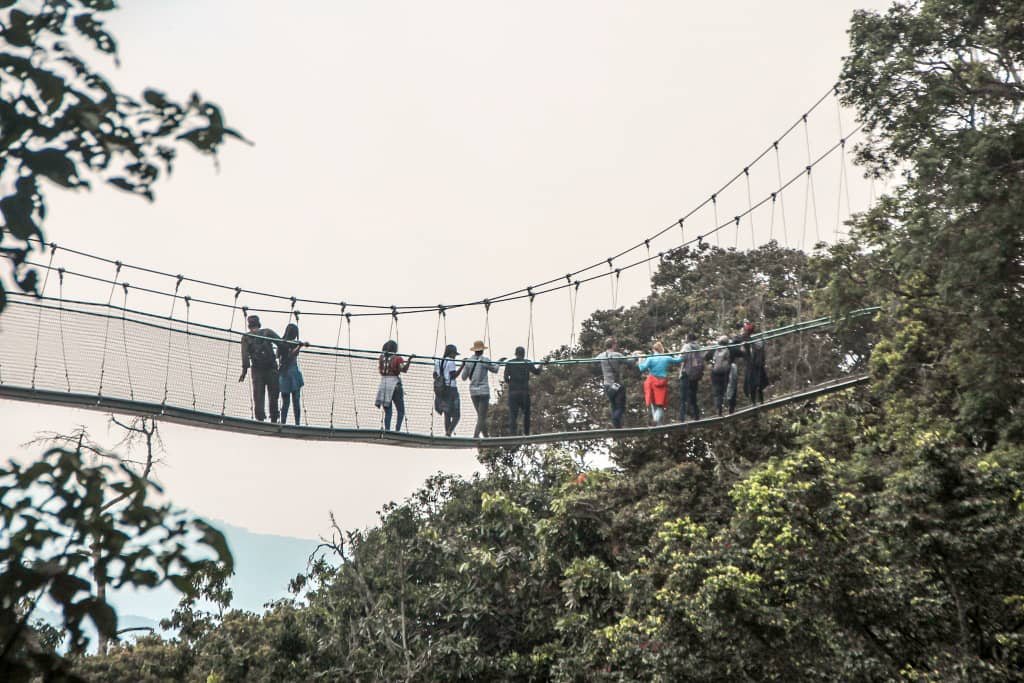
A 160-metre suspended walkway rising as much as 70 metres above the forest floor, reached on a guided hike from the Uwinka area.
3. Isumo Waterfall Trail
A rewarding forest hike combining streams, vegetation changes and a strong destination rather than walking only for distance.
4. Colobus / primate tracking
Excellent for travellers who want more than a single chimp encounter and want to understand how different primates use the forest.
5. Specialist birding
Start at first light and hire a guide who knows calls. Nyungwe’s endemic-rich bird list rewards slow, focused walking.
6. Longer forest hikes
Trails such as Imbaraga, Rukuzi and other ridge/valley routes suit travellers who want a full physical rainforest day.
Rules that matter in Nyungwe
Follow the ranger around primates
Distance, group positioning and viewing time are controlled to protect both visitors and animals. Ranger instructions override your photo angle.
Do not trek when unwell
Great apes are susceptible to human respiratory disease. Tell the operator or park team if you are sick before a primate activity.
Stay on the guided trail
Dense forest, steep slopes and wildlife make shortcuts a poor idea. Do not leave the group to chase a view or bird.
Prepare for rain
Use grippy footwear and carry a light rain layer even in the drier season. Protect cameras and phones from sudden showers.
Nyungwe National Park FAQ
What is the best time to visit Nyungwe National Park?
June to September is the best overall period for easier hiking and canopy-walk conditions. December to February can also be relatively dry, while rain is possible year-round in the forest.
How many days do you need in Nyungwe?
Two nights is the practical minimum; three nights is better. Three nights gives room for chimp trekking, the canopy walk and a separate hike or birding session without building the whole trip around one weather window.
How much is chimpanzee trekking in Nyungwe?
Current published planning material lists about USD 150 for an international visitor, plus applicable park entry. Verify the live price and residency category with Nyungwe before payment because rate sheets can change.
How much is the Nyungwe canopy walk?
Visit Rwanda lists the canopy walk at USD 40 for international visitors. Applicable park entry can be additional, so check the full booking total rather than the activity price alone.
Where does chimp trekking start?
The exact reporting point depends on the group and sector assigned by the park. Chimp activities can involve the western side and Cyamudongo as well as the wider Nyungwe system, so confirm the meeting point before choosing a hotel.
Nyungwe or Volcanoes National Park?
Choose Nyungwe for chimpanzees, rainforest hiking, canopy walking and Albertine Rift birding; choose Volcanoes primarily for mountain gorillas and Virunga volcano scenery. They complement each other rather than being substitutes.
Can you self-drive to Nyungwe?
Yes, you can reach the main visitor areas by road. Guided activities still require park arrangements, and wet weather can make remote access slower, so confirm your trailhead and reporting time in advance.
How this guide was checked
See.Africa reviewed time-sensitive information on 5 September 2026 against African Parks, UNESCO, Visit Rwanda and Nyungwe’s current public booking material. Prices, activity departure points, trail conditions and access rules can change; live park instructions override this guide.
Hero image: Laeliza23 / Wikimedia Commons, CC BY-SA 4.0.