
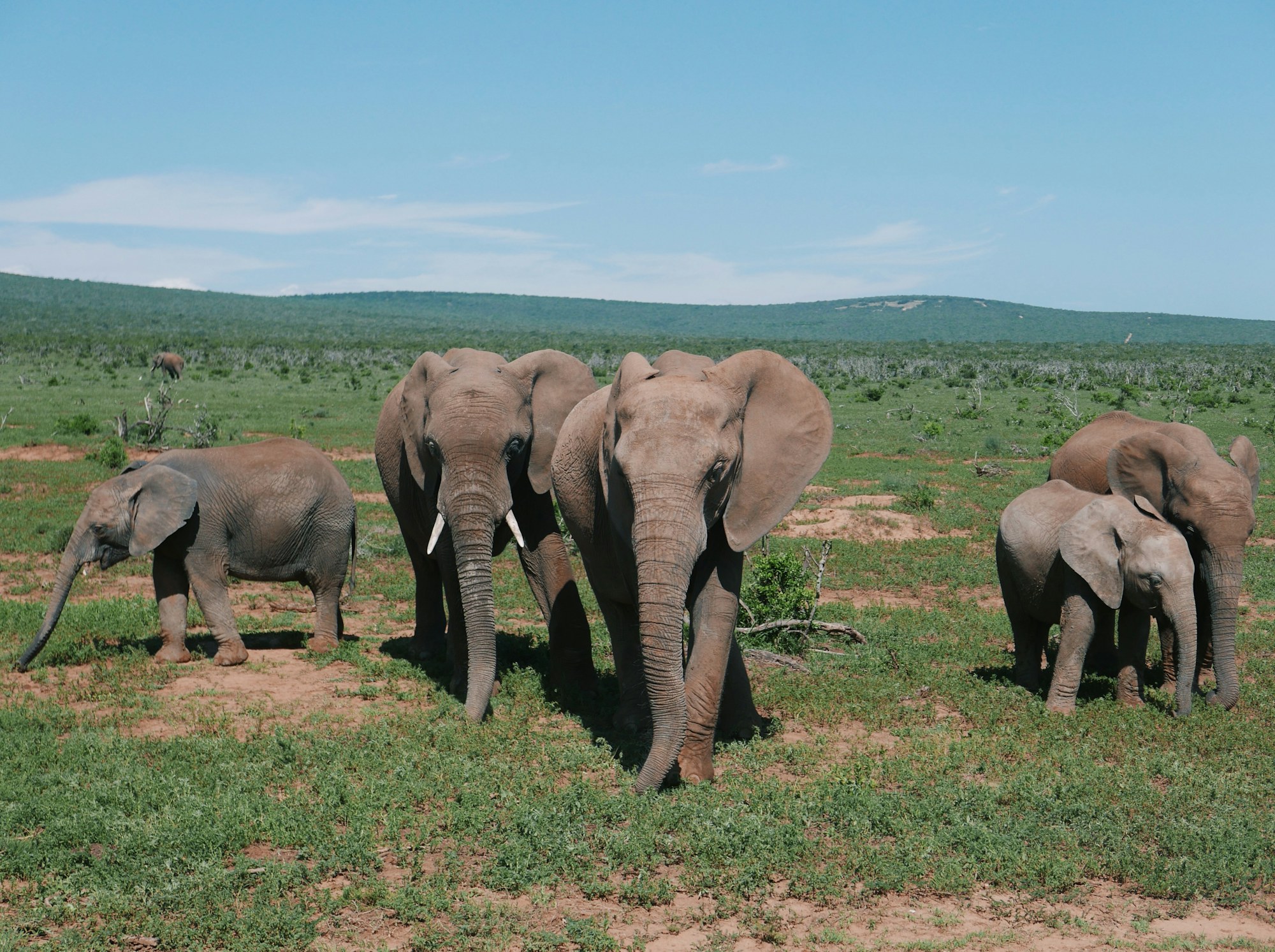
Addo Elephant National Park Guide
A practical 2026 field guide to Addo’s main game area and wider park: elephant waterholes, Main Camp vs Matyholweni, self-drive loops, current gate hours and fees, Spekboom Hide, Zuurberg, 4×4 country, five biomes and the park’s unusual Big 7 marine story.
Addo Elephant National Park at a glance
Addo is much bigger and more varied than the famous elephant circuit suggests. The expanded national park protects five of South Africa’s nine terrestrial biomes—from Albany Thicket and Zuurberg fynbos to Alexandria forest, Nama Karoo and Indian Ocean coastal vegetation—plus a marine environment in Algoa Bay. The main game area is the easiest safari section, but it is only one chapter of the park.
SANParks currently lists 91 mammal species and 418 bird species for the park. The main game area holds the Big Five and more than 600 elephants; the wider marine park underpins SANParks’ “Big 7” label by adding southern right whale and great white shark.
Which part of Addo should you visit?
For a first wildlife safari, focus on the Main Game Area between Addo Rest Camp and Matyholweni. Then choose one wider-park extension based on your interests instead of trying to “cover Addo” in a single day.
| Section | Best for | Vehicle / base | Why it matters |
|---|---|---|---|
| Main Game Area | Elephants, Big Five, self-drive, waterholes | Normal car; Main Camp / Matyholweni | Highest-value first visit: dense road network, hides, waterholes and the main concentration of classic safari wildlife. |
| Nyathi | Seclusion, elephants/buffalo, hills | Guests only | Excellent normally, but closed 1 Sep 2026–31 Mar 2027 for renovations. |
| Zuurberg | Hiking, fynbos/forest, mountain views | Road access + foot trails | Cycad and Doringnek trails show a completely different, wetter side of Addo. |
| Kabouga–Darlington | 4×4 adventure, history, remote landscapes | Low-range 4×4 | The one-way 45 km Bedrogfontein trail crosses thicket, forest, fynbos and Nama Karoo in about six hours. |
| Woody Cape / Alexandria | Forest, dunes, multi-day hiking, birds | Separate coastal trip | Includes the huge Alexandria dune field and forest species absent from the elephant circuit. |
| Marine / Algoa Bay | Whales, sharks, seabirds | Boat activity | This is the marine half of the Big 7 story; it cannot be experienced from Hapoor Dam. |
Best time to visit Addo Elephant National Park
Addo is genuinely year-round. The main section is semi-arid to arid and receives under 445 mm of rain annually, but rainfall is relatively evenly distributed with peaks around February–March and October–November. Average daily maximums are about 32°C in January and 18°C in July; winter nights can approach 5°C and frost sometimes occurs.
May–September
Easiest safari conditions. Cooler weather makes long self-drives comfortable and animals often use artificial waterholes heavily. Pack warm layers for early guided drives.
October–March
Warmer and greener. Hot days can make waterholes particularly productive for elephants. Bird activity and seasonal flowers increase, but midday heat can be tiring.
Any month
Weather can change quickly. Addo receives rain in every season; gravel roads are normally excellent but individual roads can close after very wet weather.
Addo fees and gate hours in 2026
| Daily conservation fee | Adult (12+) | Child (2–11) |
|---|---|---|
| South African citizen/resident | R110 | R54 |
| SADC national | R225 | R112 |
| International visitor | R492 | R246 |
Valid 1 November 2025–31 October 2026. Proof of eligibility is required for resident/SADC rates. A 1% community fund is added to accommodation and activity reservations.
Do not confuse entrance-gate hours with game-area hours
Main Gate
07:00–19:00 daily on current SANParks pages. Main Camp Reception also operates 07:00–19:00.
Matyholweni Gate
07:00–18:30 on current SANParks camp/contact information. Reception closes earlier than the security gate.
Internal game-area gates
Seasonal. SANParks explicitly tells guests to ask for current opening/closing times at Addo or Matyholweni Reception.
How to get to Addo from Gqeberha—and which gate to use
| Approach | Best for | Planning note |
|---|---|---|
| Gqeberha → Matyholweni | Airport arrivals, N2, Colchester stays | Take the N2 toward Makhanda/Grahamstown, turn off near Colchester and follow signs ~3 km to the gate. |
| Gqeberha → Main Gate | Main Camp stays, northern loops | Use the recommended paved approach via the N2/N10/R342 rather than relying on older shortcuts through local roads. |
| Matyholweni → Main Camp through park | Excellent full-day traverse | 36 km on the southern access road, but wildlife stops make travel time highly variable. |
| Main Camp → Kabouga | Bedrogfontein 4×4 | Separate external-road transfer toward Kirkwood; do not treat Kabouga as part of the normal game-area loop. |
Main tourist roads
SANParks says all normal tourist roads are suitable for ordinary vehicles. Some are tarred and others are good gravel.
Bedrogfontein only
The 45 km one-way trail runs Kabouga → Darlington, grade 2–3, roughly six hours. It must be booked.
40 km/h maximum
SANParks recommends 20–30 km/h for actual game viewing. Dense thicket can hide elephants and kudu metres from the road.
Southern access road
Buses, caravans and trailers cannot use the Matyholweni southern access road. Normal cars can.
Addo map: gates, waterholes, hides, viewpoints and picnic stops
This map now reflects how visitors actually drive Addo rather than showing six isolated pins. High-confidence public OpenStreetMap coordinates are used for many main-game-area sites; several southern pans/loops are marked approximately and explicitly labelled as such. SANParks’ current map and the paper map issued at the gate override this orientation map.
No wildlife-location markers are shown. Waterhole productivity changes by day and season. The optional planning line links sensible objectives but is not exact road geometry.
Where to stay in Addo: Main Camp, Matyholweni, Spekboom and wider sections
| Base | Best for | What you get | Important limitation |
|---|---|---|---|
| Addo Rest Camp (Main Camp) | First visit, guided drives, facilities | Shop, restaurant, fuel, pool, interpretive centre, floodlit waterhole, underground hide, bird hide | Busiest base, but by far the easiest logistics. |
| Matyholweni | Gqeberha/N2 access, quieter cottages | Self-catering units; Colchester supermarket/fuel/restaurants ~3 km away | Fewer on-site facilities and reception closes earlier. |
| Spekboom Tented Camp | Night waterhole atmosphere | Five simple tents inside the fenced hide area, communal kitchen/bathrooms | Guests must remain inside the fenced hide between sunset and sunrise; no after-hours game-area access. |
| Nyathi | Normally secluded Big Five stay | Exclusive self-catering cottages and camp waterhole | Closed 1 Sep 2026–31 Mar 2027 for renovations. |
| Kabouga / Mvubu | 4×4 start, Sundays River, rustic camping | Very basic facilities; limited cell signal | Separate section near Kirkwood; not a convenient base for normal Addo loops. |
| Langebos / Woody Cape | Alexandria forest and dune hiking | Hiking huts and coastal forest access | A separate coastal itinerary, not a safari camp beside Hapoor. |
A practical 2-day Addo safari plan
For a longer South African road trip, compare Addo’s thicket with the open slopes of Mountain Zebra National Park or the dry landscapes and fossil interpretation of Karoo National Park. Give each park its own overnight stay and allow a proper transfer day.
North game area
Enter from Main Camp, work Rooidam/Gwarrie/Domkrag and nearby loops slowly. Early hours are better for predators and hyena than a midday waterhole marathon.
Hapoor + Kadouw
Use Hapoor as one anchor, not the whole safari. Check Kadouw/Zuurkop and connecting thicket edges if the dam is quiet.
Jack’s Picnic Site
Use the designated picnic/braai/ablution stop. This is the correct place to get out—not a random waterhole verge.
Spekboom + south-central
Work Spekboom, Marion Baree and Gorah/Carols Rest depending your route and current sightings, then return with internal-gate margin.
Matyholweni traverse
Start at one gate and finish at the other. The 36 km southern road crosses changing vegetation and gives a more complete sense of the park.
SANParks guided drive
Sunset/night drives depart Main Camp and reveal nocturnal species that independent visitors cannot pursue after game-area closing.
How to read an Addo waterhole
Elephants approaching
Leave road space and do not position your car between the herd and water. A perfect viewing angle is less important than keeping an escape route open.
Quiet waterhole
Give it 15–25 minutes if conditions are hot, then move. Addo has many artificial water points; elephants may simply be using another one.
Dense thicket
Drive slower than the speed limit. Ears, trunks and dust often appear before an entire elephant becomes visible.
Flightless dung beetle
It has right of way. SANParks specifically warns visitors to avoid driving over beetles and dung piles.
22 mammals to know in Addo
Use the habitat tags: not every Addo mammal belongs in the main elephant circuit. Zuurberg, Darlington and the coastal forest add species that most day visitors never encounter.
African bush elephant
Addo’s 600+ elephants are the defining experience. Hot days concentrate herds at artificial waterholes; cooler days reward slow driving through spekboom thicket and open patches.
African buffalo
SANParks reports more than 400 buffalo, one of South Africa’s largest disease-free populations. Lions have altered their behaviour, making daytime sightings more common than historically.
Lion
Reintroduced in 2003. Early morning and the SANParks sunset/night drives are more productive than expecting lions to be obvious in dense midday thicket.
Black rhinoceros
Dense succulent thicket is excellent black-rhino habitat but makes animals hard to see. Never publish precise or real-time locations.
Leopard
SANParks says leopards occur through most parts of expanded Addo but are very seldom seen. Tracks are a more realistic find than a cat in the main game area.
Spotted hyena
Reintroduced alongside lions in 2003. Early road patrols and guided night drives are the best opportunities.
Brown hyena
More associated with outlying and coastal sections than the standard elephant loops. Distinct shaggy coat and sloping back separate it from spotted hyena.
Burchell’s zebra
Many Addo zebras show pale hindquarters reminiscent of the extinct quagga. Look in grassier areas with hartebeest and other grazers.
Greater kudu
Huge ears and spiral horns often appear above vegetation before the body. Slow down in dense thicket rather than scanning only open plains.
Red hartebeest
Reddish coat, long face and sloping back are easy field marks. Often found in open areas where farming once cleared thicket.
Eland
Africa’s largest antelope. Heavy adults can still clear fences or obstacles surprisingly well when disturbed.
Common warthog
SANParks describes warthogs as abundant. Watch them kneel on their front wrists to graze and run with tails upright.
Show 10 more Addo mammals
Bushbuck
Solitary and secretive in dense drainage lines, forest edges and riverine cover. Matyholweni and coastal forest habitat can be productive.
Black-backed jackal
Most obvious in open terrain at dawn and dusk. Also active around carcasses and predator kills.
Caracal
A lucky sighting rather than a target species. Long black ear tufts and powerful hindquarters are diagnostic.
Aardwolf
Nocturnal termite specialist, more likely on night activities or in open outlying habitats than during a busy midday loop.
Bat-eared fox
Best in open country during cooler hours. The enormous ears help locate insects underground.
Cape mountain zebra
A Zuurberg/outlying-area animal rather than a standard Hapoor Dam sighting. Narrow stripes and a gridiron rump differ from plains zebra.
Hippopotamus
SANParks records hippos in the Sundays River below the Zuurberg. They are not residents of the artificial waterholes in the main game area.
Meerkat
Associated with the drier, more open outer sections rather than dense Albany Thicket. Look for upright sentries near burrow systems.
Honey badger
Widespread but elusive and often nocturnal. Digging signs may be more common than direct sightings.
Blue duiker
Tiny forest antelope of wetter wooded areas such as Zuurberg/Alexandria rather than the main elephant plains.
12 Addo birds worth learning
The 418-species park checklist reflects Addo’s huge habitat range. A main-game-area bird list and an Alexandria/Zuurberg bird list can look like two different parks.
Common ostrich
Conspicuous on open grassier sections. Males are black-and-white; females and immature birds are grey-brown.
Southern black korhaan
A regional specialty of open scrub and grassland. The harsh call often reveals the bird before it stands clear of vegetation.
Denham’s bustard
Large bustard of open grassland; the coastal grasslands south of Alexandria Forest are also important habitat.
Martial eagle
SANParks specifically lists it among possible main game area raptors. Scan high thermals rather than only roadside perches.
Secretarybird
Walks open ground hunting reptiles and large insects. Tall black crest and long bare legs are unmistakable.
Karoo scrub robin
Common around Main Camp according to SANParks. Frequently forages low or on the ground in dry scrub.
Bokmakierie
Bold yellow-and-black shrike-like bird with a ringing duet. Common in camp and thicket-edge habitats.
Southern tchagra
Dense scrub specialist often located by its distinctive call. Main Camp vegetation can be productive.
Bar-throated apalis
Small active thicket bird; listen for repeated calls in camp vegetation and wooded gullies.
Cape bunting
Rockier open ground and camp margins suit this striped-headed endemic-region bunting.
African crowned eagle
Zuurberg wooded kloofs support breeding crowned eagles. This is a forest/mountain target, not a Hapoor waterhole bird.
Knysna turaco
Alexandria Forest specialty. Listen for loud calls and watch for crimson wings flashing between canopy trees.
Addo flora: spekboom thicket to fynbos and coastal forest
Addo is botanically exceptional because one national park spans five terrestrial biomes. The elephant circuit is mostly Albany Thicket, but Zuurberg climbs into fynbos and forest, Darlington becomes Nama Karoo and the coast adds forest, dunes and Indian Ocean coastal vegetation.
Trees, shrubs & structural succulents
Spekboom
The emblematic Albany Thicket plant. Succulent leaves store water and provide important elephant browse; dense stands can survive in very dry conditions.
Noors
A blue-green spiny succulent euphorbia characteristic of Sundays River thicket. Avoid contact with irritating milky latex.
Jacket plum
Hardy evergreen/small tree of dry thicket. Red fruits split to expose dark seeds.
Sweet thorn
Common in open drainage and disturbed ground; paired pale thorns and yellow puffball flowers are easy field marks.
Cape leadwort
Pale blue flowers stand out on thicket margins during favourable conditions.
Cape honeysuckle
Orange-red tubular flowers attract sunbirds; plants can scramble through thicket edges.
Wild olive
Small evergreen tree of rocky and sheltered sites; tiny dark fruits are eaten by birds.
Guarri
Tough evergreen shrub with small leathery leaves, common through drier thicket.
Spike-thorn
Dense thorny shrub/small tree important as refuge habitat for small birds and browsing antelope.
Karoo boer-bean
Gnarled shrub/tree of dry succulent vegetation with vivid red flowers that attract nectar-feeding birds.
Grasses, aloes & smaller plants
Bitter aloe
Tall winter flower spikes provide a major nectar resource for sunbirds and insects.
Jade plant
Succulent shrub of Eastern Cape thicket with fleshy leaves adapted to long dry periods.
Pig’s ear
Broad grey-green succulent leaves and tall red-orange flowers are typical of rocky dry habitats.
Red grass
Occurs in better grassland patches; mature reddish seed heads are obvious in season.
Finger grass
Useful grazer forage in open patches, especially after rain.
Lovegrass
Fine-seeded grasses common through disturbed and open habitats across the broader park.
Couch grass
Low spreading grass around wetter or heavily grazed ground; frequently forms short feeding lawns.
Pelargoniums
Eastern Cape species range from succulent to aromatic herbs/shrubs; flowering responds strongly to season and rainfall.
Everlastings
Papery flower heads are common in fynbos and open upland habitats such as Zuurberg.
Restios
Reed-like Cape flora plants become important in the fynbos sections, a sharp contrast with lowland succulent thicket.
Best things to do in Addo
1. Main-area self-drive
The essential Addo experience. Build the day around several waterholes, viewpoints and slow thicket roads rather than one famous dam.
2. Guided sunrise/sunset/night drive
Two-hour SANParks drives depart Main Camp. Seasonal sunrise/night times extend your wildlife window beyond self-drive hours.
3. Hop-on guide
A trained local guide joins your own vehicle. From 1 March 2026 SANParks lists R400 for a two-hour sedan guide, with higher rates for larger vehicles.
4. Spekboom Hide
A designated waterhole hide inside the game area; overnight tent guests can watch nocturnal wildlife after normal self-drive has ended.
5. Zuurberg hikes
The 2 km Cycad Trail and 8 km Doringnek Trail move through cooler mountain vegetation far removed from the elephant plains.
6. Bedrogfontein 4×4
45 km, one-way Kabouga → Darlington, low-range 4×4 only, roughly six hours and separately booked.
7. Alexandria dunes + forest
The multi-day Alexandria trail crosses forest and one of the southern hemisphere’s largest and least degraded coastal dune fields.
8. Main Camp interpretation
Visit the Ulwazi Interpretive Centre, floodlit waterhole, underground hide, bird hide and accessible PPC Discovery Trail.
9. Marine eco-tour
The only way to make the Big 7 concept meaningful: venture into Algoa Bay for southern right whale, marine birds and potential shark sightings.
Addo rules and safety that matter
Stay inside your vehicle
Only leave at clearly designated lookout/get-out points, and even there SANParks warns that you do so at your own risk.
40 km/h maximum
Drive 20–30 km/h for real wildlife viewing. Fast vehicles miss animals and increase risk to dung beetles and other small wildlife.
Dung beetles have right of way
Addo’s rare flightless dung beetles use roads and elephant dung. Avoid driving over both beetles and dung balls.
Do not crowd elephants
Leave a retreat route and do not block a herd between vehicles, fences or a waterhole entrance.
No feeding
Food habituation creates dangerous animals around picnic sites and camps. Secure leftovers and rubbish.
Respect internal gate times
Main entrance hours do not mean you can remain in the wildlife area until 19:00. Ask reception for that day’s game-gate times.
Very wet roads can close
Normal cars are fine on standard roads, but SANParks can close gravel sections after heavy rain.
Bedrogfontein is not a shortcut
It is a booked one-way 4×4 trail requiring low range, not an alternative route for a sedan.
Night wildlife stays outside the car
Independent night driving is not the solution. Book a SANParks night drive or use the Main Camp/Spekboom hides.
Addo Elephant National Park FAQ
What is the best time to visit Addo Elephant National Park?
Addo is good year-round, with May to September the easiest all-round period for many first-time visitors. Cooler weather is comfortable for long drives, while hot summer days can be excellent for elephants at waterholes.
Can I drive Addo in a normal rental car?
Yes. SANParks says standard tourist roads are suitable for normal vehicles. A low-range 4×4 is only required for the Bedrogfontein 4×4 Trail; some remote accommodation has separate clearance requirements.
Which Addo gate is best from Gqeberha?
Matyholweni is particularly convenient from the N2/Gqeberha side. It also allows a rewarding 36 km south-to-north game drive toward Main Camp.
How much is Addo entry in 2026?
Until 31 October 2026, the daily adult rates are R110 for South African citizens/residents, R225 for SADC nationals and R492 for standard international visitors.
What time do Addo’s gates close?
Main Gate currently closes at 19:00 and Matyholweni at 18:30. Internal game-viewing gates operate seasonal times, so confirm them at reception rather than assuming the entrance-gate time applies to wildlife roads.
Is Addo malaria-free?
Yes. SANParks’ current visitor guidance states that no immunisations are needed for the park because it is in a malaria-free area. Compare Addo with our best malaria-free safari destinations in Africa.
What does Addo’s Big 7 mean?
It means the traditional Big Five on land plus southern right whale and great white shark in the marine environment. The final two require a coastal/marine experience rather than a normal self-drive.
Is Nyathi Rest Camp open in September 2026?
No. SANParks has closed Nyathi Rest Camp from 1 September 2026 through 31 March 2027 for renovations, with reopening planned for April 2027.
How this Addo guide was checked
See.Africa reviewed this guide on 1 September 2026 against current SANParks pages for conservation fees, entrance gates, camps, access roads, mammals, birds, vegetation, activities, visitor tips and current park notifications. SANParks’ live gate and notification pages take precedence over older downloadable visitor maps where opening hours differ.
Hero photo: Falco Negenman via Unsplash. Existing featured-image attachment and URL retained.