
Arusha National Park Guide
Momella Lakes, Ngurdoto Crater, black-and-white colobus monkeys and Mount Meru. This 2026 guide covers the best time, current TANAPA planning, safari areas, hiking, wildlife and a detailed orientation map.
Information checked 6 September 2026Arusha National Park at a glance
Arusha National Park is one of Tanzania’s most varied small parks. Within a compact area you move from alkaline Momella Lakes and open grassland to Ngurdoto Crater, montane forest and the slopes of Mount Meru. It is particularly strong for black-and-white colobus monkeys, giraffes, waterbirds, walking safaris and hiking rather than classic Big Five expectations.
Quick Answers
Pair this guide with Tarangire National Park, Lake Manyara National Park, the Tanzania travel guide or all National Park Guides.
Best time to visit Arusha National Park
June to October is the simplest all-round choice. Trails are generally drier, wildlife is easier to spot in shorter vegetation and Mount Meru conditions are usually more predictable. December to February is another strong window. March–May is wetter and cloudier, which can affect hiking and road conditions.
Choose the drier periods and confirm current trail/weather conditions before climbing.
Momella Lakes remain rewarding year-round; wetter/greener months can add seasonal bird activity.
Clearer dry-season mornings improve your odds of seeing Meru and, from some viewpoints, Kilimanjaro.
Arusha National Park fees and permits
Use TANAPA’s live tariff instead of a copied fixed 2026 price. Current official visitor guidance states that charges vary by visitor category, age, vehicle and activity. Mount Meru, walking, accommodation/huts and ranger/guide services can create separate charges.
Which Arusha National Park area should you choose?
| Area | Best for | Main experience | Planning note |
|---|---|---|---|
| Momella Lakes | Birding, giraffes, flamingos, scenery | Lake circuit + viewpoints | Best easy safari zone for a first visit. |
| Ngurdoto Crater | Scenery, buffalo habitat, forest edge | Crater viewpoints | Viewing is from the rim rather than a crater-floor drive. |
| Montane forest | Colobus monkeys, blue monkeys, forest birds | Slow forest-edge driving | Listen and scan canopy rather than rushing between viewpoints. |
| Lower Mount Meru | Walking, waterfalls, hiking | Tululusia + trail access | Guided arrangements apply for walking/hiking. |
| Mount Meru summit route | Multi-day hiking | Miriakamba → Saddle → Socialist Peak | A mountain trek, not an add-on to a normal safari drive. |
How to get to Arusha National Park
The park is one of the easiest major protected areas to combine with Arusha city. Road access is normally via the park’s southern/eastern entrance network, while Momella provides the core visitor circuit. For Mount Meru, register through the appropriate park/ranger process rather than treating the trail as an independent hike.
Ideal for a full-day outing before or after a longer Northern Circuit safari.
Useful as a first or final wildlife stop when flight timing allows; arrange a vehicle rather than improvising at arrival.
Confirm ranger, hut/camp, porter and route arrangements before travel; the climb is managed separately from a normal day safari.
Arusha National Park map
This map deliberately includes both safari and mountain geography. It shows gates, Momella Lakes, Ngurdoto viewpoints, waterfall/trail points, huts and Mount Meru landmarks. Approximate points are labelled as such; use TANAPA signage and ranger instructions for navigation.
How to plan a one-day Arusha National Park visit
Use the cooler first hours to scan montane forest and forest-edge roads for black-and-white colobus and blue monkeys.
Move to crater viewpoints while visibility is good and buffalo/open-ground activity is easier to pick out.
Slow down around Small and Big Momella, Rishateni and associated lake viewpoints for giraffes and waterbirds.
Use a signed picnic/rest point. Do not turn an attractive roadside verge into an unofficial walking area.
Revisit productive open areas rather than attempting a rushed Mount Meru detour late in the day.
Confirm current gate/return timing, screenshot the map, save lodge/operator contacts and leave a comfortable buffer before closing.
18 mammals to know in Arusha National Park
Arusha’s mammal list is more about forest primates, giraffes and mixed highland wildlife than Big Five density. Each card includes where to look and a practical ID/behavior cue.
Black-and-white colobus
Signature • strong chance
Where: montane forest canopy. ID: black body with long white mantle and tail plume. Behavior: arboreal groups often reveal themselves through movement and calls before you get a clear view.
Blue monkey
Good chance
Where: mature forest. ID: grey-blue body, darker cap and expressive face. Behavior: active in the mid/upper canopy and often easier to detect by branch movement.
Masai giraffe
Very good chance
Where: Momella grassland and woodland edges. ID: irregular leaf-like patches. Behavior: browsers often move in loose groups across open country.
African buffalo
Good chance
Where: Ngurdoto area, forest edge and grassland. ID: heavy dark body and broad horn bosses. Behavior: groups can disappear surprisingly quickly into thick vegetation.
Plains zebra
Good chance
Where: open Momella grassland. ID: black-and-white striping to the belly. Behavior: family groups graze with other open-country herbivores.
Common warthog
Common
Where: short grass and road verges. ID: facial warts and tusks. Behavior: often runs with tail erect; frequently kneels to graze.
Bushbuck
Possible
Where: forest edge and thick cover. ID: compact reddish-brown antelope with white markings. Behavior: solitary and quick to melt into vegetation.
Waterbuck
Possible to good
Where: wetter grass and lake-associated habitat. ID: shaggy grey-brown coat and white rump ring. Behavior: usually stays relatively close to dependable water.
Kirk’s dik-dik
Possible
Where: dry bush and woodland edge. ID: tiny antelope with elongated snout. Behavior: often appears in pairs and freezes before darting into cover.
Bohor reedbuck
Possible
Where: damp grassland. ID: medium tan antelope; males carry forward-curving horns. Behavior: often lies low in grass and flushes suddenly.
Common duiker
Possible
Where: bushy forest margins. ID: small grey-brown antelope with dark forehead stripe. Behavior: solitary and usually seen crossing tracks quickly.
Red duiker
Uncommon
Where: dense forest understorey. ID: richer reddish coat than common duiker. Behavior: secretive and easiest to encounter on quiet forest-edge routes.
Leopard
Rare / possible
Where: forest and rugged slopes. ID: rosette coat and long tail. Behavior: present but not a realistic day-trip expectation.
Spotted hyena
Possible
Where: open zones and forest edge. ID: sloping back and spotted coat. Behavior: more active in cooler hours and at night.
Olive baboon
Common
Where: woodland, open ground and roadsides. ID: large grey-olive primate with dog-like muzzle. Behavior: social troops forage widely; never feed them.
Vervet monkey
Common
Where: tree-rich areas and visitor zones. ID: grey body and black face. Behavior: opportunistic around food, so keep bags secured.
Porcupine
Mostly nocturnal
Where: woodland and rocky ground. ID: large black-and-white quills. Behavior: usually detected by tracks/quills rather than daytime sightings.
Rock hyrax
Possible on rocky slopes
Where: rocky Meru terrain. ID: compact brown mammal with rounded ears. Behavior: colonies bask on rocks and whistle alarm calls.
12 birds worth learning
Greater flamingo
Where: Momella Lakes. Large pale-pink flamingo; numbers fluctuate with lake conditions.
Lesser flamingo
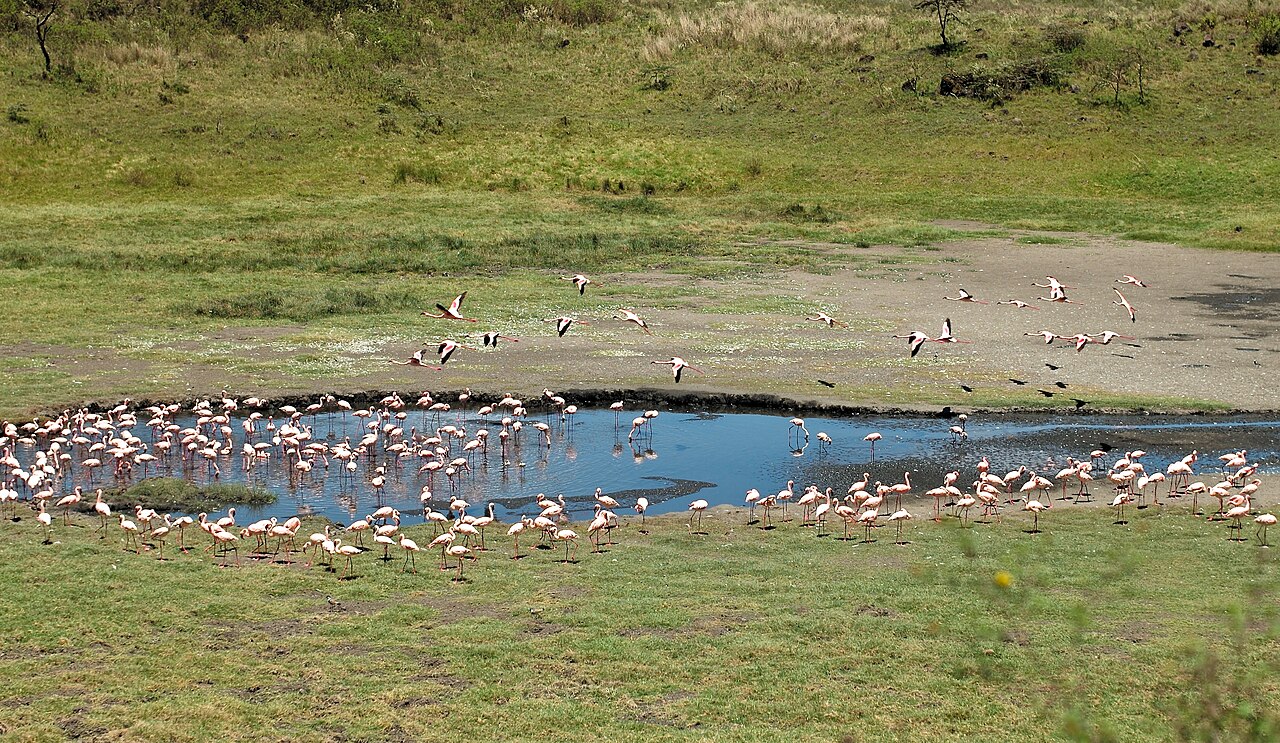
Where: alkaline Momella Lakes. Smaller, deeper pink and often present in larger flocks when conditions suit.
African fish eagle
Listen around lakes and wetlands for the ringing call before scanning dead trees and shoreline perches.
Augur buzzard
Highland raptor often using thermals and exposed perches around the mountain.
Hartlaub’s turaco
Montane-forest specialty; look for green plumage and listen for loud calls in the canopy.
Silvery-cheeked hornbill
Large forest hornbill; powerful wingbeats and noisy fruit-tree activity make it easier to detect.
Crowned eagle
Forest raptor associated with primate-rich woodland; far less predictable than common savanna raptors.
Grey crowned crane
Open wet grassland and lake margins; unmistakable golden crown and elegant posture.
Hamerkop
Wetland edges and shallow water; brown bird with hammer-shaped head profile.
Malachite kingfisher
Tiny, bright wetland kingfisher of reeds and quiet lake edges.
White-eyed slaty flycatcher
Highland forest-edge bird with obvious pale eye-ring; useful beginner ID on the Meru slopes.
Mountain white-eye
Small greenish montane bird moving actively through flowering shrubs and forest edges.
Flora: montane forest, grassland and lake-edge plants
Arusha National Park’s plant diversity reflects its steep elevation change. These are useful recognition groups, not a definitive botanical checklist.
Trees & shrubs
Large evergreen montane-forest tree supporting rich canopy habitat.
Ancient conifer group characteristic of East African montane forest.
Highland tree associated with cooler upper-montane habitat.
Hardy evergreen tree in woodland and forest-edge settings.
Common East African highland tree; often supports insects and birds.
Fruit can attract monkeys and hornbills in forest habitat.
More open savanna/grassland margins around lower elevations.
Mixed woodland component in drier lower park areas.
Montane shrub/tree group associated with highland forest.
Becomes important higher on Mount Meru above the closed forest zone.
Flowers, reeds, ferns & understory plants
Moist forest floor and streamside habitat.
Colorful moisture-loving forest herbs in suitable shaded sites.
Epiphytic and terrestrial species occur in montane forest; exact ID can be difficult.
Shade-tolerant species on openings and road edges.
Lake margins and damp ground around Momella.
Shallow wet edges used by birds and amphibians.
Higher Mount Meru slopes above the forest belt.
Characteristic high-elevation “everlasting” plants on East African mountains.
Sunny rocky ground and drier lower slopes where conditions suit.
Appear after rains in grassland, roadsides and forest clearings.
Best things to do in Arusha National Park
Best easy combination of scenery, giraffes and waterbirds.
Look into the crater floor and scan forest edge/open ground from signed viewpoints.
Slow forest driving and patient canopy watching can be more rewarding than chasing large mammals.
Authorized walking adds a ground-level experience unavailable in many classic safari parks.
A popular walking objective in the lower Mount Meru area; follow current ranger guidance.
Multi-day climb via Miriakamba and Saddle huts to Socialist Peak.
Momella Lakes plus montane forest create unusually varied birding in one compact park.
Use lakes, forest, crater rim and mountain views rather than treating the park as only a wildlife checklist.
Excellent first/last day before Tarangire, Manyara, Ngorongoro or Serengeti.
Rules and safety
Walking and Mount Meru hiking are managed activities, not independent trail access. Stay on designated roads/trails, follow ranger instructions, keep distance from buffalo and other wildlife, do not feed primates and check weather before mountain activity. Drones require prior written permission under TANAPA rules.
Arusha National Park FAQ
Is Arusha National Park worth visiting?
Yes, especially as a first or final safari day for Momella Lakes, black-and-white colobus monkeys, giraffes, birding and Mount Meru scenery.
What is Arusha National Park famous for?
Momella Lakes, Ngurdoto Crater, Mount Meru, black-and-white colobus monkeys, giraffes, highland forest and waterbirds.
What is the best time to visit?
June to October is the simplest all-round choice for drier hiking and wildlife viewing. December to February is also attractive and green.
Can you see the Big Five?
No. Arusha is better for primates, giraffes, buffalo, birding and scenery than for a Big Five checklist.
Can you hike Mount Meru?
Yes. Mount Meru is a multi-day managed trek through Arusha National Park and requires the appropriate TANAPA/ranger arrangements.
Can you do Arusha National Park as a day trip?
Yes. A full day is ideal for combining forest, Ngurdoto viewpoints and the Momella Lakes without rushing.
Are flamingos always at Momella Lakes?
No. Flamingo numbers vary with water levels, chemistry, food and season, so treat them as a strong possibility rather than a guarantee.
How do you combine Arusha with other parks?
Use it before or after a Northern Circuit trip to Tarangire, Lake Manyara, Ngorongoro and Serengeti.
Primary sources & live checks
See.Africa checked time-sensitive planning on 6 September 2026 against current Tanzania National Parks (TANAPA) visitor/tariff guidance and used public mapping references for orientation points. Official signage, ranger instructions and current TANAPA tariffs override approximate coordinates, hiking plans and saved maps.