

Bwabwata National Park Guide
Plan Bwabwata National Park with maps of Mahango and Kwando, permits, river wildlife, birding, community conservation, camps and Caprivi travel advice.
Baobab in the Mahango area of Bwabwata National Park. Photo: Marco Schmidt[1] · CC BY-SA 3.0. Resized and cropped for this layout.
![Marco Schmidt[1]](https://commons.wikimedia.org/wiki/File:Adansonia_digitata_MS_10040.jpg)
Bwabwata National Park at a glance
Bwabwata National Park stretches across Namibia’s Zambezi Region between the Okavango and Kwando rivers. It combines elephant and buffalo country, floodplain antelope, exceptional river birding and a lived-in conservation landscape where resident communities participate in tourism and resource management. The B8 road crosses the wider park, but ordinary transit is not permission to leave the road or enter core wildlife areas. Most first visits concentrate on the Mahango and Buffalo areas near Divundu or the Kwando core near Kongola, using accommodation outside or at authorised community concessions. Two or three nights in each chosen river sector is more useful than racing the full strip. Confirm permits, seasonal tracks and border formalities before setting out.
Official sources · checked 10 September 2026: MEFT: Bwabwata National Park. Confirm arrangements for your travel date.
When is the best time to visit Bwabwata?
The dry season from roughly May to October makes many tracks easier and can concentrate wildlife near the Okavango and Kwando systems. June through August brings cooler mornings; September and October become hot, with elephants and other animals relying heavily on water. The rainy season from November to April turns the landscape green, brings migrants and breeding birds, and can flood or close low tracks. River levels do not follow only local rain, so ask locally about Mahango loops, floodplain access and boat operations. Humidity, insects and heat increase in summer. Carry rain protection, warm layers for winter drives, drinking water and sun protection. Plan a second activity when a loop is closed rather than creating a bypass through community or wildlife habitat.
Typical seasonal pattern, not a forecast or a guarantee of road or trail access. Current local conditions take priority.
Which Bwabwata area suits your trip?
| Area | Best for | What to expect | Planning point |
|---|---|---|---|
| Mahango Core Area | Floodplain drives and accessible river wildlife | Open wetlands can reveal elephant, antelope, hippo and abundant birds. | Check the day’s loop direction, flood level and gate times before entering. |
| Buffalo Core Area | Woodland and Okavango river frontage | A quieter western sector offers different views of the same river system. | Use the authorised entrance and do not treat old military or service roads as visitor tracks. |
| Popa Falls area | Rapids, river scenery and a practical base | The Okavango breaks over rocky ledges rather than forming a single high waterfall. | Use managed viewpoints; currents and rocks make casual swimming unsafe. |
| Kwando Core Area | Elephants, predators and floodplain habitats | The eastern river system is a strong base for guided drives and boat outings. | Access may be tied to a concession or lodge; ordinary park transit does not include it. |
| Multiple-use and community conservation areas | A lived-in protected landscape | People, livestock, wildlife and tourism share parts of the park under zoning. | Respect villages, speed limits and community land; ask before photographing people. |
Bwabwata fees, permits and opening hours
MEFT’s publicly accessible general fee PDF is labelled effective 1 January 2021 and does not provide a sufficiently safe September 2026 price basis here. Obtain written current rates for Mahango, Buffalo and Kwando from MEFT or the authorised booking channel. Lodges and community concessions may collect their own accommodation, guiding, boat, conservancy or transfer charges. A transit on the B8 does not establish that core-area entry is included. Carry identity documents and official receipts.
| Item | Public tariff status | Planning action |
|---|---|---|
| Park entry | Current amount not established from the public page | Request a date-specific MEFT quote for each core area. |
| Vehicle | May be charged separately | Confirm vehicle class and each day or re-entry. |
| Concession activities | Separate provider price | Ask whether park, community and activity levies are included. |
Official sources · checked 10 September 2026: MEFT: park fee download currently labelled effective 1 January 2021. Confirm arrangements for your travel date.
Opening hours and reporting times
Visitor hours differ among core areas, gates, concessions and river activities. Confirm each gate’s current opening and last-entry time with MEFT or your lodge on the day before visiting. Boat trips have their own reporting and daylight limits. Reach remote accommodation in daylight, and do not use the B8’s round-the-clock transport function as evidence that wildlife loops permit night self-driving.
Official sources · checked 10 September 2026: MEFT: Bwabwata National Park visitor overview. Confirm arrangements for your travel date.
How do you get to Bwabwata?
The B8 links Rundu and Divundu in the west with Kongola, Katima Mulilo and onward borders in the east. It crosses a long, sparsely serviced protected landscape. Fill fuel when reliable, carry water and a working spare, and respect settlement speed limits and wildlife crossings. Divundu is the practical base for Popa Falls, Mahango and Buffalo; Kongola suits Kwando. Visitors combining Botswana, Zambia or Zimbabwe need to verify border hours, vehicle letters, road charges and insurance separately. A river-bank lodge may require a signed sand track or boat transfer; use its exact directions rather than a generic map pin.
Official sources · checked 10 September 2026: MEFT: Bwabwata National Park management plan. Confirm arrangements for your travel date.
Bwabwata map: 23 useful places
Use this map to compare bases and understand the landscape. Search by place or filter by type. All locations are approximate orientation points; current park, guide and lodge directions override the map.
Loading map near this section. All places are also listed below.
All original park places and 3 featured lodges
- Divundu · Areas & trail referencesWestern supply and accommodation hub; it is outside the wildlife loops. Map source. Approximate.
- Popa Falls · Water featuresManaged rapid and river-viewing area; currents and rocks require caution. Map source. Approximate.
- Mahango Core Area entrance · Gates & visitor centresApproximate visitor gate reference; confirm current hours and loop conditions. Map source. Approximate.
- Mahango waterhole · Water featuresWildlife-viewing reference; remain on the authorised circuit. Map source. Approximate.
- Buffalo Core Area entrance · Gates & visitor centresApproximate access reference; use only the signed visitor entrance. Map source. Approximate.
- Kongola · Areas & trail referencesEastern supply and lodge-access hub on the B8. Map source. Approximate.
- Kwando Core Area entrance · Gates & visitor centresCore-area reference; verify whether entry is tied to a concession or guide. Map source. Approximate.
- Nambwa community concession · Camps & lodgesCommunity tourism reference; visit or stay only with a confirmed booking. Map source. Approximate.
- Horseshoe Lagoon · Water featuresKwando floodplain reference; route access changes with water and concession rules. Map source. Approximate.
- Bagani bridge · Gates & visitor centresApproximate regional bridge reference; confirm current road, park and community-concession access. Map source. Approximate.
- Divundu service area · Areas & trail referencesApproximate service base outside park sections; arrange fuel, supplies and permits locally. Map source. Approximate.
- Popa Falls public access · ViewpointsApproximate visitor reference; river conditions and access fees apply. Map source. Approximate.
- Okavango River crossing area · Water featuresApproximate river reference; use authorised launch and guide arrangements. Map source. Approximate.
- Buffalo Core Area camp reference · Camps & lodgesApproximate camp-area reference; confirm booking, access route and concession rules. Map source. Approximate.
- Susuwe/Ngonga area · Areas & trail referencesApproximate landscape reference; community-concession access is controlled. Map source. Approximate.
- Omega settlement area · Areas & trail referencesApproximate regional orientation point; follow local access guidance. Map source. Approximate.
- Kwando River reference · Water featuresApproximate river reference; no live wildlife location is implied. Map source. Approximate.
- Mashi Conservancy access · Gates & visitor centresApproximate community-conservancy access; arrange current permission and local guidance. Map source. Approximate.
- Mahango picnic area · Areas & trail referencesApproximate visitor-area reference; confirm facilities and current opening. Map source. Approximate.
- Nakatwa area · Areas & trail referencesApproximate landscape reference; use designated tracks and current park maps. Map source. Approximate.
Map references include official material where specified and OpenStreetMap contributors, checked 10 September 2026. Selected and labelled by See.Africa. No live animal locations or verified driving route is shown.
A practical Bwabwata itinerary
Two nights near Divundu
Use arrival for Popa Falls or a short river session, then give a cool morning to Mahango. Reserve the second half-day for Buffalo, birding or a guided boat trip according to water and road conditions.
Two nights near Kongola
Choose an authorised lodge or community concession, book one guided drive and one river activity, and leave the remainder for quiet birding. This avoids repeated long B8 transfers.
Four to six nights: both rivers
Split nights between Divundu and Kongola. Travel the B8 in daylight, pause only at safe authorised places and resist adding an international border crossing to a full game-drive day.
Rainy-season plan
Confirm flooded roads before entry, use a guide where local route knowledge matters and keep a birding or boat alternative. Never drive around a closure through grass or village land.
Where should you stay around Bwabwata? Our top 3 lodges
Most accommodation lies outside the formal wildlife core areas or operates in a managed tourism concession. If visiting Mahango and Buffalo, prioritise the Divundu side; for Kwando safaris, stay nearer Kongola. Explore our 10 best Bwabwata lodges and stays for more riverfront and self-catering options.

Divava Okavango Resort & Spa
A comfortable resort on the Okavango near Popa Falls, suited to Mahango and Buffalo outings.
Check availability on Expedia ↗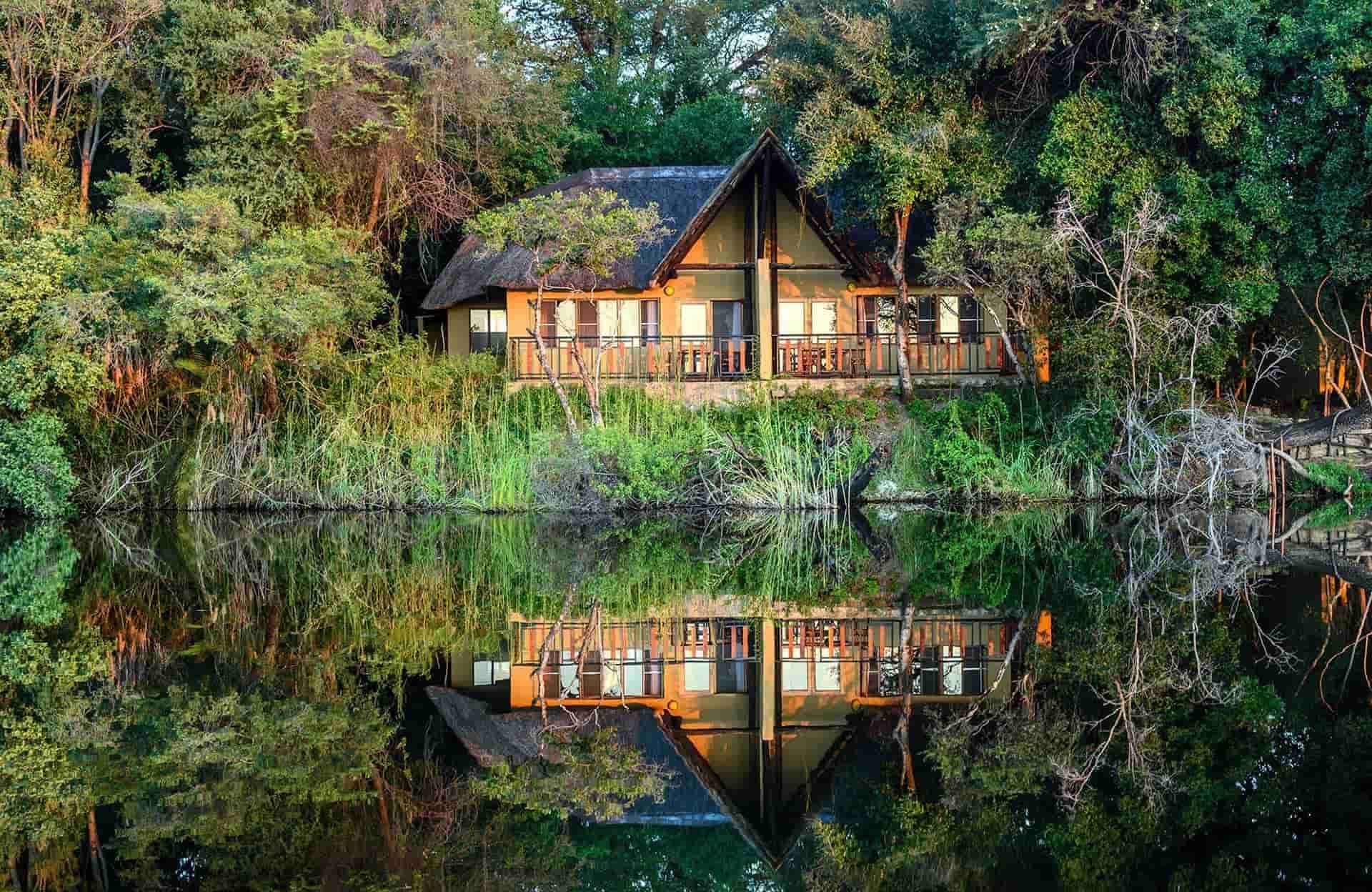
Namushasha River Lodge
A riverside lodge near Kongola with boat excursions and access to the eastern Bwabwata landscape.
Check availability on Expedia ↗
Nambwa Tented Lodge
A luxury tented lodge in a managed Kwando concession within Bwabwata, requiring approved access.
View official lodge website ↗Planning note: Divundu and Kongola are widely separated on the B8, and park access depends on the specific core area or concession. Confirm fees, guided excursions, community levies, boat activities and the lodge’s exact check-in route.
Affiliate disclosure: see.africa may earn a commission from Expedia bookings at no extra charge. Nambwa uses its official operator link.
Bwabwata mammals to look for
Bwabwata’s official overview lists an unusually broad river-and-woodland assemblage. Elephant and buffalo numbers and locations shift with water and disturbance. Sable and roan reward careful woodland-edge scanning, while red lechwe, reedbuck and sitatunga reflect different wetland niches. Lions, leopards, cheetahs and African wild dogs range over large areas and remain unpredictable. Hippos leave water after dark, which is why a lodge lawn beside a river is never a casual night-walking zone.

African bush elephant
The broad ears, curved tusks and long trunk are unmistakable. Watch how a family spreads out to feed, then regroups before moving. Stop well back from the herd and leave its crossing route open; a close calf is a reason to retreat, not advance.


African buffalo
A heavy, dark bovid with a sweeping horn boss in mature bulls. Herds graze and rest together, while solitary bulls may stay close to cover. Buffalo can be difficult to read at close range: observe from the vehicle or follow your walking guide’s exact instructions.
_male_with_cattle_egret.jpg)

Sable antelope
Backward-curving horns, strong facial markings and a dark adult male coat are striking field clues. Females and young animals are browner. Search woodland openings rather than expecting every herd on the riverbank; a slow drive through suitable habitat is worthwhile.
_adult_male.jpg)

Roan antelope
Large ears with dark tips, a pale reddish coat and a boldly marked face distinguish this substantial antelope. It can be local and elusive. Watch grassy woodland quietly and avoid turning the presence of suitable habitat into a promise that a herd will appear.
_Mlilwane.jpg)

Lion
Lions spend much of the day resting, so search shade as carefully as open ground. Dawn and late afternoon improve the chance of movement, but a sleeping pride is a normal encounter. Listen to your guide and avoid surrounding animals with vehicles.


Leopard
Rosettes, a long tail and a powerful, low body distinguish this secretive cat. Search riverine trees, shaded rocks and dense drainage lines. A leopard can disappear in apparently thin cover; patient scanning is more useful than assuming that a radio report guarantees a sighting.
.jpg)

Cheetah
A lightly built cat with solid spots and black tear marks below the eyes. It often uses low rises to scan for prey. Give hunting animals room and never move ahead to create a photograph: a vehicle can interrupt an energetically costly hunt.


Spotted hyena
Sloping shoulders and rounded ears help separate it from other large carnivores. This is an effective hunter as well as a scavenger. Animals travelling at dawn, resting near drainage lines or calling after dark reveal a social life easily missed on a hurried drive.
.jpg)

African wild dog
Large rounded ears, irregular dark-and-tan coats and white tail tips identify this wide-ranging pack hunter. Even in suitable parks, encounters are unpredictable. Let moving packs pass freely and never request a visit to a den or a pursuit across unpermitted ground.


Bohor reedbuck
A small-to-medium antelope associated with taller grass and damp ground. Animals may remain still until a vehicle is surprisingly close, then bound away. Scan before moving forward; careful watching can reveal the curved horns of a male above the grass.
_male_Serengeti.jpg)

Red lechwe
An antelope adapted to wet grassland, with a raised rump and long, spreading hooves that help on soft ground. Males carry sweeping horns. Lechwe forms differ across Zambia: this red lechwe profile should not be used to identify the distinct Kafue Flats population solely from the park’s name.
_male.jpg)

Hippopotamus
Ears, eyes and nostrils are positioned high on the head for a life largely spent in water. Pods may look placid, but hippos are powerful and territorial. Use designated viewpoints and guided boats; never walk between an animal and its route back to water.


Waterbuck
A shaggy coat, robust build and affinity for water are the main clues. Rump patterns differ between forms and regions. Look at the woodland–grassland boundary near rivers or lakes, where animals can graze while remaining within reach of shade and water.


Common warthog
Facial pads, curved tusks and a tail held upright when running make identification straightforward. Warthogs often kneel on their front legs to feed. Give burrow entrances space, and do not approach a family because the piglets appear small or playful.
,_parque_nacional_del_Lago_Mburo,_Uganda,_2024-02-01,_DD_26.jpg)
Official sources · checked 10 September 2026: MEFT: Bwabwata wildlife. Confirm arrangements for your travel date.
Bwabwata birds and habitat clues
The Okavango and Kwando systems support wetland, woodland and river specialists. African skimmers depend on suitable sandbars, while wattled cranes need intact shallow wetlands. Pel’s fishing owl and Narina trogon are sought-after but elusive. Use a quiet boat and experienced guide, avoid sandbars holding nesting birds, and keep lights and playback away from owl roosts.

Wattled crane
A very tall crane with a pale neck, grey body and hanging throat wattles. Wet grassland and marsh edges are the key habitats. Watch with binoculars from an existing route; approaching a feeding or breeding pair can disrupt birds using a limited patch of suitable ground.


African skimmer
Long pointed wings and an elongated lower bill suit feeding close to the water’s surface. Birds may rest on exposed sandbars. View them from well back, especially around colonies; a quiet-looking sandbank can contain eggs or chicks.


Pel’s fishing owl
This large ginger-brown owl roosts in dense riverside trees and fishes mainly at night. It is a specialist target even where habitat is excellent. Use a guide who protects roosting birds, and avoid flash, playback or repeated approaches.


Narina trogon
The male’s metallic green upperparts and red belly are striking, yet a stationary bird can be very hard to spot. Listen first and search horizontal branches in suitable woodland. Keep any viewing session quiet and brief when a bird appears unsettled.
.jpg)

African fish eagle
The white head and chest contrast with dark wings; its carrying call is a classic sound of African waterways. Scan exposed trees beside lakes and rivers. A bird returning to the same perch can offer better observation than following it in flight.
.jpg)

Saddle-billed stork
A tall black-and-white stork with a striking red, yellow and black bill. It stalks shallow water deliberately. Look along quiet margins and flooded grassland, where reflections can make a stationary bird surprisingly difficult to separate from its surroundings.


Goliath heron
An enormous heron with a chestnut head and neck and grey wings. It often stands motionless in shallow water. Watch through binoculars and wait for a slow strike: its deliberate feeding rhythm rewards an unhurried boat or shoreline stop.
.jpg)

Southern carmine bee-eater
Brilliant carmine plumage and a long tail stand out when this seasonal visitor is present. It catches insects in flight and may gather near suitable feeding areas. Ask about current seasonal presence rather than expecting it on every safari.
_(16732824032).jpg)

African jacana
Long toes spread its weight across floating vegetation. Chestnut plumage, a white face and dark neck make adults distinctive. Scan lily-covered margins from a boat or safe viewpoint, where patient observation can reveal feeding behaviour and small, well-camouflaged young.


Pied kingfisher
A black-and-white kingfisher often seen hovering above open water before a vertical plunge. Check wires, reeds and low perches near shore. Following its feeding pattern is a useful way to watch behaviour without approaching a nest bank.
_male.jpg)
Official sources · checked 10 September 2026: MEFT: Bwabwata birdlife. Confirm arrangements for your travel date.
Bwabwata plants and habitats
Riverine woodland
Tall trees along the Okavango and Kwando provide shade, browse and nesting structure. A river cruise and a woodland drive reveal different layers.
Seasonal floodplain
Changing water depth controls grazing, fish nurseries and bird feeding. Tyre tracks can damage wet soils long after water recedes.
Kalahari woodland
Sandy interior woodland supports sable, roan, elephant and dry-country birds. Wildlife may be less visible than on open floodplain.
Community-use mosaic
Fields, settlements and resource areas form part of the zoned conservation landscape. Respect local rules and never assume apparently open ground is public.
Plant identification may require leaves, flowers, fruit and a knowledgeable guide. Do not collect plants or leave authorised routes to inspect them.
What can you do in Bwabwata?
Drive Mahango slowly
Use the current loop and stop to scan floodplain margins. Give elephants space and never place the vehicle between a herd and water.
Take a guided river outing
Ask the operator about lifejackets, weather and route. A guide can interpret birds and channels while avoiding nesting bars and hippo paths.
Support community tourism
Choose transparent community concessions, buy crafts directly where appropriate and ask before photographing residents or cultural activities.
Bird from one good position
Spend time on a quiet river edge or hide rather than chasing each call. Repeated views help separate kingfishers, herons and raptors.
Official sources · checked 10 September 2026: MEFT: Bwabwata activities and concessions. Confirm arrangements for your travel date.
Rules and practical precautions
Use only authorised gates, roads, camps and concessions. Do not leave the B8 except on signed permitted access, drive around flood closures or enter village land without permission. Give elephants, buffalo and hippos a wide route, remain inside the vehicle in wildlife areas unless a guide directs otherwise, and keep food secure. No off-road driving, feeding, collecting, unauthorised fires or recreational drones.
Give wildlife space
Never feed, surround or block an animal. Keep food secure, voices low and movements predictable. Your guide or ranger’s instructions take priority over a desired photograph.
Prepare for the actual activity
Bring water, weather protection, suitable footwear and charged equipment. Tell the operator about relevant mobility or medical needs before booking so the route and support can be matched to you.
Official sources · checked 10 September 2026: MEFT: Bwabwata National Park. Confirm arrangements for your travel date.
Bwabwata travel FAQ
Where is Bwabwata National Park?
It spans Namibia’s Zambezi Region between the Okavango River near Divundu and the Kwando River near Kongola.
Which part is best for a first visit?
Mahango is a practical first choice from Divundu. Kwando works well with a booked community-concession or lodge stay near Kongola.
Can I see elephants from the B8?
Wildlife may cross or appear beside the road, but the B8 is a transport corridor. Stop only where safe and legal and never approach animals on foot.
How long should I stay?
Allow two nights for one river sector or four to six nights to combine the Divundu and Kongola sides without rushing.
What are Bwabwata’s current entry fees?
Request a date-specific quote from MEFT. The older public fee PDF should not be presented as a current September 2026 tariff.
Is Bwabwata suitable in the rainy season?
Yes for green landscapes and birds, but minor roads may flood. Confirm each loop and use a guide rather than bypassing closures.
Sources, method and review date
This guide combines official park information with editorial planning advice. Operational details were checked on 10 September 2026. Season descriptions are typical patterns; suggested stays are planning recommendations. Wildlife profiles support identification and do not promise sightings.
Wildlife and image references
Species names and identification photographs were checked against the linked records. Photographs are identification examples and may have been taken elsewhere. Each image carries its creator and licence credit.
Species reference links
African bush elephant · African buffalo · Sable antelope · Roan antelope · Lion · Leopard · Cheetah · Spotted hyena · African wild dog · Bohor reedbuck · Red lechwe · Hippopotamus · Waterbuck · Common warthog · Wattled crane · African skimmer · Pel’s fishing owl · Narina trogon · African fish eagle · Saddle-billed stork · Goliath heron · Southern carmine bee-eater · African jacana · Pied kingfisher