
Marakele National Park Guide
Plan Marakele with a detailed map, Lenong viewpoint, Bontle and Tlopi camps, conservation fees, Cape vultures, wildlife and practical Waterberg travel advice.
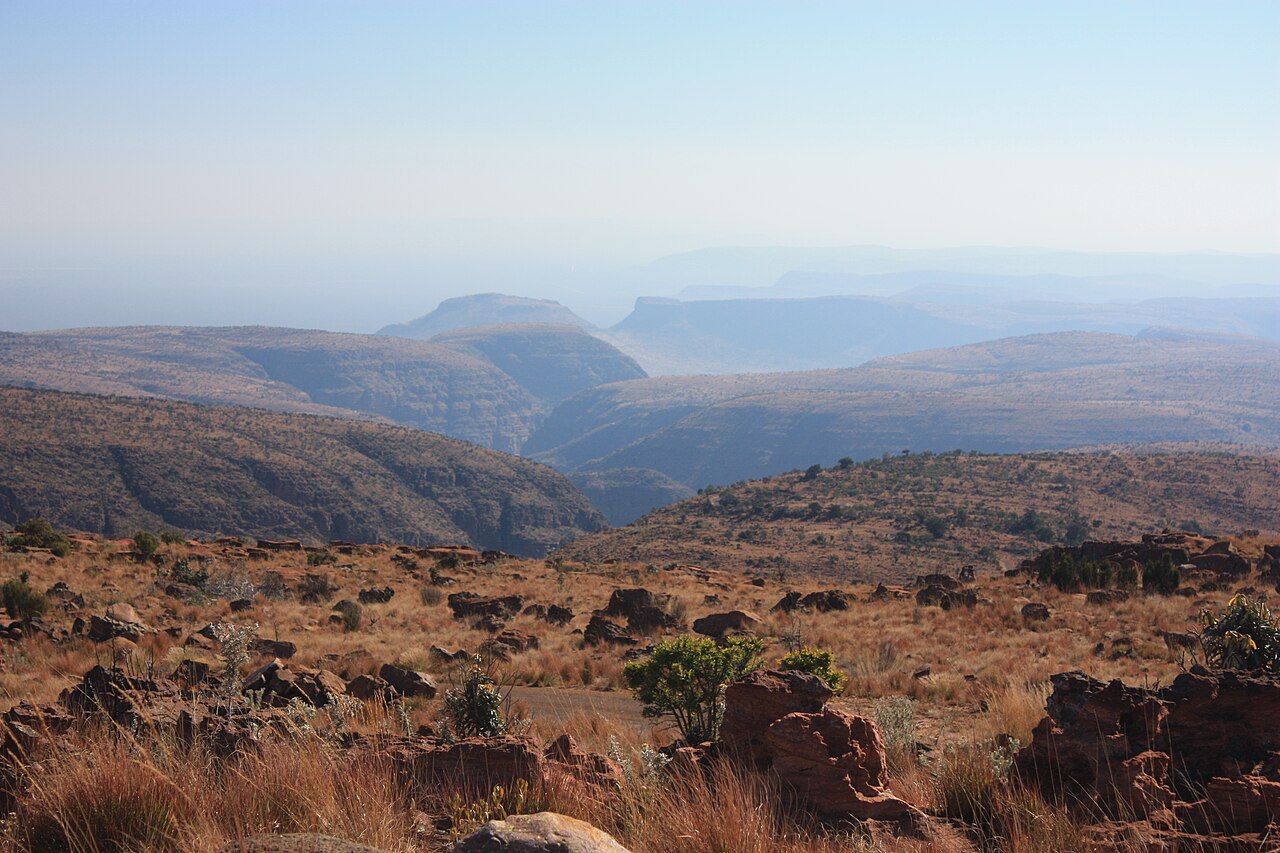
Waterberg mountain panorama in Marakele National Park. Photo: Marco Schmidt · CC BY-SA 3.0. Resized and cropped for this layout.

Marakele National Park at a glance
Marakele combines a Waterberg mountain drive with bushveld wildlife close enough to Gauteng for a manageable short break. The contrast matters: open lower country, wooded slopes and high viewpoints offer different experiences within the same visit. Cape vultures are a major attraction, while elephant, rhino and antelope give the safari its larger scale. Choose the public SANParks sector and a suitable base first. Marataba is a separately managed private section with its own bookings and access, so a lodge pin there is not a destination available on an ordinary public self-drive ticket.
Official sources · checked 9 September 2026: SANParks: Marakele National Park overview · SANParks: current visitor notices. Confirm arrangements for your travel date.
When is the best time to visit Marakele?
May–August is often a comfortable first-visit period for cooler days and a generally drier bushveld, with cold mornings to prepare for. The warmer months can bring thunderstorms, richer vegetation and summer birds. The mountain viewpoint depends as much on visibility and wind as on the month: cloud can remove the view and a storm can make the exposed outing unsuitable. If the forecast is clear early, consider the mountain before committing the whole morning to the lower loops. On a hot day, allow time for shade and rest rather than making repeated climbs. Ask about current road work and the exact route to your camp; the condition of one accessible plains loop does not describe every track in the park.
Typical seasonal pattern, not a forecast or a guarantee of road access. Current local conditions take priority.
Which Marakele area suits your trip?
| Area | Best for | What to expect | Planning point |
|---|---|---|---|
| Kwaggasvlakte and Bontle | A first public-sector safari | Lower open country and bushveld provide a practical introduction to the park. | Obtain the current map and distinguish ordinary visitor roads from rougher routes. |
| Tlopi and the dam setting | A different overnight base | Waterside vegetation adds birds and changing views close to the tented camp. | Accommodation access is for booked guests; do not walk along the water’s edge independently. |
| Lenong and the high mountain road | Panoramas and soaring raptors | Elevation changes the vegetation and the scale of the surrounding landscape. | Check visibility and road conditions; use designated stops and leave cliffs undisturbed. |
| Guided 4×4 and specialist routes | A separately organised experience | More remote country needs suitable vehicles, permissions and preparation. | Historic mapped trail camps do not imply a currently bookable independent route. |
| Marataba private section | An independently booked lodge safari | Private accommodation operates with its own guiding and arrival arrangements. | Keep its gate and booking instructions separate from the SANParks public entrance. |
Marakele entry fees, permits and opening hours
These are daily conservation fees per person for 1 November 2025–31 October 2026, as displayed by SANParks when reviewed. Adult rates apply from age 12; child rates apply at ages 2–11. Bring the identity or residency documents needed for your category and a payment card. Accommodation, guided activities and any equipment or transport are separate. A 1% community fund is added to accommodation and activity reservations. If you hold a Wild Card, check that its membership category covers the park and all travellers; bring the current membership confirmation and identification. For visits from 1 November 2026, use the next tariff rather than extending these prices.
| Visitor category / section | Adult | Child (2–11) |
|---|---|---|
| South African citizens and residents | R73 | R37 |
| SADC nationals | R149 | R74 |
| Other international visitors | R325 | R163 |
Official sources · checked 9 September 2026: SANParks: current conservation fees · SANParks: current visitor notices. Confirm arrangements for your travel date.
Opening hours
Confirm the applicable seasonal entrance, reception and internal driving hours with SANParks before arrival. The entrance-gate page lists different schedules for the available gate selections, while the access page separately restricts travel to accommodation to the daytime period and states no driving after 18:00. Plan a daylight check-in well before the confirmed cut-off; do not use a general opening time as permission for a late mountain drive.
Official sources · checked 9 September 2026: SANParks: current visitor notices · SANParks: entrance hours · SANParks: access and directions. Confirm arrangements for your travel date.
How do you get to Marakele?
Thabazimbi is the practical town to use when arranging the final approach to the public park entrance. SANParks describes routes from Gauteng via Brits and the R511, or via Bela-Bela and the R516; choose using current road conditions and your starting point. Refuel and shop before entering, then allow time for reception and the drive to your actual camp. Ask specifically about the narrow mountain road and any road works, especially with a low-clearance rental car. Regional airstrip markers provide orientation only and require separate landing and transfer arrangements. If staying at Marataba, use the lodge’s own arrival directions throughout rather than routing through the public park entrance.
Official sources · checked 9 September 2026: SANParks: current visitor notices · SANParks: access and directions. Confirm arrangements for your travel date.
Marakele map: 20 useful places
Use this map to compare bases and understand the landscape. Search by place or filter by type. All locations are approximate orientation points; current park, guide and lodge directions override the map.
Loading map near this section. All places are also listed below.
All 20 map places and access notes
- Main gate — Thabazimbi approach · Gates & visitor centresVisitor access point. Confirm the correct entrance, current hours and onward directions before arrival. Map source. Approximate.
- Ikhutseng Picnic Site · Areas & trail referencesLandscape or trail reference. This pin is not a trailhead or a verified route; obtain the current authorised map and advice. Map source. Approximate.
- Lenong view point · ViewpointsUse the designated viewpoint or hide only when open. Follow the current visitor route and keep clear of edges and wildlife. Map source. Approximate.
- Tlopi Tented Camp · Camps & lodgesAccommodation reference. Book ahead and obtain the correct reception, arrival route and current facilities from the operator. Map source. Approximate.
- Bontle Rest Camp · Camps & lodgesAccommodation reference. Book ahead and obtain the correct reception, arrival route and current facilities from the operator. Map source. Approximate.
- Bollonoto Bird Hide · Areas & trail referencesLandscape or trail reference. This pin is not a trailhead or a verified route; obtain the current authorised map and advice. Map source. Approximate.
- Bollonoto Dam · Water featuresGeographic water-feature reference, not a launch, swimming or direct driving destination. Use only authorised visitor access. Map source. Approximate.
- Tlopi Dam · Water featuresGeographic water-feature reference, not a launch, swimming or direct driving destination. Use only authorised visitor access. Map source. Approximate.
- Bontle Camp Waterhole · Water featuresGeographic water-feature reference, not a launch, swimming or direct driving destination. Use only authorised visitor access. Map source. Approximate.
- Kransberg · Areas & trail referencesLandscape or trail reference. This pin is not a trailhead or a verified route; obtain the current authorised map and advice. Map source. Approximate.
- Thutong Environmental Centre · Gates & visitor centresEducation facility reference. Arrange a visit and confirm the correct approach; this is not the ordinary main entrance. Map source. Approximate.
- Thabazimbi airfield — outside park · AirstripsAirfield reference only. Landing permission, service availability and ground transfers must be arranged separately. Map source. Approximate.
- Marakele 4×4 Eco Trail Trail Camp · Camps & lodgesSpecialised 4×4 eco-trail facility. Advance booking, current operation and the permitted itinerary must be confirmed; not a normal self-drive shortcut. Map source. Approximate.
- Entrace Gate to Marakele 4×4 Eco Trail · Gates & visitor centresSpecialised 4×4 eco-trail facility. Advance booking, current operation and the permitted itinerary must be confirmed; not a normal self-drive shortcut. Map source. Approximate.
- Trail Camp Marakele 4×4 Eco Trail · Camps & lodgesSpecialised 4×4 eco-trail facility. Advance booking, current operation and the permitted itinerary must be confirmed; not a normal self-drive shortcut. Map source. Approximate.
- Marataba private lodge entrance · Gates & visitor centresPrivate concession facility requiring a confirmed booking and operator directions. Ordinary park entry does not give unrestricted access. Map source. Approximate.
- Marataba Safari Lodge · Camps & lodgesPrivate concession facility requiring a confirmed booking and operator directions. Ordinary park entry does not give unrestricted access. Map source. Approximate.
- Marataba Trails Camp · Camps & lodgesPrivate concession facility requiring a confirmed booking and operator directions. Ordinary park entry does not give unrestricted access. Map source. Approximate.
- Marataba Explorers Camp · Camps & lodgesPrivate concession facility requiring a confirmed booking and operator directions. Ordinary park entry does not give unrestricted access. Map source. Approximate.
- Marataba Founders Camp · Camps & lodgesPrivate concession facility requiring a confirmed booking and operator directions. Ordinary park entry does not give unrestricted access. Map source. Approximate.
Map references include official park material where specified below, plus OpenStreetMap contributors, checked 9 September 2026. Selected and labelled by See.Africa. Waterbody-centre pins and summits are geographic references, not destinations for direct navigation. Accommodation and airstrip operation must be confirmed. No live animal locations or verified driving route is shown.
A practical Marakele itinerary
One day: lower country plus one mountain outing
Arrive early and ask about weather and roads. Combine a manageable lower loop with Lenong only if conditions and remaining time suit. A rushed climb near closing is a poor substitute for a deliberate scenic drive.
Two nights: camp and mountain contrast
Spend arrival afternoon near the chosen base. Use the full day for a mountain visit and a separate bushveld drive, with a rest between them. Leave the final morning for a shorter circuit that fits the onward journey.
Three nights: add a guide
Book a guided walk or drive on a day without a transfer. Ask about ages, fitness, group size and weather alternatives. A guide can help distinguish woodland birds and tracks that are easy to overlook from the road.
A birding-focused stay
Allocate time to both lower woodland and high ground. Watch soaring conditions rather than expecting vultures overhead all day. Revisit a productive edge quietly and avoid directing attention toward nests or roosts.
Where should you stay in Marakele?
Bontle and Tlopi are the main public-sector choices and should be compared by location and facilities before price. Bontle offers camping and safari-tent options in the lower landscape; Tlopi’s tents overlook a dam and suit visitors seeking that setting. Check kitchens, power, bedding and how the camp handles wildlife movement. Camps are not grounds for independent wandering into the surrounding bush, and food must be protected from primates. A Marataba lodge stay is a separate product with different inclusions, transport and guiding. If your priority is self-driving public roads, compare the SANParks bases directly; if it is a lodge programme, ask the lodge which part of the wider park its activities cover.
Marakele mammals to look for
Habitat and timing affect what you see more than the length of the park’s species list. Compare grazers in more open country with browsers in denser vegetation. Predators and brown hyena are elusive, and a good viewpoint is not a guaranteed animal-watching station. Sensitive or live animal locations are not mapped; follow the park’s responsible wildlife-viewing instructions.

African bush elephant
The broad ears, curved tusks and long trunk are unmistakable. Watch how a family spreads out to feed, then regroups before moving. Stop well back from the herd and leave its crossing route open; a close calf is a reason to retreat, not advance.


White rhinoceros
The broad, square muzzle is adapted to grazing; a long head carried low also helps identification. Keep your distance even when an animal appears relaxed. Do not publish live locations or ask a guide to pressure a rhino into a clearer position.


Black rhinoceros
A hooked upper lip helps this browser select twigs and leaves. It is often harder to spot than a grazing white rhino because it uses thicker cover. Sightings deserve patience and a quiet approach, with current ranger guidance taking priority over photography.


Lion
Lions spend much of the day resting, so search shade as carefully as open ground. Dawn and late afternoon improve the chance of movement, but a sleeping pride is a normal encounter. Listen to your guide and avoid surrounding animals with vehicles.


Leopard
Rosettes, a long tail and a powerful, low body distinguish this secretive cat. Search riverine trees, shaded rocks and dense drainage lines. A leopard can disappear in apparently thin cover; patient scanning is more useful than assuming that a radio report guarantees a sighting.
.jpg)

Brown hyena
A shaggy brown coat, sloping back and relatively pale legs separate this elusive carnivore from spotted hyena. Most visitors will not see one. Tracks and a guide’s interpretation may provide the better introduction; do not approach dens or use food to attract animals.
_leaving_waterhole_..._(50915531592),_crop.jpg)

Greater kudu
Large ears, narrow pale body stripes and the male’s long spiral horns help identify this woodland browser. Kudu can freeze and blend into scrub remarkably well. Scan the shady side of thickets; a pair of ears is often the first thing you notice.


Impala
The slender body, black tail stripe and dark markings above the hind feet are useful clues. Males have lyre-shaped horns. Pause to watch bachelor groups or territorial behaviour: familiar antelope are often the best animals for learning how a safari ecosystem works.
_male_Serengeti.jpg)

Waterbuck
A shaggy coat, robust build and affinity for water are the main clues. Rump patterns differ between forms and regions. Look at the woodland–grassland boundary near rivers or lakes, where animals can graze while remaining within reach of shade and water.


Sable antelope
Backward-curving horns, strong facial markings and a dark adult male coat are striking field clues. Females and young animals are browner. Search woodland openings rather than expecting every herd on the riverbank; a slow drive through suitable habitat is worthwhile.
_adult_male.jpg)

Chacma baboon
A long muzzle and substantial build identify this southern African baboon. Troops forage widely and readily investigate unsecured food. Keep doors, windows and picnic bags closed; never feed an animal or display food to attract it for a photograph.
_(16824823063).jpg)

Vervet monkey
A black face framed by pale fur contrasts with the grey-green body. Small groups use woodland, river edges and some camps. Alarm calls can alert other animals to danger. Keep snacks hidden and enjoy the troop’s behaviour without trying to attract it closer.
,_parque_nacional_del_lago_Nakuru,_Kenia,_2024-05-18,_DD_77.jpg)
Marakele birds and habitat clues
Marakele sits between wetter eastern and drier western bird communities, making changes in elevation and vegetation particularly useful. High ground offers raptors and mountain birds, while wooded waterways and the lower bushveld hold different species. Cape vultures are a highlight, but distant birds require patient identification. River specialists belong to suitable habitat and access conditions, not every camp-side puddle.

Cape vulture
A large, pale-bodied vulture whose broad wings make an impressive shape against mountain skies. Wind and rising warm air influence when birds soar. Observe from authorised viewpoints without approaching breeding ledges or disturbing resting birds.
_1.jpg)

Verreaux’s eagle
A large dark eagle associated with rocky landscapes. Adults show a pale back marking and contrasting wing panels, although distance and strong backlight can hide them. Watch the shape and soaring pattern with binoculars. Cliff nesting birds should be observed from public routes without approaching ledges.
,_Aquila_verreauxii,_at_Walter_Sisulu_National_Botanical_Garden,_Gauteng,_South_Africa_(28825027073).jpg)

Jackal buzzard
This broad-winged southern African raptor often uses slopes and uplift. Adults can show rich chestnut on the chest and tail, though distance and light complicate identification. Study several features together and compare with other buzzards before naming a silhouette.


Martial eagle
A very large eagle with broad wings; adults have a dark upper chest and spotted pale belly. Search high perches and scan soaring raptors carefully. Size alone is unreliable, so use shape and plumage rather than a distant silhouette as proof.
.jpg)

Little bee-eater
A small green bee-eater with a yellow throat and dark breast band. Pairs use low exposed twigs to launch after insects. Wait at a respectful distance for a return to the perch, avoiding nesting banks and fragile waterside vegetation.
_Namibia.jpg)

Malachite sunbird
Breeding males have brilliant green plumage and a long tail; females and non-breeding birds require a more careful look. Flowering slopes can be productive. Avoid confusing a flash of green with a complete identification, particularly when several sunbirds share a patch.


Cape bunting
A striped face, warm wing tones and seed-eating bill identify this bunting of suitable rocky and open habitats. Watch the ground around a natural perch. Small birds often reveal themselves through repeated short movements rather than an obvious long flight.


Half-collared kingfisher
A small blue kingfisher associated with suitable wooded waterways. It can sit quietly over water and be overlooked even at close range. Keep your distance from riverbanks and nesting holes; the right habitat improves your chances but does not guarantee a sighting.

Marakele plants and habitats
Waterberg moist bushveld
Higher and intermediate slopes support vegetation different from the drier low ground. Shade, exposure and elevation influence which trees and birds you encounter.
Mixed bushveld
Silver cluster-leaf, sickle bush and related woody vegetation provide browse and structure in lower areas. Compare open patches with dense cover rather than expecting uniform visibility.
Mountain vegetation
Exposed ground near the high viewpoints has its own plants and bird community. Stay on authorised surfaces, keeping away from cliffs and sensitive vegetation.
Water and drainage edges
Dam margins and wooded watercourses concentrate different plants and insects. Use the camp’s permitted viewpoints and never infer safe walking or swimming access from a waterside setting.
Plant identification may require leaves, flowers, fruit and a knowledgeable guide. Do not collect plants or leave authorised routes to inspect them.
What can you do in Marakele?
Visit Lenong in suitable conditions
Make the mountain outing about the panorama and birding, allowing time for the road itself. Turning back in poor visibility is a sensible part of a flexible visit.
Watch Cape vultures responsibly
Use binoculars from public viewpoints and look for natural flight behaviour. Do not approach breeding ledges, use drones or leave food to draw birds closer.
Arrange a guided walk
A booked walk can add tracks, plants and smaller details to a vehicle safari. Follow the ranger’s instructions and treat the route as a specifically authorised activity.
Compare two habitats in one day
A lower bushveld circuit and a mountain visit reveal how much changes with height. Give each enough time rather than treating the viewpoint as a quick stop between animal sightings.
Rules and practical precautions
Respect internal road restrictions, closing times and the narrow mountain route. Get out only where authorised and never follow animals on foot from a camp. Private lodge gates and specialist trail camps need prior arrangements. Keep food secure around primates and give vultures, other nesting birds and cliff habitats an undisturbed buffer.
Give wildlife space
Never feed, surround or block an animal. Keep food secure, voices low and movements predictable. Your guide or ranger’s instructions take priority over a desired photograph.
Prepare for your actual activity
Bring water, sun or rain protection as appropriate, suitable footwear and charged equipment. Tell the operator about relevant mobility needs before booking so the route and vehicle can be matched to you.
Official sources · checked 9 September 2026: SANParks: Marakele National Park overview · SANParks: current visitor notices. Confirm arrangements for your travel date.
Marakele travel FAQ
How many nights are useful in Marakele?
Two or three nights allows a balanced visit to the lower bushveld, mountain viewpoint and a possible guided activity.
Can public visitors drive into Marataba?
No ordinary public access should be assumed. Marataba is a privately managed section with separate lodge bookings and entry arrangements.
Is Lenong viewpoint always worth the drive?
It is best approached in suitable visibility, weather and road conditions. Confirm the day’s advice and leave enough time for a careful return.
What are the international entry fees?
SANParks lists R325 per adult and R163 per child aged 2–11 per day for 1 November 2025–31 October 2026.
Are sedan vehicles suitable?
Some main routes can work in suitable conditions, but SANParks warns that sections can be challenging. Ask about the exact roads and camp access before travelling.
Can I walk independently near the camps?
Follow each camp’s permitted pedestrian areas. Walking into wildlife habitat requires the appropriate authorised guided arrangement.
Sources, method and review date
This guide combines official park and operator information with editorial planning advice. Operational details were checked on 9 September 2026. Season descriptions are typical patterns, and suggested stays are planning recommendations. Wildlife profiles explain identification and habitat; they do not promise sightings.
Wildlife and image references
Species names and identification photographs were checked against the linked reference and image records. Photographs are identification examples and may have been taken elsewhere. Each image carries its own creator and licence credit.
Species reference links
African bush elephant · White rhinoceros · Black rhinoceros · Lion · Leopard · Brown hyena · Greater kudu · Impala · Waterbuck · Sable antelope · Chacma baboon · Vervet monkey · Cape vulture · Verreaux’s eagle · Jackal buzzard · Martial eagle · Little bee-eater · Malachite sunbird · Cape bunting · Half-collared kingfisher