
Serengeti Safari Guide
The practical 2026 guide to the Serengeti: best time to visit, Great Migration regions, interactive map, wildlife, access, safari planning and how to choose the right area for your trip.
Serengeti National Park at a glance
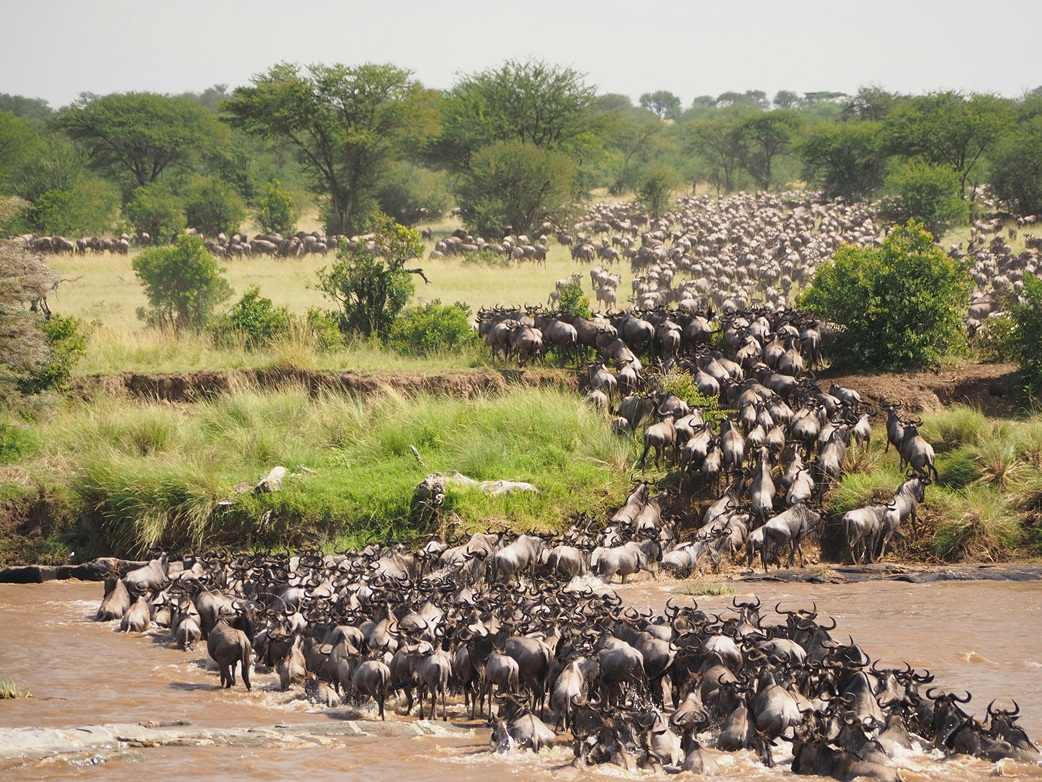
Serengeti National Park is the core protected area of Tanzania’s Serengeti ecosystem and one of Africa’s defining safari landscapes. UNESCO lists the World Heritage property at 1,476,300 hectares and describes the annual movement of huge wildebeest, zebra and gazelle herds followed by predators as one of the world’s most impressive natural spectacles. The Serengeti is much more than migration season: lions, cheetahs, elephants, buffalo, giraffes and resident plains game make strong safari viewing possible throughout the year.
Best time to visit Serengeti
There is no single best month for every Serengeti safari. June to October is the easiest general recommendation for dry-season wildlife and road conditions. January to March is the classic period for the southern short-grass plains and calving phase of the Great Migration. July to October is the broad northern Serengeti window for Mara River crossing opportunities. Migration timing remains rain-driven and can shift.
For calving
January–March is the broad southern-plains window. Much of the famous Ndutu short-grass area lies in the adjoining Ngorongoro Conservation Area, so choose accommodation by actual herd position rather than the park name alone.
For river crossings
July–October is the broad northern Serengeti / Mara River window. Crossings cannot be scheduled or guaranteed, and several quiet days may separate dramatic events.
For fewer crowds
April–May and November can be quieter and greener. Rain can make some tracks slower, so build flexibility into road itineraries.
Planning where to sleep? See our three recommended Central Serengeti lodges ↓
Which Serengeti region is best for your safari?
Central Serengeti is the best default for a first safari, but the best region changes with the migration. Serengeti is too large to treat as one uniform game-drive area. Choose where you sleep according to season and wildlife objective.
| Region | Best for | Strongest broad season | Planning note |
|---|---|---|---|
| Central / Seronera | First safari, big cats, year-round resident wildlife | Year-round | Best all-round base; can be busy because wildlife and access are consistently good. |
| Western Corridor / Grumeti | Migration movement, river habitat, quieter feel | Roughly May–July | Useful when herds move west/north; exact timing follows rainfall. |
| Northern / Kogatende | Mara River, crossing chances, remote landscapes | Roughly July–October | Best when migration herds are north; distances from Seronera are substantial. |
| Southern plains / Ndutu ecosystem | Calving, short-grass plains, predator action | Roughly Dec–March | Much of Ndutu lies outside Serengeti National Park in the Ngorongoro Conservation Area; plan the ecosystem, not just the boundary. |
Serengeti park fees: what to budget for
Serengeti National Park fees are set by Tanzania National Parks (TANAPA) and vary by visitor category, age and the services used. The TANAPA tariff page currently displays a non-resident Serengeti conservation-fee figure, but the same page labels its tariff schedule as financial year 2023/2024. Because that date label is stale, this guide does not present the displayed figure as a guaranteed 2026 rate.
Check the live TANAPA tariff
Reconfirm conservation, vehicle, camping and any other applicable fees immediately before payment. Taxes and additional accommodation/concession-related charges can affect the final park cost.
Ask what is included
Confirm whether the quoted safari price includes TANAPA conservation fees, vehicle charges, concession/camping fees and applicable taxes, rather than comparing only the headline tour price.
How to get to Serengeti
Naabi Hill side
Many overland safaris enter the Serengeti ecosystem from the Arusha–Ngorongoro side through the southern/eastern approach. Allow a full travel day when combining Ngorongoro and Central Serengeti rather than treating the distance as a short transfer.
Seronera
Seronera is the practical centre of Central Serengeti, with a major light-aircraft airstrip, visitor services and access to productive plains, riverine habitat and kopjes.
Ndabaka side
The western gateway is useful for itineraries connecting toward Lake Victoria/Mwanza and the Western Corridor. Confirm current road and gate arrangements with TANAPA or your operator.
Serengeti map: regions, rivers and safari hubs
Use this map to understand scale and safari regions. Pins and shaded zones are planning aids, not navigation-grade boundaries or live migration locations. Herds move with rain and grazing.
The optional route is a Central Serengeti planning sequence, not a turn-by-turn road line. Follow TANAPA signs, current road conditions and ranger/operator instructions.
How to plan one day in Central Serengeti
Dawn: Seronera predator country
Start early around plains, drainage lines and kopjes. Lions, hyenas and cheetahs are often most rewarding before heat builds, and soft light improves photography.
Morning: riverine habitat + plains
Work one productive zone slowly instead of chasing distant radio calls. Seronera’s mix of water, woodland and open grass creates year-round resident wildlife.
Midday: rest rather than distance
Use midday for a lodge/camp break or safe designated stop. Do not turn a Central Serengeti day into a rushed Northern Serengeti return trip.
Late afternoon: kopjes and open ground
Position near rocky outcrops or open hunting habitat for cats and plains game as temperatures fall, leaving enough time to follow current park operating rules.
Where should you stay in Serengeti? Our top 3 lodges
For a first Serengeti safari, choosing the right region matters as much as the lodge. These three stays suit a Central Serengeti itinerary around Seronera; for northern migration or southern calving trips, choose a camp nearer the relevant region. Explore our 10 best Serengeti safari lodges and camps for a wider selection.

Four Seasons Safari Lodge Serengeti
A full-service luxury base for central Serengeti wildlife drives, with comfortable rooms and a savannah-facing setting.
Check availability on Expedia ↗
Serengeti Serena Safari Lodge
Established central-park lodge with traditional architecture, open-plain views and a practical base for Seronera game drives.
Check availability on Expedia ↗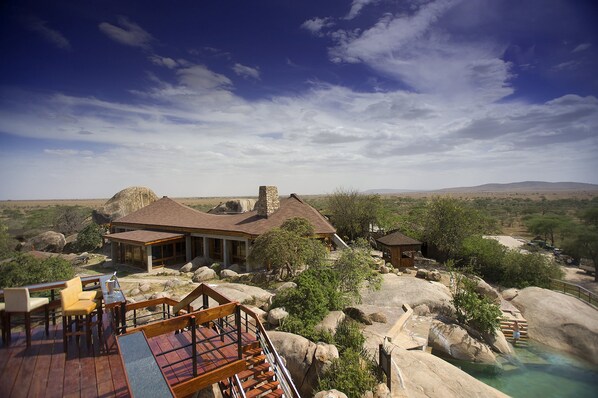
Seronera Wildlife Lodge
A straightforward, long-established Seronera lodge for travellers who put time in the park ahead of boutique styling.
Check availability on Expedia ↗Affiliate disclosure: Booking through Expedia links may earn see.africa a commission at no additional cost to you. Final price, current availability, access, fees and transfers must be confirmed with the booking provider.
24 mammals to know on a Serengeti safari
The Serengeti supports exceptional resident predator and herbivore communities in addition to the migration. Likelihood labels are practical visitor context, not population estimates; sightings vary by region, season and luck.
Lion
One of the Serengeti’s signature predators. Scan kopjes, drainage lines and prey-rich plains, especially early and late.
Field notes
- Prides may use rocky outcrops for shade and visibility.
- Watch herbivore alarm behaviour as well as the landscape.
- Give hunting animals space and avoid crowding.
Cheetah
Short-grass and open plains make Serengeti excellent cheetah country, especially where gazelles are abundant.
Field notes
- Look for black tear marks and a light, long-legged build.
- Individuals often use low rises to scan.
- Midday can still be productive if a cheetah has shade.
Leopard
Central Serengeti riverine woodland is classic leopard habitat, but sightings remain less predictable than lion.
Field notes
- Scan large branches and shady riverbank trees.
- Rosettes distinguish leopard spots from cheetah dots.
- Be patient around dense cover.
African bush elephant
Family groups and bulls move through woodland, river systems and open country throughout the wider ecosystem.
Field notes
- Never block a herd’s travel direction.
- Watch trunk, ear and herd behaviour for signs of discomfort.
- Wide landscape photographs suit Serengeti’s scale.
African buffalo
Large herds occur where grazing and water are suitable, while older bulls may be in smaller groups.
Field notes
- Adult bulls develop heavy horn bosses.
- Oxpeckers and egrets can accompany buffalo.
- Always give them generous space.
Black rhinoceros
UNESCO lists black rhino among Serengeti’s threatened species. A sighting is special and never something to promise.
Field notes
- Hooked upper lip adapted for browsing.
- Follow all ranger guidance around sensitive sightings.
- Do not publicise real-time rhino locations.
Blue wildebeest
The animal most associated with the Great Migration. UNESCO describes more than a million wildebeest participating in the wider annual movement.
Field notes
- Herd distribution changes dramatically with rain and grass.
- Calves synchronize broadly in the southern ecosystem.
- Large herds attract predators and scavengers.
Plains zebra
Zebra often travel with wildebeest, using different parts of the grass layer and adding to huge mixed-herd spectacles.
Field notes
- Every stripe pattern is unique.
- Mixed herds are good places to scan for carnivores.
- Listen for barking contact calls.
Masai giraffe
Often encountered around acacia woodland and bush rather than the shortest treeless plains.
Field notes
- Irregular leaf-like patches are characteristic.
- Watch for browsing and social necking behaviour.
- Useful scale subject in wide landscapes.
Spotted hyena
A highly successful social hunter and scavenger, especially visible around dense herbivore concentrations.
Field notes
- Sloping back and spotted coat.
- Clans can cover large territories.
- Dawn is excellent for active animals.
Hippopotamus
Look for hippos in deeper river pools and permanent water, including central river systems.
Field notes
- They graze mostly on land at night.
- Never approach water margins casually.
- Eyes and ears may be the only visible features.
Topi
A dark-shouldered antelope often standing conspicuously on termite mounds or rises.
Field notes
- Long face and sloping body profile.
- Excellent lookout behaviour.
- Commoner in some regions than others.
Show 12 more Serengeti mammals
Thomson’s gazelle
Small fast gazelle with a bold black side stripe; important prey on short-grass plains.
Grant’s gazelle
Larger and paler than Thomson’s gazelle and well suited to drier open country.
Impala
Most associated with woodland and bush edges rather than the barest short-grass plains.
Common eland
A huge yet athletic antelope found in open bush and plains.
Coke’s hartebeest
A long-faced plains antelope that uses open grassland in the wider Serengeti ecosystem.
Waterbuck
A shaggy antelope tied more closely to reliable water and greener cover.
Common warthog
Frequently seen grazing on knees or running tail-up toward a burrow.
Black-backed jackal
Alert small canid that both hunts and scavenges around plains and predator activity.
Bat-eared fox
Huge ears help locate termites and insects; often most active in cooler hours.
Serval
Long-legged spotted cat of tall grass and wetter habitat; sightings are a rewarding bonus.
African wild dog
UNESCO lists wild dog among threatened Serengeti species. Encounters are rare and unpredictable.
Olive baboon
Large social primate using woodland, rocky areas and riverine habitats. Never feed wildlife around camps.
10 Serengeti birds worth learning
The Serengeti is a serious birding destination, not simply a mammal park. UNESCO notes more than 500 bird species across the ecosystem.
Common ostrich
The world’s largest living bird is conspicuous on open plains; males are black-and-white and females greyer brown.
Secretarybird
A long-legged ground-hunting raptor that patrols open grassland on foot.
Kori bustard
A massive ground bird that can disappear surprisingly well against dry grass.
Lilac-breasted roller
A colourful roadside favourite often hunting from exposed thorn-tree perches.
Martial eagle
One of Africa’s largest eagles; scan tall trees and the sky for this powerful raptor.
Bateleur
A distinctive short-tailed eagle frequently seen rocking in low soaring flight.
Grey crowned crane
Elegant crane of wetter grassland and marsh margins, with a golden crown.
Southern ground hornbill
Large terrestrial hornbill moving through grassland in slow family groups.
Fischer’s lovebird
A colourful northern-Tanzania specialty associated with dry woodland and savanna.
Superb starling
Iridescent, common and approachable around many visitor areas—one of the easiest Serengeti birds to learn.
Serengeti trees, grasses and wetland plants
The landscape changes from short-grass volcanic plains to acacia woodland, rocky kopjes, riverine vegetation and wetter corridors. Exact plant occurrence varies by soil, rainfall and region.
Key trees & shrubs
Umbrella thorn
The classic flat-topped savanna tree and an important browse/perch species.
Whistling thorn
A swollen-thorn acacia relative associated with black-cotton savannas in East Africa.
Fever tree
Yellow-green bark marks this moisture-associated tree in suitable wetter habitats.
African myrrh
Dryland tree/shrub with peeling bark and aromatic resin.
Desert date
A hardy thorny tree tolerant of dry savanna conditions.
Sausage tree
Large hanging fruits make this riverine/wetter-habitat tree unmistakable.
Sycamore fig
Spreading fig of better-watered ground; fruit can attract birds and mammals.
Toothbrush tree
Salt- and drought-tolerant shrub/tree known for traditional use as miswak.
Grasses, reeds & seasonal plants
Red oat grass
A major savanna grass contributing to the Serengeti grazing mosaic.
Buffel grass
Drought-tolerant perennial grass of dry savanna.
Bermuda grass
Low-growing grazing grass that tolerates disturbance and repeated herbivory.
Dropseed grasses
Several grasses in this broad group occur in East African open and seasonally wet habitats.
Papyrus
Tall wetland sedge associated with permanent freshwater systems.
Common reed
Dense emergent reed providing cover around wetland and river margins.
East African aloe
Drought-adapted aloe of the wider region with conspicuous flower spikes after favourable rains.
Lion’s ear
Orange-flowered herb of disturbed or seasonal vegetation, attractive to pollinators.
Best Serengeti safari experiences
1. Dawn game drive
The essential Serengeti experience: cooler temperatures, active predators and soft light.
2. Great Migration safari
Base yourself in the correct region for the month and follow current guide information rather than treating migration as one fixed location.
3. Hot-air balloon safari
TANAPA lists balloon safari among Serengeti activities. Book through an authorised operator and confirm the launch area, transfer and current fee structure.
4. Kopje safari
Rocky outcrops provide shade, viewpoints and habitat for lions, leopards, hyraxes and reptiles; Moru and central kopjes are classic landscape features.
5. Birding drive
With more than 500 species noted by UNESCO, slowing down for raptors, bustards, cranes, hornbills and lovebirds can transform a safari day.
6. Photography-focused safari
Serengeti rewards environmental images: migration columns, kopjes, storms, dust and huge skies are as important as close animal portraits.
Serengeti vs Masai Mara: which safari is better?
Choose Serengeti for scale, regional variety and following different phases of the Great Migration; choose Masai Mara for a more compact safari landscape and a strong July–October river-crossing focus. They are not competing ecosystems—they are connected parts of the same wider migration landscape across Tanzania and Kenya.
| Serengeti | Masai Mara | |
|---|---|---|
| Country | Tanzania | Kenya |
| Feel | Huge, regional, expedition-like | More compact and concentrated |
| Migration strength | Different regions matter across much of the year | Strongest broad migration focus July–October |
| Best first base | Central Serengeti / Seronera | Main reserve or Mara Triangle depending itinerary |
| Travel trade-off | Longer distances between regions | Easier to cover multiple areas in fewer days |
Serengeti rules that matter
Stay on authorised roads
Do not create new tracks or drive wherever a sighting appears. Follow current TANAPA/ranger directions and sector-specific restrictions.
Give wildlife space
Never use a vehicle to block movement or pressure an animal into standing, hunting or crossing where you want it.
Remain in the vehicle
Leave the vehicle only at authorised visitor areas or when explicitly permitted and guided.
Never feed animals
Feeding changes behaviour, creates conflict and can make camps and picnic areas unsafe for people and wildlife.
Serengeti FAQ
What is Serengeti famous for?
Serengeti is most famous for the Great Migration and its vast predator-rich savannahs. More than a million wildebeest take part in the wider annual migration alongside large numbers of zebra and gazelles, while lions, cheetahs, hyenas and other predators follow prey across the ecosystem.
What is the best time to visit Serengeti?
June to October is the best simple answer for a general dry-season safari. Choose January to March for the southern calving ecosystem and July to October for northern Serengeti / Mara River crossing opportunities. Migration timing changes with rainfall.
When is the Great Migration in Serengeti?
The Great Migration is a year-round cycle, not a single season. Herds generally use the southern short-grass ecosystem early in the year, move through central/western areas as conditions change, spend part of the dry season farther north, then move south again with returning rains.
How many days do you need in Serengeti?
Three to four nights is a strong first-trip minimum. Five or more nights is better if you want to combine two Serengeti regions or build flexibility around migration movements and weather.
Which part of Serengeti is best?
Central Serengeti around Seronera is the best all-round region for most first-time visitors. Northern Serengeti is strongest for Mara River crossing opportunities in the broad July–October period, the western corridor can be strong during northward migration, and the southern ecosystem is famous for calving early in the year.
Is Serengeti better than Masai Mara?
Neither is universally better. Serengeti is much larger and offers more regional variety across the migration cycle. Masai Mara is more compact and can deliver extremely concentrated wildlife viewing, especially during the broad July–October migration period.
Is Serengeti a Big Five park?
Yes, the wider Serengeti supports lion, leopard, elephant, buffalo and black rhino. Rhino is rare and should never be treated as a guaranteed sighting.
Can you self-drive in Serengeti?
Yes, independent driving is possible, but Serengeti’s scale makes preparation important. Use a capable 4×4, carry offline maps, plan fuel and travel time conservatively, check current TANAPA regulations and avoid turning long regional transfers into rushed game drives.
How this Serengeti guide was checked
See.Africa reviewed time-sensitive Serengeti information on 14 August 2026 against Tanzania National Parks (TANAPA) visitor resources and UNESCO’s Serengeti World Heritage listing. Fee pages, road notices and migration locations can change. TANAPA, rangers and current operator instructions override approximate map or seasonal planning guidance.