
Masai Mara Safari Guide
The practical 2026 guide to the Masai Mara National Reserve: best time to visit, Great Migration, best safari areas, fees, gates, interactive map, wildlife and how to plan your days.
Masai Mara National Reserve at a glance
Masai Mara is the spelling many international travellers type into search engines; Maasai Mara is the spelling that reflects the Maasai people and is widely used by Kenyan and conservation organisations. This guide uses both naturally. The reserve lies in south-western Kenya and connects ecologically with Tanzania’s Serengeti, creating one of Africa’s best-known wildlife landscapes.
Best time to visit Masai Mara
The best time to visit Masai Mara for most first-time safari travellers is June to October. Wildlife is generally easier to see in the drier season, and the Great Migration usually reaches the Mara between July and October. For lower crowds, greener scenery and excellent resident predators, January to March is a strong alternative.
For Great Migration
July–October is the usual broad window. August and September are often favoured for river-crossing chances, but herd timing moves with rain and grazing.
For fewer crowds
January–March keeps the Mara’s resident lions, elephants, cheetahs, plains game and birdlife without the same migration-season intensity.
For value + green scenery
April–May can be lush and quieter, but heavy rain can slow or close difficult tracks. Choose a capable vehicle and flexible itinerary.
What is the best Masai Mara safari?
For a first visit, the best Masai Mara safari is usually 3–4 nights with at least two full game-drive days. Choose your base by wildlife objective rather than by hotel category alone. The main reserve gives classic open-access game drives; the Mara Triangle gives excellent river/escarpment landscapes; surrounding conservancies can offer lower vehicle density and activities not generally available in the National Reserve.
| Area | Best for | Main advantage | Planning note |
|---|---|---|---|
| Main National Reserve | First safari, big cats, central access | Large classic game-drive area and many camps | Peak migration months can be busy around famous sightings. |
| Mara Triangle | Mara River, Oloololo Escarpment, migration season | 510 km² western sector with dedicated Conservancy management | Access via Oloololo/Purungat side; confirm fees and route for where you stay. |
| Private conservancies | Quieter safari, walking/night-drive options | Lower vehicle density can improve the feel of sightings | Conservancies are outside the National Reserve and use separate fees/rules. |
Masai Mara entrance fees and ticket rules
For 2026, published fee guidance shows a strong seasonal split for non-resident adults: USD 100 from January–June and USD 200 from July–December. Child, resident, citizen, vehicle, camping and other rates use separate categories. The Mara Triangle’s official guidance confirms 12-hour entry logic and cashless payment, and fees depend on where visitors stay.
Non-resident adult
USD 100 per applicable entry period. Confirm the current payment portal/rule before arrival.
Non-resident adult
USD 200 per applicable entry period. Peak-season park fees can materially change the total safari budget.
How to get to Masai Mara
Sekenani side
The Narok–Sekenani approach is the standard road route for many lodges and camps in the eastern/main reserve. Mara Conservancy notes that the road from Narok to Sekenani is tarmacked.
Oloololo / Purungat
These are important Mara Triangle entry points. Choose your route based on the exact camp location rather than simply routing to “Masai Mara.”
Fly to your camp’s airstrip
Scheduled light aircraft operate from Wilson Airport to several Mara airstrips. The correct airstrip depends on the lodge/camp transfer, so confirm it before buying a flight.
Masai Mara map: gates, river and safari areas
Use this map for orientation, not turn-by-turn navigation. Several pins are approximate planning points; actual tracks, bridge access and gate approach can change.
The optional route is a planning sequence, not a navigation line. Follow official signage, current ranger instructions and your camp/operator directions on the ground.
How to plan a Masai Mara safari day
Dawn: predators + soft light
Start at first permitted light. Lions, hyenas and cheetahs can be more active before heat builds, and the low sun is ideal for environmental photography.
Morning: work one ecosystem
Instead of chasing radio calls across the reserve, choose a productive zone—riverine woodland, plains or marsh edges—and read tracks, prey behaviour and guide cues.
Midday: reset
Use the hottest hours for a lodge break or a safe designated picnic/rest stop. Long all-day drives are worthwhile during migration only when the target area is genuinely distant.
Late afternoon: position, don’t race
Return to open predator country or a river-edge zone. Leave enough time to comply with the gate/return rules that apply to your sector and accommodation.
20 mammals to know on a Masai Mara safari
The Mara supports outstanding resident wildlife year-round. The Great Migration adds huge seasonal herds, but a good Masai Mara safari is not dependent on migration alone.
Lion
The Mara is one of Kenya’s classic lion landscapes; scan open plains, drainage lines and shade around prey-rich areas.
Cheetah
Open grassland gives cheetahs visibility for hunting. Look for animals using termite mounds or low rises as scanning points.
Leopard
Best searched for quietly around riverine woodland and dense drainage lines, especially early and late in the day.
African bush elephant
Family groups move widely between grazing, woodland and water; give herds room rather than blocking their direction of travel.
African buffalo
Large herds and old bulls occur across the Mara, often near better grazing and water.
Black rhinoceros
Present but never guaranteed. Treat a sighting as special and follow ranger/guide etiquette closely.
Blue wildebeest
Resident animals occur year-round; migration season brings far larger herds from the Serengeti ecosystem.
Plains zebra
Often mixed with wildebeest and other grazers, making zebra-rich plains good places to scan for predators.
Masai giraffe
Kenya’s distinctive giraffe with irregular leaf-like patches; often found around acacia-rich woodland and bush.
Spotted hyena
A successful social hunter as well as scavenger; dawn encounters and activity around large herbivore herds can be excellent.
Show 10 more Masai Mara mammals
Hippopotamus
Commonly associated with deeper pools and rivers. Never approach water edges casually where hippos may move between water and grazing.
Topi
A characteristic Mara antelope, often standing on termite mounds to scan the plains.
Thomson’s gazelle
Small, fast and common in open short grass; the bold black side stripe helps separate it from Grant’s gazelle.
Grant’s gazelle
Larger and paler than Thomson’s gazelle, often using somewhat drier open country.
Impala
A mixed feeder found more around woodland and bush edges than the most treeless plains.
Common eland
A huge antelope that can look surprisingly delicate in motion; often occurs in smaller groups.
Common warthog
Frequently seen grazing on short grass or running tail-up toward cover and burrows.
Black-backed jackal
A small alert canid that hunts and scavenges; often worth watching around large predator activity.
Olive baboon
Large social primates using woodland, riverine areas and some human-adjacent sites. Never feed them.
Vervet monkey
Small black-faced monkeys often seen in trees around riverine woodland and camps.
10 Masai Mara birds worth learning
Lilac-breasted roller
A colourful roadside favourite, often hunting insects from exposed perches.
Secretarybird
A long-legged ground-hunting raptor of open grassland; one of the Mara’s most distinctive birds.
Martial eagle
A huge eagle best searched for on large trees or soaring high on thermals.
Bateleur
Compact eagle with a very short tail; adults are striking in flight and frequently patrol large areas.
Southern ground hornbill
A large terrestrial hornbill moving slowly through grassland in family groups.
Kori bustard
One of the world’s heaviest flying birds and a classic species of open Mara plains.
Grey crowned crane
An elegant wet-grassland bird with a golden crown, often in pairs or small groups.
African fish eagle
Look and listen around the Mara and Talek river systems; its carrying call is often the first clue.
Saddle-billed stork
A spectacular wetland stork with red, black and yellow on the bill.
Superb starling
Common around camps and woodland; excellent for close bird photography without chasing wildlife.
Trees, shrubs and grassland plants
The Masai Mara is not one uniform grass plain. Riverine forest, open grassland, seasonal drainage lines and scattered savanna trees create different wildlife habitats.
Key trees & shrubs
Umbrella thorn
The classic flat-topped East African savanna tree.
Fever tree
Yellow-green bark marks this moisture-associated tree in suitable riverine/wetter habitats.
Sycamore fig
Large figs along better-watered ground can attract birds and mammals when fruiting.
Croton shrub
A common East African bushland shrub in suitable drier habitats.
African myrrh
A dryland tree/shrub with peeling bark and aromatic resin.
Desert date
A hardy thorny tree of dry savanna landscapes.
Grasses, reeds & seasonal flowers
Red oat grass
An important East African savanna grass and part of the grazing mosaic supporting large herbivores.
Buffel grass
A drought-tolerant perennial grass of dry savanna.
Papyrus
A wetland sedge associated with permanent water in East Africa.
Common reed
Dense reedbeds provide cover around wetland and river-edge habitats.
Kenya aloe
A drought-adapted aloe whose flower spikes become conspicuous after favourable conditions.
Lion’s ear
Orange flower whorls can attract insects and nectar-feeding birds in disturbed or seasonal vegetation.
Best Masai Mara safari experiences
For a contrasting Kenya itinerary, compare Tsavo East’s dry-country safari, Tsavo West’s springs and volcanic scenery, and Lake Nakuru’s rhinos and lake habitats. Allow a separate stay and realistic transfers for each park.
1. Dawn game drive
The core experience: predators, soft light and cooler animal activity.
2. Full-day migration drive
Useful when herds or crossing areas are far from your camp; carry water and follow ranger/guide instructions around congestion.
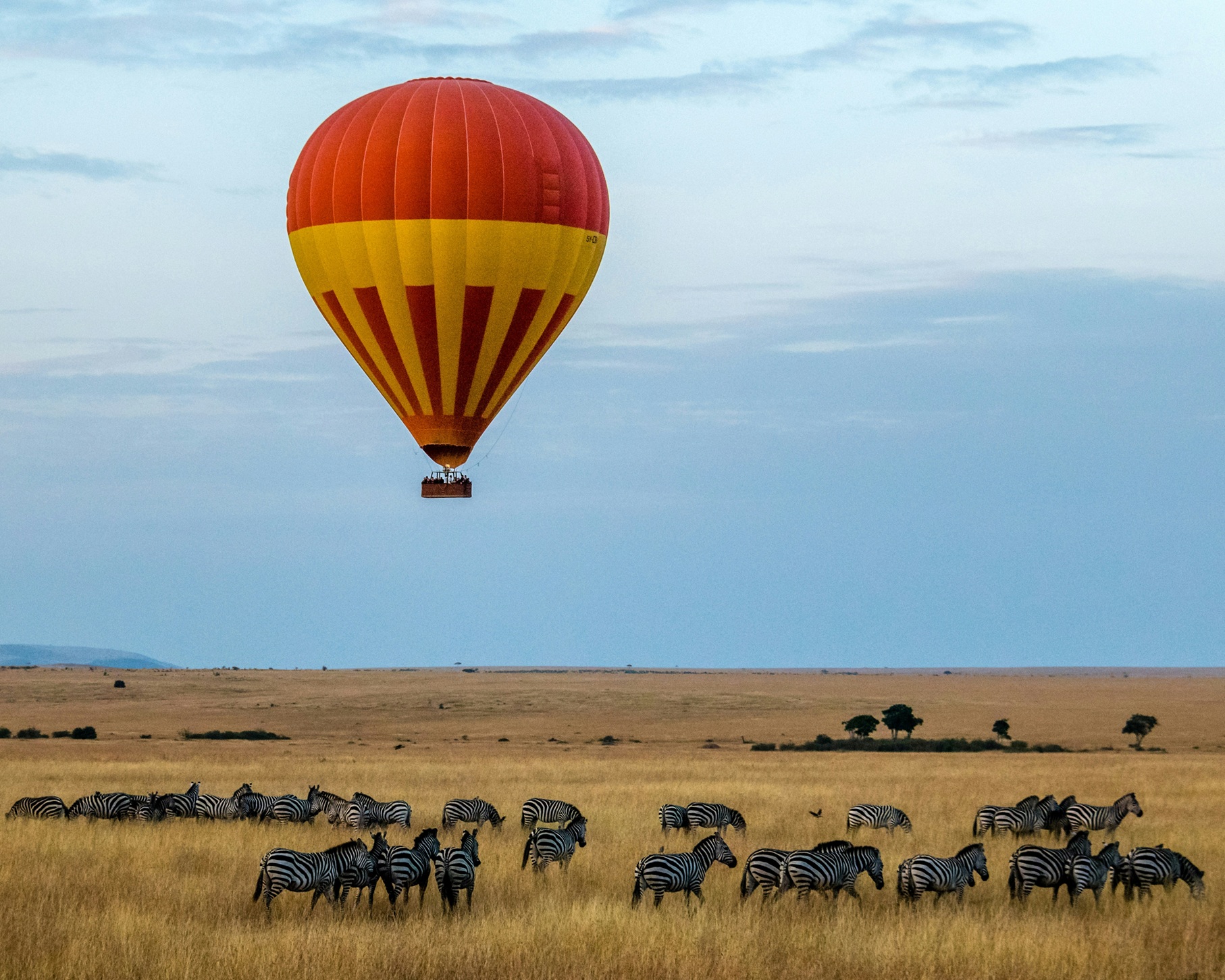
3. Hot-air balloon safari
A classic Mara experience, usually followed by breakfast. Book through a licensed operator and confirm transfer times.
4. Birding-focused drive
Ask your guide to slow down for raptors, bustards, cranes and river birds rather than only ticking large mammals.
5. Maasai community experience
Choose a respectful, community-led visit with clear local benefit rather than treating culture as a quick photo stop.
6. Conservancy safari
If your itinerary includes a surrounding conservancy, ask about activities permitted there such as guided walks or night drives; rules vary by conservancy.
Rules that matter in the Mara
Give animals space
Never box wildlife in or block its direction of travel. Mara Triangle rangers actively manage crowding and rule violations.
Stay on permitted tracks
Off-road access is restricted and controlled in parts of the ecosystem. Follow the rule for the exact sector you are driving.
Wildlife has right of way
Stop for animals on roads, keep noise low and never use the vehicle to pressure an animal into moving.
Respect sighting limits
At busy sightings, ranger instructions override your desired photo angle or viewing time.
Masai Mara FAQ
What is the best time to visit Masai Mara?
June to October is the best overall period for most first-time visitors. Wildlife is easier to see in the drier season, while July to October is the usual Great Migration window. January to March is excellent for resident wildlife with fewer peak-season crowds.
When is the Great Migration in Masai Mara?
The broad Masai Mara Migration window is usually July to October. Exact herd arrival and river crossings depend on rainfall and grazing, so no operator can guarantee a specific crossing date or time.
How many days are best for a Masai Mara safari?
Three nights is a strong first-safari default. Four nights is better if river crossings are a major goal or if you want to combine different Mara areas without rushing.
What is the best Masai Mara safari area?
There is no single best area for every trip. The main National Reserve is excellent for classic game drives, the Mara Triangle is strong for river/escarpment landscapes, and private conservancies suit travellers prioritising lower vehicle density and a broader activity mix.
Is it Masai Mara or Maasai Mara?
Maasai Mara is the culturally correct spelling linked to the Maasai people; Masai Mara is a very common international search spelling. Both usually refer to the same Kenyan reserve/ecosystem in travel searches.
Can I self-drive in Masai Mara?
Yes, but a high-clearance 4×4 is strongly recommended. Track conditions can deteriorate after rain, and independent drivers must understand gate, fee and sector rules before entering.
How much are Masai Mara park fees in 2026?
Published 2026 guidance lists non-resident adults at USD 100 from January–June and USD 200 from July–December. Other visitor categories and extras differ, and rules can change, so verify the current official/payment-source information immediately before travel.
How this guide was checked
See.Africa reviewed time-sensitive information on 13 August 2026 against Mara Conservancy visitor pages and current reserve/industry guidance. Approximate map points are for orientation only. Current authority, ranger, lodge and operator instructions override this web guide.