
Kasanka National Park Guide
Plan Kasanka around its fruit-bat migration, sitatunga-rich wetlands and quiet miombo: when to go, where to stay, map, wildlife, access and practical safari advice.
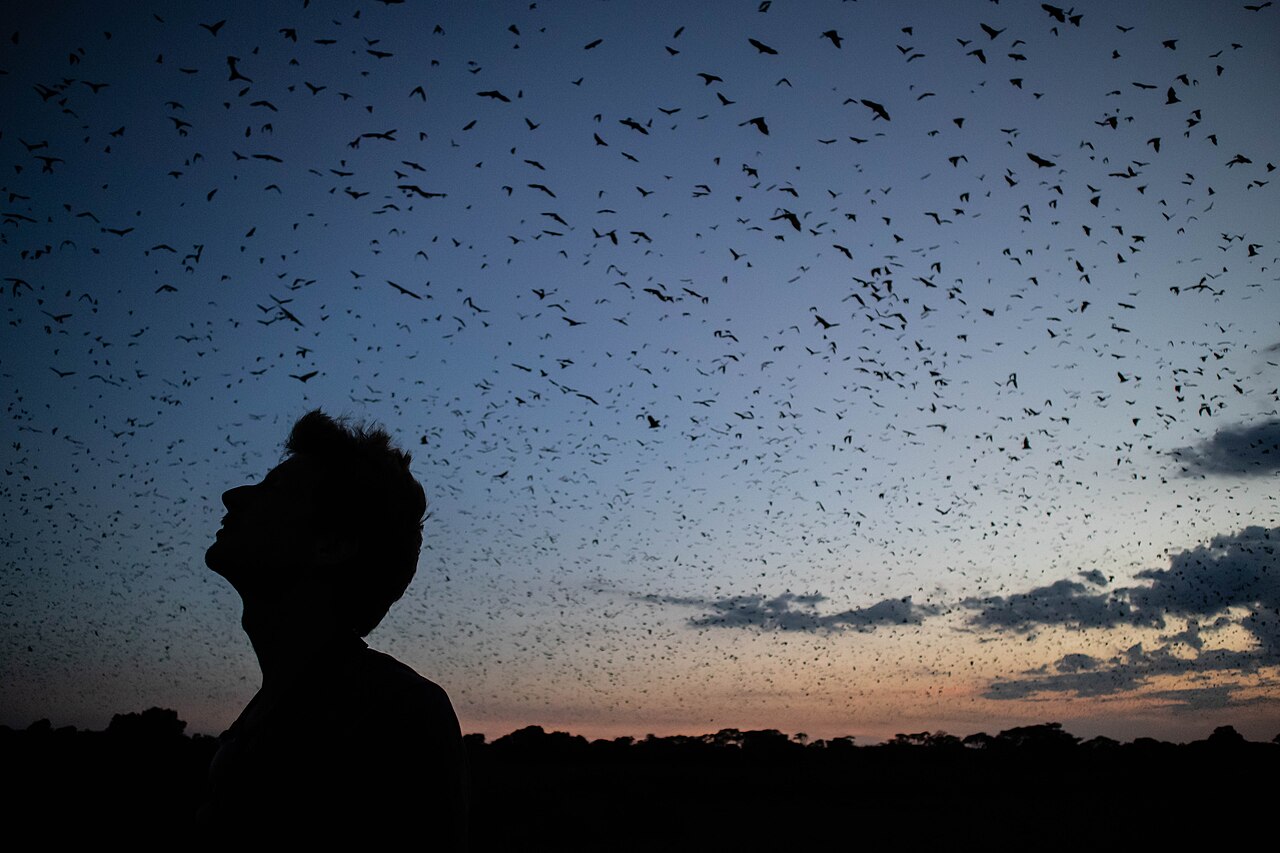
Fruit-bat emergence at Kasanka National Park. Photo: Sybryn · CC BY-SA 4.0. Resized for web.

Kasanka National Park at a glance
Kasanka is a small Zambian park with an outsized ecological story. Its headline event is the annual gathering of roughly ten million straw-coloured fruit bats between October and December, but a good visit is not only about one evening fly-out. Swamps and wet grassland hold unusually visible sitatunga and dense puku populations, riverine forest adds primates and specialist birds, and miombo woodland changes the character of a drive within a few kilometres. Because the park is compact, two to four nights can combine several habitats without the long internal transfers common in Zambia’s largest parks.
First-party sources · checked 8 September 2026: Kasanka Trust overview · wildlife and conservation · management and ecological significance.
When is the best time to visit Kasanka?
The best month depends on whether the bat migration is your main reason for travelling. Kasanka Trust describes the bats as resident between October and December. If that spectacle is essential, build flexibility into the trip and confirm recent arrivals with the park rather than assuming a fixed “peak week.” For general game viewing and self-drive logistics, the drier middle months usually make roads simpler and vegetation more open. The wet season turns the park green and can be rewarding for birding and plants, but local access changes after rain.
First-party source: Kasanka Trust states that the annual bat migration occurs between October and December. Kasanka Trust’s resource-protection material also describes their seasonal residence and forest roost.
Which Kasanka area suits your trip?
| Area or base | Best for | What to expect | Planning point |
|---|---|---|---|
| Wasa Lodge & Lake Wasa | First visits and easy logistics | Central reception base, lake scenery and a useful position for Fibwe and general drives. | Ask for current departure times to bat-viewing and sitatunga sites. |
| Fibwe / Bat Forest zone | Sitatunga and seasonal bats | Wetland/evergreen forest edge with established viewing infrastructure. | Viewing access is controlled; follow staff directions and do not enter the roost forest. |
| Pontoon area | Wetland wildlife and simple camping | Swamp-edge country close to prime sitatunga habitat and the wider Bat Forest landscape. | Confirm campsite facilities, water and seasonal access before relying on it. |
| Luwombwa River & Lodge | Birding, canoeing and a quieter extension | Riverine forest, water-based activity and a distinctly different feel from Wasa. | Allow transfer time; it is not simply another loop around Wasa Lake. |
| Chifukwe / grassland mosaic | Puku, open-country scanning and habitat contrast | Dambo and grassland edges meeting woodland. | Conditions change strongly with the season; current drive routes take priority over maps. |
Kasanka entry fees, activities and opening hours
Do not budget from undated or archived Kasanka rate tables. During this review, a complete current 2026 visitor tariff covering all park, vehicle, activity and accommodation charges could not be verified on a clearly dated official page. That is a better reason to request a current written quote than to republish an old dollar figure as if it were live.
Also confirm the current gate/reception reporting window for your arrival date. Plan to reach your accommodation in daylight. An overnight booking or guided activity does not create permission for independent after-hours driving or walking.
Checked 8 September 2026. The live Kasanka site was used for current operations; old tariff pages were deliberately not treated as a 2026 price source.
How do you get to Kasanka National Park?
Kasanka sits on Zambia’s northern safari circuit and is reachable by road from Lusaka, the Copperbelt and the Luangwa/Bangweulu side of a longer itinerary. The park’s current getting-there information describes tarred-road access to the entrance, with Wasa reception inside the park. Treat the final drive as part of the safari day: fuel outside the park, carry drinking water, save offline directions and obtain the current gate and road instructions before departure.
Kasanka also publishes an airstrip coordinate for private charter arrivals. A charter only solves the long road transfer if a confirmed ground pickup, baggage allowance and arrival time are arranged with your lodge. Do not navigate to an approximate map pin expecting airport-style services.
Driving
Use Kasanka’s current written directions rather than a generic shortest-route suggestion. Seasonal rain can change the suitability of internal roads, particularly away from the main visitor base.
Private charter
Kasanka lists an in-park airstrip. Confirm runway status and transfer arrangements directly with the park or operator before filing a flight plan or paying for a charter.
First-party source: Kasanka Trust: Getting to Kasanka, checked 8 September 2026.
Kasanka safari map: 10 useful orientation points
Use this map to understand the relationship between Wasa, the wetland/bat-viewing zone and the Luwombwa side of the park. Pins are approximate orientation references, not turn-by-turn navigation, gate status, campsite availability or live wildlife locations.
Loading interactive map. The complete place list is available below.
All 10 map points and why they matter
- Wasa Lodge / reception areaPractical first base and arrival reference. Approximate; follow Kasanka’s current directions.
- Lake WasaCentral waterbody and activity landscape near Wasa.
- Fibwe Hide / sitatunga viewing areaWetland-edge viewing reference; use the authorised access path and current staff instructions.
- Bat Forest orientation pointApproximate landscape reference only. Do not enter or approach the roost independently.
- Pontoon areaSwamp-edge visitor/camping reference associated with good sitatunga habitat.
- Luwombwa LodgeRiver-side base for a quieter, bird-rich extension.
- Luwombwa RiverWaterway used for authorised canoeing and birding activities.
- Chifukwe PlainOpen-country habitat reference useful for understanding the park’s grassland–woodland mosaic.
- Kasanka airstrip — published coordinateApproximate marker based on Kasanka’s published coordinate; confirm runway status and pickup.
- Mpululwe HillHigher-ground orientation reference on the eastern side of the visitor landscape.
Coordinates are approximate orientation points compiled from Kasanka’s visitor material and publicly mapped references, checked 8 September 2026. OpenStreetMap provides the basemap. Current park instructions override every pin.
How should you plan two, three or four nights?
Two nights: focused first look
Base at Wasa. Use the first afternoon for a nearby drive or lake activity, then make the next dawn about sitatunga. In bat season, protect the late afternoon for the emergence and avoid scheduling a long transfer on the same day.
Three nights: the strongest first visit
Add time for a second wetland watch, a woodland/grassland drive and an unhurried bat evening if in season. The extra night matters because wildlife events do not follow a timetable and rain can slow a plan.
Four nights: add Luwombwa
Combine Wasa/Fibwe with a river-side stay or dedicated Luwombwa excursion. Shift the emphasis from one spectacle to birding, forest, water and the smaller species that make Kasanka unusually varied.
Outside bat season
Keep the same habitat-based structure: dawn swamp, daylight miombo and grassland, then a river or lake session. A quieter Kasanka can be more rewarding for naturalists who want to watch behaviour rather than crowds.
Where should you stay in Kasanka?
Kasanka Trust currently presents Wasa and Luwombwa as its main lodge bases. Wasa is the easiest recommendation for a first visit because it connects reception, Lake Wasa and the core visitor network. Luwombwa sits in a different river landscape and suits travellers who want more birding, canoeing and forest time. The park also advertises seasonal or simpler camping/tented options, including bat-season arrangements near the wider viewing zone. Confirm the exact operating dates, facilities, meals, electricity, water and transfer method before choosing a remote camp solely from a map.
Wasa
Best for: first visit, central logistics, bat-season planning and a broad mix of activities.
Luwombwa
Best for: river atmosphere, birding, canoeing and a slower second base.
Camping / seasonal tented options
Best for: independent travellers who confirm facilities and dates in advance, not for arriving without a plan.
First-party source: Kasanka Trust accommodation, checked 8 September 2026.
Which mammals can you see in Kasanka?
Kasanka’s mammal list is best read by habitat and likelihood, not as a checklist. The bats are seasonal; sitatunga and puku are the defining resident herbivores; primates reward forest-edge scanning; and large mammals such as elephant, hippo, sable and leopard occur without being guaranteed. Dawn and late afternoon are useful, but a quiet hour at a wetland can be more productive than kilometres of constant driving.

Straw-coloured fruit bat
Seasonal signature. Roughly ten million bats can congregate in the small evergreen swamp-forest roost between October and December. Watch the evening emergence from authorised viewing areas and avoid lights, noise or movement that disturbs the roost.


Sitatunga
One of Kasanka’s strongest year-round targets. Long, splayed hooves help this antelope move through swamp vegetation. Fibwe and Pontoon are associated with good viewing; arrive quietly and scan reed edges rather than expecting animals in the open immediately.


Puku
A warm golden antelope common in suitable grassland. Kasanka Trust highlights the park’s dense puku population. Compare puku with impala by body colour, habitat and facial pattern instead of relying only on a quick roadside glance.


Kinda baboon
A smaller, more lightly built baboon than many visitors expect. Watch troops feeding and travelling at woodland edges. Give them space around camps and never use food to create a closer encounter.


Blue monkey
Look for this forest-associated primate in taller evergreen and riverine trees rather than open plains. Movement in the canopy, falling fruit and contact calls may reveal a group before the animals themselves are obvious.


African bush elephant
Kasanka holds an important but not safari-park-dense elephant population. Encounters can be brief and unpredictable. Stop well back, keep the animal’s route open and treat calves or a tense herd as a reason to increase distance.


Hippopotamus
Small populations use suitable waterways. Never turn a riverbank into an informal walking viewpoint and never enter water outside an authorised activity. Hippos can move surprisingly far on land after dark.

_adult_male.jpg?width=640)
Sable antelope
Backward-curving horns, bold facial markings and the dark coat of mature males are key clues. Search woodland openings and transition zones. Presence in the park is not a promise that a short drive will find a herd.
_adult_male.jpg)
_Mlilwane.jpg?width=640)
Roan antelope
A large pale antelope with strongly marked face and large ears. Roan can be local and elusive. Slow scanning of grassy woodland is more productive than assuming every open dambo will hold them.
_Mlilwane.jpg)

Waterbuck
A robust, shaggy antelope associated with water and nearby cover. Scan wetland margins and woodland–grassland edges, especially when heat pushes animals toward shade.

.jpg?width=640)
Bushbuck
A secretive browser of dense cover and riverine edges. Individuals can freeze almost invisibly in shadow. Quiet early-morning observation around forest margins gives a better chance than chasing movement through vegetation.
.jpg)
_iSimangaliso_Wetland_Park,_KwaZulu-Natal,_South_Africa.jpg?width=640)
Southern reedbuck
Look for pairs or small groups in moist grassland. A grey-brown coat and characteristic bounding escape can help identification. Remain on roads and viewing areas rather than pushing into wet grass for a photograph.
_iSimangaliso_Wetland_Park,_KwaZulu-Natal,_South_Africa.jpg)
.jpg?width=640)
Leopard
Present but secretive. Search shaded riverine trees, drainage lines and woodland margins without turning a species list into an expectation. Tracks, calls and guide knowledge may be more realistic evidence than a daylight sighting.
.jpg)
First-party wildlife source: Kasanka Trust game viewing and wildlife conservation, checked 8 September 2026. Photographs are identification examples and may have been taken elsewhere.
Which birds should you look for in Kasanka?
Kasanka Trust highlights the park as one of Zambia’s most diverse birding areas. The reason is habitat compression: swamp, river, lake, evergreen forest, dambo and miombo sit close together. Rather than chase a huge list, split birding time between water, forest edge and woodland. Pel’s fishing-owl and some other specialists need local knowledge and should never be disturbed at roost or nest sites.

Wattled crane
Search wet grassland and open swamp edges for this very tall crane. Keep a long viewing distance, especially from pairs using breeding habitat.


Pel’s fishing-owl
A large ginger-brown owl of wooded waterways. It is a specialist target, not an easy promise. Use a guide who protects known roosts and avoid flash, playback and repeated approaches.

.jpg?width=640)
African fish eagle
Listen for the carrying call around lakes and rivers, then scan exposed perches. Watching one fishing or defending a perch is often more rewarding than adding another species to the list.
.jpg)

Ross’s turaco
Look for rich violet-blue plumage and red flight feathers in taller woodland and forest. Calls often reveal a bird hidden by leaves before it crosses an opening.


Saddle-billed stork
A very large black-and-white stork with a red-yellow-black bill. Scan shallow water and wetland edges slowly; a stationary bird can blend into reflections.


Osprey
A seasonal visitor to suitable waters. Long wings, a dark eye-stripe and hovering before a plunge are useful clues. Check open snags around water as well as the sky.

Böhm’s bee-eater
A sought-after south-central African bee-eater associated with woodland. Watch exposed branches and sallies after insects, especially on quiet miombo drives.
African finfoot
A secretive waterbird of shaded rivers. A slow canoe or patient riverbank watch with a guide can be far more effective than searching noisy open water.
Half-collared kingfisher
Look along quieter shaded waterways. The bird often flashes past low over water, so learning likely perches and waiting is useful.
Schalow’s turaco
Another forest/woodland specialist that rewards listening. Turacos can remain hidden in the canopy even when calling nearby.
Kasanka’s habitats support many more species than shown here. These ten are a planning shortlist, not a guaranteed checklist. Specialist roost and nest locations should not be published or approached closely.
What plants and habitats shape Kasanka?
Kasanka is unusually diverse at small scale. The Trust specifically highlights mushitu wet evergreen forest, mateshe dry evergreen forest, peat swamps, plains and a network of rivers, while miombo dominates much of the wider woodland. Plant identification is difficult from a vehicle: leaves, flowers, fruit and bark may all be needed, and a collection record in the park does not mean a species is conspicuous on every visitor route.

Miombo / Brachystegia woodland
The broad woodland matrix of Kasanka. New leaf flush can bring copper-red colour, while mature canopy changes how light, birds and mammals use the understory.

.jpg?width=640)
Mobola plum / mpundu
A characteristic woodland tree whose fruit is ecologically important. Kasanka accommodation material also notes prominent mpundu around the Luwombwa setting.
.jpg)

Mitzeeri
A riverine/forest tree recorded in the Kasanka landscape. Its presence helps illustrate how wetter forest patches differ from surrounding miombo.


Maesa
Recorded around moist forest habitat in the Kasanka area. Its evergreen foliage fits the cooler, denser character of mushitu compared with open woodland.

Mushitu wet evergreen forest
This rare, moisture-dependent forest is central to Kasanka’s identity and contains the famous seasonal bat roost. It should be experienced from authorised paths/viewpoints rather than entered for a closer look.
Mateshe dry evergreen forest
A different evergreen-forest type highlighted by Kasanka Trust. Learning the contrast with wetter mushitu helps explain why such a compact park can hold so many species.
Dambos and wet grassland
Seasonally wet grasslands are crucial feeding and viewing spaces for puku, reedbuck, cranes and many smaller species. Water depth and fire history can change their appearance quickly.
Peat swamps
Kasanka’s extensive swamp systems store water and carbon and support sitatunga habitat. Stay on authorised access because apparently firm ground can be waterlogged and ecologically sensitive.
Riverine forest
The Luwombwa and other rivers create taller, moister vegetation used by primates, owls, kingfishers and other specialists. Scan vertically from water level to canopy.
Waterberry and fruiting forest trees
Seasonal fruit production is part of the food landscape used by fruit bats. Exact fruiting varies with species and rainfall, so it should not be reduced to a fixed calendar.
Landolphia vines
Woody climbers occur in wetter forest and woodland mosaics. Their growth form is easier to appreciate on a guided walk than from a moving vehicle.
Forest ferns
Fern records near moist forest show how sharply the understory changes where shade and humidity increase. Do not collect specimens for identification.
Dambo herbs
Small seasonal herbs can flower after rain and are easily overlooked beneath the wildlife headline. Their timing depends on moisture and fire.
Riparian reeds and sedges
Dense wetland vegetation provides cover for sitatunga and nesting/feeding habitat for birds. Species-level identification is best done with a botanist or field guide.
Habitat source: Kasanka Trust: ecological significance. Botanical examples were cross-checked against regional collection records and Wikimedia botanical references; they illustrate the vegetation, not a flowering guarantee.
What are the best things to do in Kasanka?
Watch the bat emergence
In season, arrive with enough time to settle before the fly-out. Follow platform/hide instructions and keep light and noise low. The experience is scale, sound and movement across the sky—not getting close to roosting bats.
Wait for sitatunga
A quiet dawn at the swamp edge can be the most rewarding hour of the trip. Scan reed openings, watch for ears and movement, and resist leaving after the first few minutes.
Canoe Wasa or Luwombwa
Kasanka advertises authorised canoeing on its water systems. Book through the park, wear the supplied safety equipment and follow the guide’s wildlife-distance instructions.
Bird the habitat transitions
Move between wetland, forest and miombo rather than trying to accumulate species from one road. Early morning and late afternoon are particularly useful for calls and movement.
Take a guided walk
Walking makes tracks, plants, insects and small ecological changes much more visible. Use an authorised guide and never treat a campsite as permission for independent wildlife walking.
Build a Zambia park circuit
Kasanka adds a specialist wetland/miombo experience to a longer Zambia safari. Pair it with a large wilderness park rather than expecting it to imitate one.
First-party activities: Kasanka Trust activities. Activity existence was used; old-looking price figures were not republished as current 2026 rates.
Rules and practical precautions
Protect the bat roost
Use designated viewing infrastructure. Do not enter the roost forest, shine strong lights into the colony, fly a drone without explicit authorisation or push past staff instructions for a photograph.
Stay on authorised routes
Wetlands and seasonal roads can be fragile or unsafe. A line visible on a map is not proof that a track is open today.
Give all wildlife space
Never feed animals, block elephants, approach hippos on foot or surround an animal with vehicles. A quiet, predictable vehicle is usually the least disruptive viewing platform.
Prepare for remote travel
Carry drinking water, sun/rain protection, insect protection, a charged phone/power bank and offline directions. Confirm communications and emergency arrangements with the accommodation before entering remote sections.
Park rules and operational instructions can change. Kasanka Trust, DNPW staff and your licensed guide have authority over this guide on the ground.
Kasanka National Park FAQ
When is the Kasanka bat migration?
Kasanka Trust gives October to December as the annual period when the straw-coloured fruit bats gather in the park. Exact arrival, colony size and departure vary each year, so confirm current observations before fixing a trip around one date.
How many bats migrate to Kasanka?
Kasanka Trust describes a seasonal colony of roughly ten million straw-coloured fruit bats. It is a natural population estimate, not a guaranteed nightly count.
Where is the best place to see sitatunga?
Fibwe and the Pontoon wetland area are strongly associated with sitatunga viewing. Dawn, patience and quiet observation are more important than moving constantly between viewpoints.
How long should I stay in Kasanka?
Two nights can work for a focused visit, while three nights gives a better first experience. Four nights lets you add Luwombwa or deeper birding without compressing every activity into one day.
Can I visit Kasanka without the bat migration?
Yes. The park’s sitatunga, puku, primates, birds, wetlands, rivers and miombo are year-round reasons to visit, subject to seasonal access and activity conditions.
Can I self-drive in Kasanka?
Yes, on open authorised roads in suitable conditions. Obtain current route guidance and do not assume a road shown online is passable after rain.
What are the current Kasanka entry fees?
A complete clearly dated 2026 tariff was not verified during this review. Ask Kasanka Trust for an itemised current quote covering park, vehicle, activity and accommodation charges before payment.
Is Kasanka worth combining with other Zambia parks?
Yes. Its compact wetlands, bat spectacle and specialist wildlife complement rather than duplicate the large predator-and-wilderness experiences of Kafue, South Luangwa or Lower Zambezi.
How this Kasanka guide was checked
See.Africa reviewed this guide on 8 September 2026. Current operational and ecological claims were prioritised from Kasanka Trust, the organisation with a long-standing park-management role, together with official/park-linked visitor material. We deliberately did not convert old or undated tariff pages into “2026 fees.” Map pins are approximate orientation points; wildlife and seasonal statements are planning guidance, not guarantees.