
Lake Nakuru National Park Guide
Plan Lake Nakuru with current KWS fees, rhino and birding advice, gates, viewpoints, a detailed map, places to stay and practical safari itineraries.
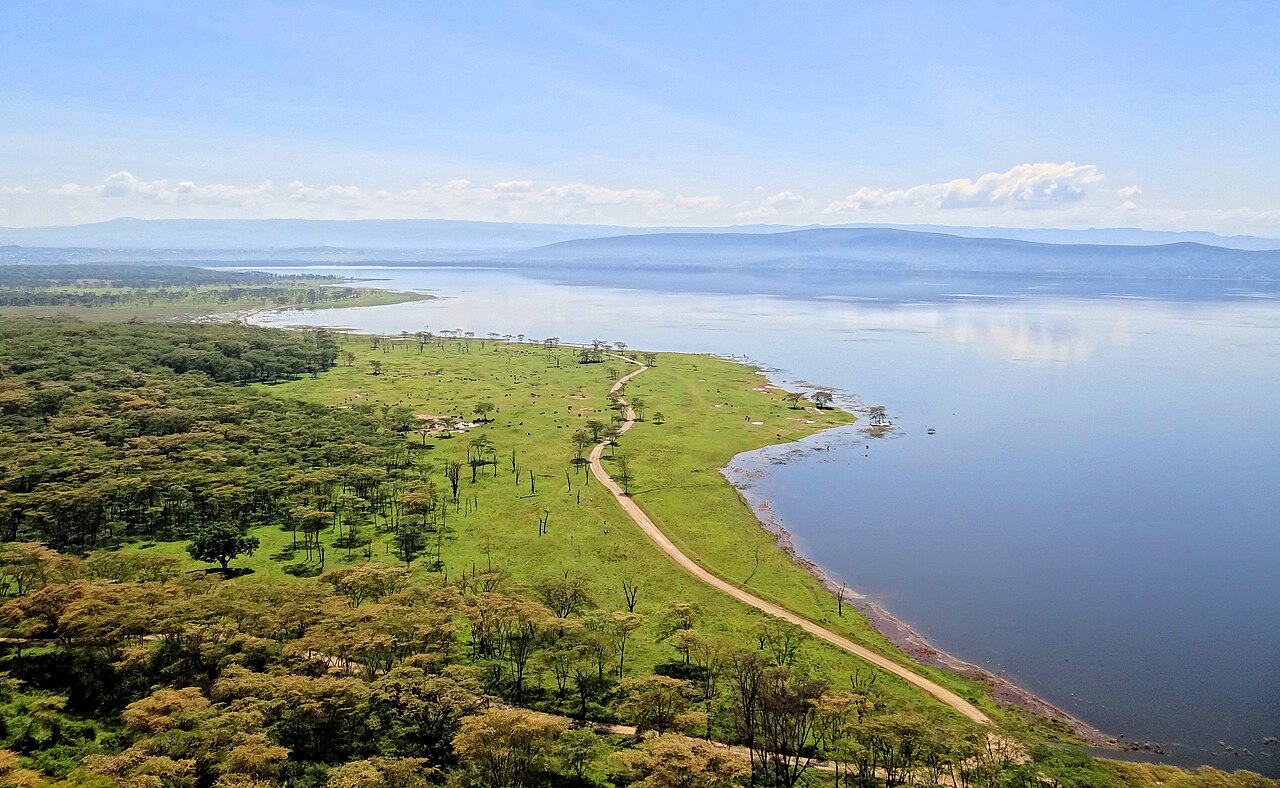
Lake Nakuru and surrounding woodland viewed from Baboon Cliff. Photo: Bjørn Christian Tørrissen · CC BY-SA 3.0. Resized and cropped for this layout; historical lake view, shoreline varies.

Lake Nakuru National Park at a glance
Lake Nakuru is a compact Rift Valley safari with strong rhino conservation, woodland, grassland and a changing alkaline-lake ecosystem. It works well as a short dedicated wildlife stop or part of a wider Kenya circuit. Visit for the whole landscape: a vast pink line of flamingos is not a permanent feature, and fluctuating lake levels can change both bird concentrations and accessible roads.
Official sources · checked 8 September 2026: Kenya Wildlife Service: Lake Nakuru, current fees and visitor rules · KWS Lake Nakuru visitor brochure and gate guidance. Confirm arrangements for your travel date.
When is the best time to visit Lake Nakuru?
Lake Nakuru can be visited throughout the year, with January–February and the drier middle months often practical for general wildlife viewing. Rain makes the landscape greener and can improve photographic atmosphere, while also affecting roads and visibility. Flamingos respond to food and water chemistry across the wider Rift Valley lake system; there is no reliable calendar month that guarantees an immense flock at Nakuru. Birders should allow time for woodland, shoreline and grassland rather than basing the trip on one species. Start early for quieter roads and active mammals, use a midday break, then return to productive habitat in softer light. In a compact park, patience usually beats repeating the entire road network at speed.
Typical seasonal pattern, not a forecast or a guarantee of road access. Current local conditions take priority.
Which Lake Nakuru area suits your trip?
| Area | Best for | What to expect | Planning point |
|---|---|---|---|
| Northern entrance and woodland | Short first drive | Accessible forest and woodland make a useful introduction before choosing the day’s open route. | Allow for gate formalities and ask for a current road briefing. |
| Lakeshore grasslands | Rhinos, buffalo and waterbirds | Open grazing and changing water margins can be productive for slow observation. | Stay on the road; flooded or soft shorelines are not shortcuts. |
| Baboon Cliff and western escarpment | Orientation and landscape photography | A designated viewpoint helps explain the lake basin and surrounding habitat. | Keep food secure around baboons and obey visitor-area boundaries. |
| Southern park and Makalia area | A longer wildlife loop | Grassland, woodland and the waterfall area add variety to a full park day. | Check the condition of southern tracks and the waterfall approach before setting out. |
Lake Nakuru entry fees, permits and opening hours
These amounts are displayed on the live KWS Lake Nakuru page. Its Kenya-resident child amount is shown as KES 1,050; verify your booking calculation through KWS, particularly if an older tariff table differs. Vehicle, campsite, lodge and guided-service charges are separate. Confirm age categories, identity requirements and ticket validity before payment.
| Visitor category | Adult / listed amount | Child / other detail |
|---|---|---|
| East African citizen | KES 1,500 | KES 750 |
| Kenya resident | KES 2,025 | KES 1,050 |
| Other African citizen | USD 50 | USD 25 |
| Non-resident | USD 90 | USD 45 |
Official sources · checked 8 September 2026: Kenya Wildlife Service: Lake Nakuru, current fees and visitor rules · KWS Lake Nakuru visitor brochure and gate guidance. Confirm arrangements for your travel date.
Opening hours
KWS publishes gate hours of 06:00–18:00. Allow time for entry formalities and return before closing; lodge activities have their own arrangements.
Official sources · checked 8 September 2026: Kenya Wildlife Service: Lake Nakuru, current fees and visitor rules · KWS Lake Nakuru visitor brochure and gate guidance. Confirm arrangements for your travel date.
How do you get to Lake Nakuru?
The principal road approach is the Nairobi–Nakuru corridor, followed by the gate that fits your accommodation. Lanet can avoid a detour through the city for some arrivals; Main Gate and Nderit remain important alternatives. Do not use a generic lake-centre location as your driving destination. Ask your host to send the current gate approach and the best internal route, especially after heavy rain or lake-level changes. Naishi airstrip is an option by arrangement rather than a substitute for confirming a flight and transfer. Fuel, food and vehicle preparation are easier to organise before entering. If staying outside, allow for daily gate procedures and the applicable repeat-entry fees; if staying inside, confirm the lodge’s latest arrival time.
Official sources · checked 8 September 2026: Kenya Wildlife Service: Lake Nakuru, current fees and visitor rules · KWS Lake Nakuru visitor brochure and gate guidance. Confirm arrangements for your travel date.
Lake Nakuru safari map: 23 useful places
Use this map to compare bases and understand the landscape. Search by place or filter by type. All locations are approximate orientation points; current park, guide and lodge directions override the map.
Loading map near this section. All places are also listed below.
All 23 map places and access notes
- Main Gate · Gates & visitor centresApproximate visitor access point. Confirm the current gate, hours and approach with the park. Map source. Approximate.
- Nderit Gate · Gates & visitor centresApproximate visitor access point. Confirm the current gate, hours and approach with the park. Map source. Approximate.
- Baboon Cliff viewpoint · ViewpointsApproximate viewpoint or landform. Use only the currently authorised visitor approach and stopping area. Map source. Approximate.
- Out of Africa picnic site · ViewpointsApproximate viewpoint or landform. Use only the currently authorised visitor approach and stopping area. Map source. Approximate.
- Lion Hill viewpoint · ViewpointsApproximate viewpoint or landform. Use only the currently authorised visitor approach and stopping area. Map source. Approximate.
- Causeway viewpoint area · ViewpointsHistoric mapped viewpoint; confirm current road and water-level access. Map source. Approximate.
- Flamingo viewpoint area · ViewpointsHistoric named viewpoint; neither access nor flamingo presence is guaranteed. Map source. Approximate.
- Sarova Lion Hill Game Lodge · Camps & lodgesApproximate accommodation location. Confirm current operation, booking, facilities and access with the host. Map source. Approximate.
- Lake Nakuru Sopa Lodge · Camps & lodgesApproximate accommodation location. Confirm current operation, booking, facilities and access with the host. Map source. Approximate.
- Lake Nakuru Lodge · Camps & lodgesApproximate accommodation location. Confirm current operation, booking, facilities and access with the host. Map source. Approximate.
- The Cliff · Camps & lodgesApproximate accommodation location. Confirm current operation, booking, facilities and access with the host. Map source. Approximate.
- Flamingo Hill Camp · Camps & lodgesApproximate accommodation location. Confirm current operation, booking, facilities and access with the host. Map source. Approximate.
- Naishi airstrip · AirstripsApproximate airstrip location. Confirm flight operation, landing permission and the correct camp pickup; no scheduled service implied. Map source. Approximate.
- Congreve airstrip — outside southern approach · AirstripsApproximate airstrip location. Confirm flight operation, landing permission and the correct camp pickup; no scheduled service implied. Map source. Approximate.
- Mbweha Safari Camp — outside southern base · Camps & lodgesApproximate accommodation location. Confirm current operation, booking, facilities and access with the host. Map source. Approximate.
- Naishi KWS accommodation area · Camps & lodgesApproximate accommodation location. Confirm current operation, booking, facilities and access with the host. Map source. Approximate.
- Ziwa Bush Lodge — outside base · Camps & lodgesApproximate accommodation location. Confirm current operation, booking, facilities and access with the host. Map source. Approximate.
- Wildlife Clubs of Kenya hostel area · Camps & lodgesApproximate accommodation location. Confirm current operation, booking, facilities and access with the host. Map source. Approximate.
- Nyati Guest House — outside northern base · Camps & lodgesApproximate accommodation location. Confirm current operation, booking, facilities and access with the host. Map source. Approximate.
- Hyrax Hill Museum — separate Nakuru visit · Areas & trail referencesOutside the national park. A separately managed cultural stop; check opening and admission. Map source. Approximate.
- Makalia Falls public campsite · Camps & lodgesBook the authorised campsite and confirm facilities and road access. Map source. Approximate.
- Makalia Falls viewpoint · ViewpointsUse the authorised viewing approach; water flow and road access vary. Map source. Approximate.
- Lanet Gate · Gates & visitor centresConfirm current opening and the correct arrival route with KWS. Map source. Approximate.
Map references include official park material where specified below, plus OpenStreetMap contributors, checked 8 September 2026. Selected and labelled by See.Africa. Waterbody-centre pins and summits are geographic references, not destinations for direct navigation. Accommodation and airstrip operation must be confirmed. No live animal locations or verified driving route is shown.
A practical Lake Nakuru itinerary
One full park day
Arrive at opening or stay nearby the previous night. Start with woodland and open grazing, pausing for rhinos at a distance. Choose the rest of the route after the gate’s road briefing rather than committing to a full lakeshore loop.
Midday and viewpoints
Use a designated picnic site or a booked lodge lunch. Keep bags closed around monkeys and baboons. A viewpoint stop offers a useful break, but never leave children or food unattended.
Afternoon wildlife
Revisit a productive area in better light or add the southern sector if roads and time allow. A second look at a rhino or bird flock often reveals more than another fast lap.
Two-night version
Give one morning to birding and another to mammals. This creates weather flexibility and lets you visit the lake, woodland and escarpment without trying to do everything between arrival and departure.
Where should you stay in Lake Nakuru?
An inside-park stay buys convenient early and late wildlife access, while Nakuru-area accommodation can offer a wider range of prices and services. Compare the gate commute and entry pattern before deciding that an outside room is cheaper overall. Sarova Lion Hill, Lake Nakuru Lodge, Lake Nakuru Sopa, The Cliff and Flamingo Hill are examples of different park-area positions; confirm the exact property, meal plan and current approach. KWS lists Naishi Guest House and campsites for travellers who prefer simpler arrangements. A one-night stop can work well, but arrive early enough to benefit from it. Do not count a late check-in and an immediate early departure as a full safari day.
Lake Nakuru mammals to look for
Rhinos are a major reason to visit, but they remain wild animals within a conservation landscape. White rhinos are grazers; black rhinos use more cover and can be harder to find. Watch giraffes and common grazers too, and keep predator expectations realistic. Elephants are deliberately absent from this field list.

White rhinoceros
The broad, square muzzle is adapted to grazing; a long head carried low also helps identification. Keep your distance even when an animal appears relaxed. Do not publish live locations or ask a guide to pressure a rhino into a clearer position.


Black rhinoceros
A hooked upper lip helps this browser select twigs and leaves. It is often harder to spot than a grazing white rhino because it uses thicker cover. Sightings deserve patience and a quiet approach, with current ranger guidance taking priority over photography.


Rothschild’s giraffe
Pale lower legs and large brown patches are useful field clues. Often treated as part of the Nubian giraffe within the northern giraffe, its taxonomy varies between authorities. Watch browsing animals from a distance and compare coat patterns without expecting every individual to look identical.
_male_(7068054987),_crop_%26_edit.jpg)

African buffalo
A heavy, dark bovid with a sweeping horn boss in mature bulls. Herds graze and rest together, while solitary bulls may stay close to cover. Buffalo can be difficult to read at close range: observe from the vehicle or follow your walking guide’s exact instructions.
_male_with_cattle_egret.jpg)

Lion
Lions spend much of the day resting, so search shade as carefully as open ground. Dawn and late afternoon improve the chance of movement, but a sleeping pride is a normal encounter. Listen to your guide and avoid surrounding animals with vehicles.


Leopard
Rosettes, a long tail and a powerful, low body distinguish this secretive cat. Search riverine trees, shaded rocks and dense drainage lines. A leopard can disappear in apparently thin cover; patient scanning is more useful than assuming that a radio report guarantees a sighting.
.jpg)

Plains zebra
Look beyond the stripes: herd spacing, ears and alarm behaviour can tell you what is happening in a grassland. Foals may rest while adults stand watch. Scan the edges of a herd for predators without losing sight of the zebras’ own social interactions.


Waterbuck
A shaggy coat, robust build and affinity for water are the main clues. Rump patterns differ between forms and regions. Look at the woodland–grassland boundary near rivers or lakes, where animals can graze while remaining within reach of shade and water.


Impala
The slender body, black tail stripe and dark markings above the hind feet are useful clues. Males have lyre-shaped horns. Pause to watch bachelor groups or territorial behaviour: familiar antelope are often the best animals for learning how a safari ecosystem works.
_male_Serengeti.jpg)

Common warthog
Facial pads, curved tusks and a tail held upright when running make identification straightforward. Warthogs often kneel on their front legs to feed. Give burrow entrances space, and do not approach a family because the piglets appear small or playful.
,_parque_nacional_del_Lago_Mburo,_Uganda,_2024-02-01,_DD_26.jpg)

Olive baboon
A dog-like muzzle and olive-grey coat identify a social primate frequently seen on roads and forest margins. Troops forage widely and may investigate picnic areas. Keep food inside closed bags and vehicles; feeding or teasing baboons creates problems for later visitors.
,_parque_nacional_del_lago_Nakuru,_Kenia,_2024-05-18,_DD_39.jpg)

Vervet monkey
A black face framed by pale fur contrasts with the grey-green body. Small groups use woodland, river edges and some camps. Alarm calls can alert other animals to danger. Keep snacks hidden and enjoy the troop’s behaviour without trying to attract it closer.
,_parque_nacional_del_lago_Nakuru,_Kenia,_2024-05-18,_DD_77.jpg)

Spotted hyena
Sloping shoulders and rounded ears help separate it from other large carnivores. This is an effective hunter as well as a scavenger. Animals travelling at dawn, resting near drainage lines or calling after dark reveal a social life easily missed on a hurried drive.
.jpg)

Bohor reedbuck
A small-to-medium antelope associated with taller grass and damp ground. Animals may remain still until a vehicle is surprisingly close, then bound away. Scan before moving forward; careful watching can reveal the curved horns of a male above the grass.
_male_Serengeti.jpg)
Lake Nakuru birds and habitat clues
Nakuru’s birding changes with lake conditions. Combine waterbirds with woodland and grassland species, and avoid using old photographs as evidence of the flock size you will see. The two flamingos differ in size, bill and feeding ecology; distant birds may need a telescope for confident identification.

Lesser flamingo
The smaller of the two common African flamingos has a darker bill and feeds on tiny organisms filtered from alkaline water. Numbers can change sharply as lake chemistry and food change. A pink shoreline is a seasonal possibility, never a permanent feature.


Greater flamingo
Larger and often paler than the lesser flamingo, with a pink bill ending in a dark tip. Mixed flocks allow useful comparisons. Keep away from resting groups and use a telescope or long lens to study birds across shallow water.


Great white pelican
A very large white waterbird with a long bill and throat pouch. Groups may fish cooperatively or rest together on shore. Use binoculars to inspect distant gatherings and compare the wings and face with other pelicans before settling on identification.
.jpg)

African fish eagle
The white head and chest contrast with dark wings; its carrying call is a classic sound of African waterways. Scan exposed trees beside lakes and rivers. A bird returning to the same perch can offer better observation than following it in flight.
.jpg)

Yellow-billed stork
The yellow bill and red face contrast with a mostly white body. It often sweeps a partly open bill through shallow water while feeding. Watch water level and shoreline shape: these help explain why birds concentrate in one bay and ignore another.


Saddle-billed stork
A tall black-and-white stork with a striking red, yellow and black bill. It stalks shallow water deliberately. Look along quiet margins and flooded grassland, where reflections can make a stationary bird surprisingly difficult to separate from its surroundings.


Grey crowned crane
The golden crown, white cheek patch and elegant grey body are unmistakable. Pairs or family parties feed in damp grassland. Watch from a distance and avoid approaching birds in breeding habitat or following chicks for photographs.
.jpg)

Pied kingfisher
A black-and-white kingfisher often seen hovering above open water before a vertical plunge. Check wires, reeds and low perches near shore. Following its feeding pattern is a useful way to watch behaviour without approaching a nest bank.
_male.jpg)

Superb starling
Iridescent blue-green upperparts, a pale eye and rusty belly make this familiar East African starling easy to learn. Camps and woodland edges often provide good views. Natural feeding behaviour makes a better photograph than a bird attracted with human food.
.jpg)

Hamerkop
The hammer-shaped head profile identifies this medium brown waterbird. It feeds around shallow pools and channels and builds an enormous stick nest. Observe nests from a distance; their size does not make close approach harmless.
_2.jpg)
Lake Nakuru plants and habitats
Fever-tree woodland
Yellow-green bark and airy crowns characterise many wetter-ground woodland scenes. Lake changes can alter these stands, so old landscape photographs may no longer match the same shoreline.
Grassland and grazing lawns
Open habitat supports rhinos and other grazers. Keep to established tracks; apparently firm ground near a receding or rising lake can be fragile.
Alkaline-lake ecology
Microscopic food resources and water chemistry influence where flamingos feed. A change in bird numbers is an ecological response, not proof that a visit has failed.
Escarpment bush and rock
The hills add dry scrub, cliffs and different bird habitat. Use designated viewpoints to understand how the lake basin, woodland and high ground fit together.
Plant identification may require leaves, flowers, fruit and a knowledgeable guide. Do not collect plants or leave authorised routes to inspect them.
What can you do in Lake Nakuru?
Learn rhino identification
Compare the broad grazing muzzle of a white rhino with the hooked browsing lip of a black rhino when views permit. Do so at a distance and never share live locations.
Make time for birding
Bring binoculars and scan both the water and tree canopy. Learning common pelicans, storks and raptors makes the whole drive more engaging.
Enjoy Baboon Cliff responsibly
A permitted viewpoint can be a highlight in its own right. Keep food packed away and take photographs from within the visitor area.
Explore Makalia when accessible
Include the southern waterfall area if current road advice supports it. Seasonal flow and access vary; it should be a flexible addition rather than the only purpose of the day.
Rules and practical precautions
Do not approach rhinos on foot or share their live locations. Keep away from the waterline except at an authorised visitor area, and do not drive onto exposed lakebed. Baboons and monkeys at picnic sites must never be fed. Follow current road closures even if an offline map shows a loop.
Give wildlife space
Never feed, surround or block an animal. Keep food secure, voices low and movements predictable. Your guide or ranger’s instructions take priority over a desired photograph.
Prepare for your actual activity
Bring water, sun or rain protection as appropriate, suitable footwear and charged equipment. Tell the operator about relevant mobility needs before booking so the route and vehicle can be matched to you.
Official sources · checked 8 September 2026: Kenya Wildlife Service: Lake Nakuru, current fees and visitor rules · KWS Lake Nakuru visitor brochure and gate guidance. Confirm arrangements for your travel date.
Lake Nakuru travel FAQ
Are there always thousands of flamingos at Lake Nakuru?
No. Flamingo numbers move with lake chemistry, water levels and feeding conditions across the Rift Valley. Plan to enjoy rhinos, other birds and the wider park as well.
Can I see both black and white rhinos?
Both occur in Lake Nakuru’s conservation landscape, but sightings are not guaranteed. White rhinos often graze in more open habitat, while black rhinos can be concealed in cover.
How long should I stay at Lake Nakuru?
One night plus a full park day is a useful first visit. Two nights allows separate birding and mammal drives and more flexibility for weather and roads.
Does Lake Nakuru have elephants?
Lake Nakuru is not an elephant safari destination. Its main mammal attractions include rhinos, giraffes, buffalo and other resident wildlife.
Which entrance is best from Nairobi?
KWS suggests Lanet as a way to avoid Nakuru city traffic. The best gate still depends on your lodge and current access, so confirm before travelling.
Can I self-drive around Lake Nakuru?
Self-drive is possible on permitted roads. Do not assume a continuous lake circuit is open, because water levels and temporary closures can change the route.
Sources, method and review date
This guide combines official park and operator information with editorial planning advice. Operational details were checked on 8 September 2026. Season descriptions are typical patterns, and suggested stays are planning recommendations. Wildlife profiles explain identification and habitat; they do not promise sightings.
Wildlife and image references
Species names and identification photographs were checked against the linked reference and image records. Photographs are identification examples and may have been taken elsewhere. Each image carries its own creator and licence credit.
Species reference links
White rhinoceros · Black rhinoceros · Rothschild’s giraffe · African buffalo · Lion · Leopard · Plains zebra · Waterbuck · Impala · Common warthog · Olive baboon · Vervet monkey · Spotted hyena · Bohor reedbuck · Lesser flamingo · Greater flamingo · Great white pelican · African fish eagle · Yellow-billed stork · Saddle-billed stork · Grey crowned crane · Pied kingfisher · Superb starling · Hamerkop